What a talk track is
A talk track is the shape of a good conversation for a specific situation: a cold call, a discovery call, a demo opener or a renewal. It sets out what to say first, what to ask, what to listen for and where the call should end.
The template has five parts: the call goal and audience, the opener, the discovery questions, the value points and proof, and the objection responses with the close. Each part leaves room for the seller's own words.
Talk tracks differ from scripts. A script is read; a talk track is learned and adapted. Teams use them to get new sellers productive faster and to keep messaging consistent when it changes.
When to write a talk track
- New sellers or SDRs are ramping and need a starting point for each call type.
- Messaging, pricing or the product changed and calls must change with it.
- You are launching into a new persona, segment or market.
- Call reviews show the same missed questions or weak answers again and again.
- You want role-play practice to rehearse the same conversation sellers will have.
Talk track, script or battlecard
Three seller aids that do different jobs. A good playbook usually links all three.
| Aid | What it is | Best for | Risk |
|---|---|---|---|
| Script | Exact words to read | Compliance-heavy calls with set wording | Sounds robotic; breaks when the buyer goes off script |
| Talk track | An outline of the conversation with key lines and questions | Cold, discovery and demo calls | Gets ignored if it is too long |
| Battlecard | One competitor: differences, landmines and proof | Competitive moments inside a call | Goes stale without regular updates |
The template
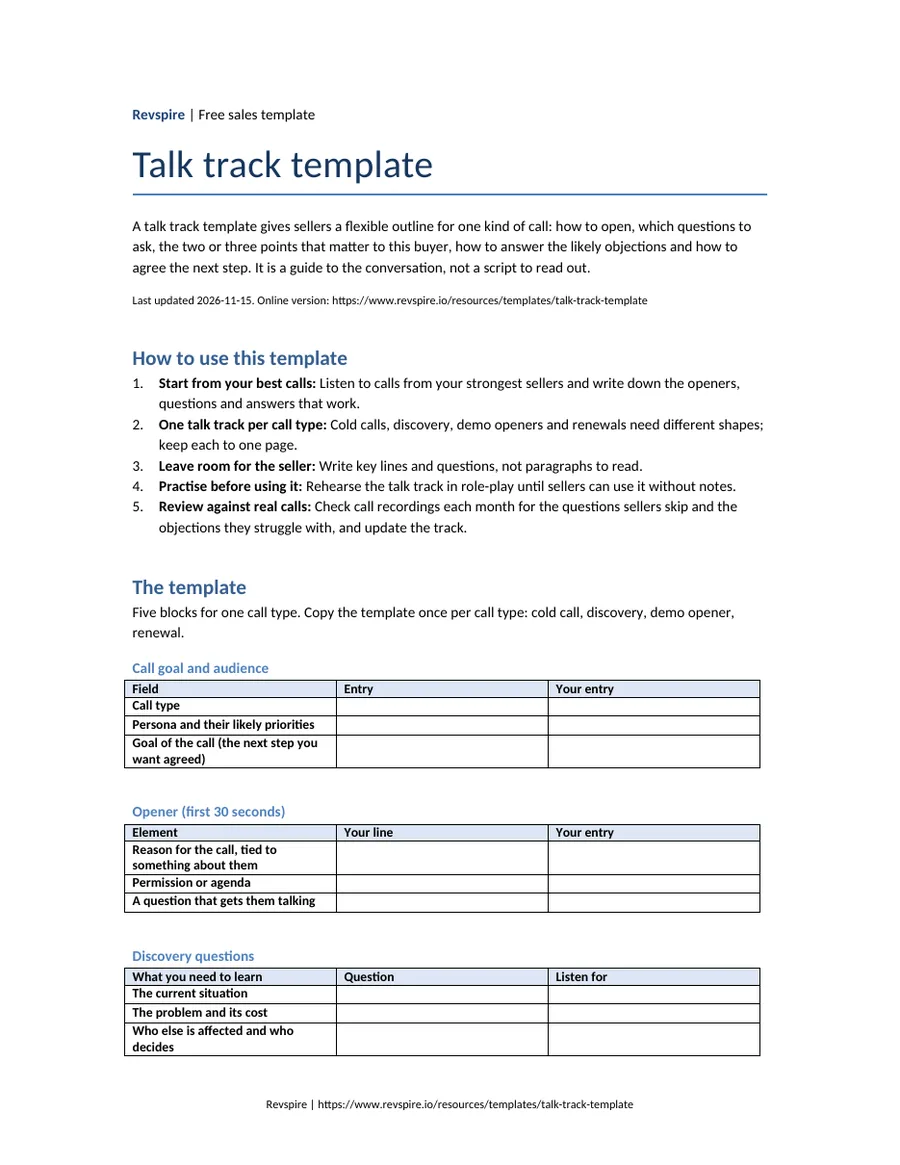
Five blocks for one call type. Copy the template once per call type: cold call, discovery, demo opener, renewal.
Call goal and audience
| Field | Entry |
|---|---|
| Call type | |
| Persona and their likely priorities | |
| Goal of the call (the next step you want agreed) |
Opener (first 30 seconds)
| Element | Your line |
|---|---|
| Reason for the call, tied to something about them | |
| Permission or agenda | |
| A question that gets them talking |
Discovery questions
| What you need to learn | Question | Listen for |
|---|---|---|
| The current situation | ||
| The problem and its cost | ||
| Who else is affected and who decides | ||
| Timing and what triggers action |
Value points and proof
| If they care about | Say | Proof to offer |
|---|---|---|
Objections and close
| Objection | Acknowledge | Respond | Check |
|---|---|---|---|
| We already have something for this | |||
| Not a priority right now | |||
| Send me some information | |||
| Close: the next step and date you will ask for |
Prefer a file? We email the Word, Excel and PDF versions to your work address, free.
Email me the filesA worked example
Example: fictional company
A discovery-call talk track for one persona, with the lines that matter and nothing more.
Marlow & Finch Logistics sells route-planning software to operations directors at regional distributors. Its sellers kept pitching features in the first minute, so the enablement lead wrote a discovery talk track that saves the product for the end of the call.
Marlow & Finch Logistics: discovery call talk track
| Part | Line or question |
|---|---|
| Opener | You opened two new depots this year. I would like to understand how routing changed, and see if there is anything worth a second conversation. |
| Discovery | How are routes planned today, and what happens when a driver calls in sick at six in the morning? |
| Cost | When a route is planned late, what does it cost you in overtime or missed delivery windows? |
| Value point | Teams like yours use us to re-plan the day's routes in minutes when something changes. |
| Objection | Our planners have done it for years. Response: they are the experts; the question is how much of their morning goes on re-planning. |
| Close | Would it be worth a 30-minute session with one of your planners next Tuesday, using last week's routes? |
Example: fictional company. Ferncastle Analytics, Harborview Metrics, Marlow & Finch Logistics and every person named in this example are invented for illustration. Any resemblance to real companies or people is coincidental.
How to build and roll out talk tracks
Start from your best calls
Listen to calls from your strongest sellers and write down the openers, questions and answers that work.
One talk track per call type
Cold calls, discovery, demo openers and renewals need different shapes; keep each to one page.
Leave room for the seller
Write key lines and questions, not paragraphs to read.
Practise before using it
Rehearse the talk track in role-play until sellers can use it without notes.
Review against real calls
Check call recordings each month for the questions sellers skip and the objections they struggle with, and update the track.
Where talk tracks go wrong
Writing a script
Sellers who read lines lose the buyer at the first unexpected answer.
Pitching first
Talk tracks that open with features skip the discovery that makes the pitch relevant.
One track for every persona
An operations director and a finance director care about different costs.
No practice
A talk track read once in onboarding is forgotten by the first real call.
Never updated
Messaging changes, competitors change and the track quietly goes out of date.
Where Revspire fits
A talk track only helps if sellers have practised it and can find it during the deal. Revspire AI Sales Training and Coaching lets reps rehearse a talk track in AI role-play, a live voice call with an AI buyer scored against the scenario's objectives, before they use it on a real call.
Revspire Conversation Intelligence then scores seven selling behaviours on real calls, with the quotes behind each score, so you can see which parts of the track sellers skip and update it from evidence.
Talk track template FAQs
What is a sales talk track?
An outline of a good conversation for one call type, with the opener, the questions to ask, the points that matter to the buyer, responses to likely objections and the next step to agree. Sellers adapt it in their own words.
What is the difference between a talk track and a script?
A script gives exact words to read. A talk track gives the structure and key lines, and leaves the seller free to follow the buyer's answers.
How long should a talk track be?
One page per call type. If sellers need to scroll during a call, it is too long to be useful.
How do you get sellers to use talk tracks?
Build them from your best sellers' real calls, practise them in role-play until they come naturally, and review them against call recordings so they stay current.
Related templates and reading
- Free templateSales playbook templateA B2B sales playbook outline: ICP, personas, stages with exit criteria, discovery questions, plays for common situations and objection responses.
- Free templateSales content audit templateOne row per asset, with the usage evidence and the verdict beside it: retire, fix or keep, each with an owner and a date.
- Free templateSales one-pager templateA one-page sales sheet in eight blocks, from headline to call to action, with a proof register and product, executive, competitive and industry variants.
- Free templateMutual action plan templateA shared, dated plan from discovery to go-live, with a buyer owner and a seller owner on every milestone.
- Template: the messages a talk track draws onMessaging framework template
- Template: score calls against the trackSales call scorecard template
- Template: for the competitive moments in a callSales battlecard template
- Glossary: what a talk track isTalk track glossary entry