B2B Sales Tech Stack 2026: 7 Layers, Costs and What to Consolidate
A practical perspective for connecting this idea to your revenue team’s next move.
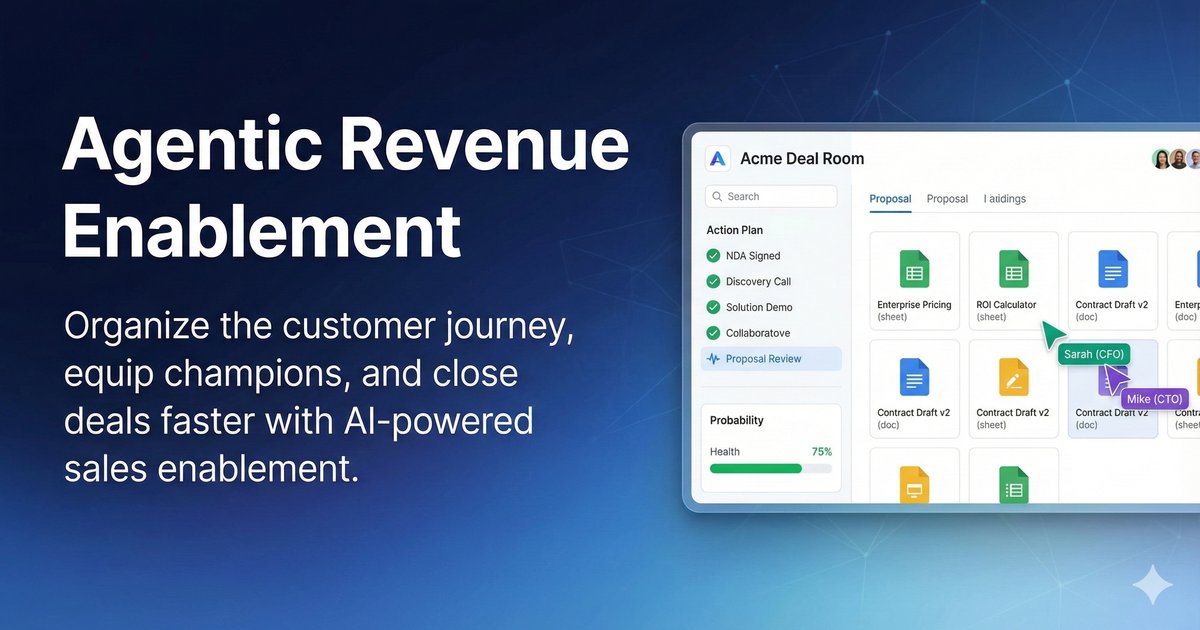
A B2B sales tech stack in 2026 has seven layers: CRM, data and prospecting, sales engagement, conversation intelligence, enablement (content, training and coaching), buyer-facing tools such as digital sales rooms and proposals, and CPQ and contracts. Most teams can consolidate the enablement and buyer-facing layers, and should keep the CRM and data layers with specialist tools.
Below: each layer with representative vendors and their prices, a stack by company stage, and an audit checklist.
Last updated: 31 October 2026
Disclosure: Revspire publishes this guide and sells products in two of the seven layers. Revspire has one entry in each of those two layers and is not listed first in either; vendors are listed alphabetically. Prices come from each vendor’s pricing page, checked 31 October 2026. Where a vendor publishes no price we say so and give Vendr’s median contract value, with its purchase count and update date, also checked that day. We estimated no prices, and there are no paid placements.
The seven layers of a B2B sales tech stack at a glance
| Layer | What it does | Representative vendors | Published prices? |
|---|---|---|---|
| 1. CRM | System of record for accounts, contacts, opportunities and forecast | HubSpot, Microsoft Dynamics 365 Sales, Pipedrive, Salesforce | Yes, all four |
| 2. Data and prospecting | Contact and company data, intent signals, list building | 6sense, Apollo.io, ZoomInfo | None read on 31 Oct |
| 3. Sales engagement | Sequences, email and calling cadences, task queues | Apollo.io, Outreach, Salesloft | No |
| 4. Conversation intelligence | Call recording, transcription, deal and coaching insight | Avoma, Gong, Salesloft | Avoma only |
| 5. Enablement | Sales content, onboarding, training, coaching and practice | Allego, Mindtickle, Revspire, Seismic and Highspot by Seismic, Spekit | No |
| 6. Buyer-facing | Digital sales rooms, mutual action plans, proposals | Dock, Proposify, Qwilr, Revspire, Trumpet | Mostly yes |
| 7. CPQ and contracts | Quotes, pricing rules, approvals, e-signature, contract lifecycle | DealHub, GetAccept, PandaDoc, Salesforce Revenue Cloud | Partly |
Vendor pricing pages and Vendr pages, checked 31 October 2026. Links are in each layer below and in Sources.
What each layer does, who sells it and what it costs
1. CRM
The CRM is the system of record every other layer reads from and writes to, so it is the layer you should almost never consolidate away.
- HubSpot Sales Hub: the pricing page shows a free tier for up to 2 users, Starter from $7 a seat a month ($20 also shown), Professional from $90 ($100 also shown) and Enterprise from $150, plus required one-time onboarding of $1,500 on Professional and $3,500 on Enterprise. See our HubSpot pricing guide.
- Microsoft Dynamics 365 Sales: the pricing page lists Sales Professional at $65, Sales Enterprise at $105 and Sales Premium at $150 per user a month, paid yearly.
- Pipedrive: the pricing page lists Lite at US$14, Growth at US$39, Premium at US$59 and Ultimate at US$79 per seat a month, billed annually.
- Salesforce Sales Cloud: the editions and pricing page lists Starter Suite at $25 and Pro Suite at $100, then Core at $195, Advanced at $395 and Max at $550 USD per user a month. Every tier except Starter Suite is billed annually. See our Salesforce pricing guide.
Our CRM software roundup covers more options.
2. Data and prospecting
This layer supplies contact data, firmographics and intent signals for list building. Test coverage on your own target accounts before you sign.
- 6sense: the pricing page shows no prices; it builds a custom package and prices seats, credits, records or conversations by volume band. Vendr puts the median at $62,000 a year from 387 purchases (February 2026).
- Apollo.io: the pricing page names Free, Basic, Professional and Custom plans and says annual billing is discounted, but its prices did not load when we read it on 31 October 2026. Vendr reports a median of $19,004 a year from 102 purchases (February 2026). See our Apollo pricing guide.
- ZoomInfo: the pricing page says it “offers custom packages based on your B2B data use cases” and shows no prices. Vendr reports a median of $33,500 a year from 1,578 purchases (February 2026). See our ZoomInfo pricing guide.
Our sales intelligence tools comparison covers the wider field.
3. Sales engagement
Engagement platforms run multi-step email, phone and social sequences and queue tasks for reps. Apollo.io bundles sequencing with its data, so small teams often buy one tool for layers 2 and 3.
- Apollo.io: describes its Basic plan as including email sequencing and core integrations; pricing as above.
- Outreach: the pricing page shows “Request pricing” on every package, with “Per user pricing” and “No platform fees”. Its four Amplify packages run from 10,000 AI credits (Essentials) to 100,000 (Pro). Vendr reports a median of $45,600 a year from 920 purchases (February 2026). See our Outreach pricing guide.
- Salesloft: the pricing page shows no prices and lists Cadence, Conversation Intelligence, Deals, Rhythm, Clari Forecast and Inspect as modules. Vendr reports a median of $30,740 a year from 710 purchases (February 2026). See our Salesloft pricing guide.
4. Conversation intelligence
Conversation intelligence records and transcribes calls, then surfaces deal risks and coaching moments. Some vendors here also sell engagement and forecasting, so check for overlap.
- Avoma: the pricing page lists Startup at $19 a recorder seat a month billed annually ($29 monthly) and Enterprise at $39 billed annually. Organization showed both $24 and $29, so confirm it.
- Gong: the pricing page shows no prices and says “Licenses are priced per user”, with a platform fee based on the number of users. Vendr reports a median of $55,359 a year from 1,151 purchases (March 2026). See our Gong pricing guide.
- Salesloft: sells Conversation Intelligence as a module beside its engagement product.
Our conversation intelligence software comparison goes deeper.
5. Enablement: content, training and coaching
Enablement covers approved sales content, onboarding and certification, training, coaching and practice. Most stacks carry overlap here, because different teams buy the content library, LMS and role-play tool.
- Allego: the pricing page lists four packages (Modern Learning with Conversation Intelligence, AI Role Play, Content Management, and Digital Rooms with Deal Navigator), priced “per user per month, billed annually upfront”, with a 3-year term typical. No figures are published.
- Mindtickle: the pricing page shows no plans or prices. Vendr reports a median of $44,356 a year from 65 purchases (February 2026).
- Revspire: combines governed sales content (Content Hub), AI sales training, role-play, coaching and certification (Academy) and digital sales rooms in one platform, with CRM integrations for Salesforce, HubSpot, Microsoft Dynamics 365, Zoho CRM and Pipedrive. It is priced by module with unlimited user licenses; about $25,000 USD a year on average. The first team is typically live 2 weeks after signature, with full rollout in about 6 weeks. Limitations: module prices are quoted, and its conversation intelligence module is listed as coming soon, so it does not replace a call recorder today. See Revspire pricing.
- Seismic and Highspot by Seismic: Seismic completed its Highspot merger on 18 August 2026. Highspot’s pricing page shows Good, Better and Best packages with “Contact sales” only. Vendr reports medians of $60,005 a year for Highspot (351 purchases) and $31,950 for Seismic (415 purchases), both February 2026.
- Spekit: the pricing page says Spekit “uses a per-seat pricing model, quoted based on your requirements”, across two packages, with AI Role Play Practice as an add-on.
Our sales enablement software pricing guide compares 18 vendors’ pricing models, and the best sales enablement tools list reviews the main platforms.
6. Buyer-facing: digital sales rooms and proposals
Buyer-facing tools put the deal in front of the buying committee, as a shared room with a mutual action plan or as a tracked interactive proposal. The two now overlap, so pick one as the buyer’s system before buying both.
- Dock: the pricing page lists Free at $0, Standard at $350 a month with 5 users, Premium at $1,000 a month billed annually with 10 users, extra seats at $50 a month, and Enterprise on a custom annual contract for 25+ users.
- Proposify: the pricing page lists Build at $49 a user a month, or $39 billed annually, Grow at $65 billed annually, and Scale as a $12,800 yearly platform fee covering 10 users, with extra users at $780 a year.
- Qwilr: the pricing page lists Starter at $35 a user a month billed annually ($49 monthly), Growth at $55 with a 5-user minimum and Scale at $75 with a 10-user minimum, both annual only.
- Revspire: branded deal rooms with mutual action plans, AI stakeholder mapping and real-time engagement analytics, sold as a module on top of Content Hub next to training, with an optional CPQ module. Revspire is priced by module with unlimited user licenses; about $25,000 USD a year on average. Limitation: the deal room cannot be bought without the Content Hub base. See Revspire deal rooms.
- Trumpet: the pricing page lists Pro at $45 a user a month or $450 a year (up to 5 users), Scale at $100 or $1,000 and Elite at $160 or $1,600, plus a free plan capped at 10 Pods.
Our digital sales room pricing guide compares 15 vendors, and our digital sales room software and sales proposal software lists review them.
7. CPQ and contracts
CPQ handles configuration, price books, discount approvals and quotes; the contract side adds e-signature and contract lifecycle management. A short price list rarely needs full CPQ.
- DealHub: the pricing page names Growth and Scale tiers with “Request Pricing” and no figures, and lists CPQ, CLM, DealRoom and Billing. Vendr reports a median of $44,400 a year from 145 purchases (February 2026).
- GetAccept: the pricing page lists eSign at 25 $ per user a month, Professional at 49 $ with a 5-user minimum, and Enterprise by quote, each on a 12-month agreement.
- PandaDoc: the pricing page lists Starter at $19 and Business at $49 per seat a month billed annually, and Enterprise quoted per seat or per document. CPQ appears on Enterprise as an add-on or usage-credit item with no price.
- Salesforce Revenue Cloud: listed on Salesforce’s pricing page as an add-on “From $200 USD/user/month”.
Our best CPQ software comparison covers the category.
What does a sales tech stack look like at each company stage?
Seller count and deal complexity decide which layers to prioritize.
| Stage | Typical sales team | Layers to own | Where to stay light |
|---|---|---|---|
| Seed | Founders plus 1 to 5 sellers | A low-tier CRM and one tool for data and sequencing | Shared drive for content, a free or entry proposal or sales room plan; skip CI and enablement software |
| Series A to B | 5 to 40 sellers, first managers and SDRs | CRM, data, sales engagement, conversation intelligence, one buyer-facing tool | Run onboarding from documents and call recordings until hiring outpaces managers’ time |
| Mid-market | 40 to 300 sellers across AE, SDR, CS and partners | All seven layers, with enablement and buyer-facing ideally on one platform | Add CPQ only when pricing rules or approvals slow deals down |
| Enterprise | 300+ sellers across regions or business units | All seven, plus intent data, forecasting and contract lifecycle management | Retire overlapping point tools bought by individual regions or teams |
Our editorial guidance, 31 October 2026. Team sizes are indicative ranges, not survey data.
At list price, ten sellers on Pipedrive Growth (US$39 a seat a month) cost $4,680 a year, and ten on Qwilr Starter ($35 billed annually) add $4,200. At 100 sellers, Salesforce Core at $195 a user a month is $234,000 a year before add-ons, tax or discounts.
Where does consolidating your sales tech stack save money?
Consolidation saves money where two tools charge per seat for the same job, or where a platform you already own covers a tool you pay for separately. It rarely saves money where a specialist’s data or depth is the reason you bought it.
Where consolidation usually pays off
- Content, training and sales rooms. A content library, an LMS, a role-play tool and a sales room often hold the same assets and users. Allego, for example, sells all four as packages from one vendor, which can retire a per-seat license and an integration.
- Proposals and sales rooms. Two tools mean two links for the buyer and two bills. At list price, 50 users on Proposify Grow at $65 a month is $39,000 a year, and 50 on Trumpet Scale at $1,000 a year is $50,000. If one tool covers both jobs well enough, cut the other.
- Engagement, call recording and forecasting. Salesloft lists Conversation Intelligence and Clari Forecast beside Cadence, so a team paying three vendors can compare a combined quote with its renewals.
- Quote, contract and sign. DealHub lists CPQ, CLM and DealRoom together, and PandaDoc pairs documents and e-signature with CPQ on Enterprise.
Where a point tool is worth keeping
- CRM. Every layer writes back to it, and migration, rebuilt reports and retraining can cost more than the license savings.
- Data providers. If a specialist finds the contacts you need and a bundled data feature does not, the specialist is the better buy even at a higher price.
- Conversation intelligence at depth. If managers coach and forecast from recordings every week, a dedicated tool such as Gong can be worth its platform fee even when a suite offers basic recording.
- Complex CPQ. Bundles, usage pricing and multi-level approvals need dedicated CPQ such as Salesforce Revenue Cloud or DealHub, even if your enablement vendor offers lighter quoting.
For a retire, merge or keep plan, our sales tech consolidation guide covers the 90-day process.
How do you audit your sales tech stack? A checklist
Start about 90 days before your earliest renewal; Allego, for one, bills annually upfront on a typical 3-year term.
- List every tool and owner. Use invoices and expense reports. Record layer, owner, pricing unit, end date and notice period.
- Measure seat utilization. Compare paid seats with users active in the last 30 and 90 days.
- Map overlapping features. Grid the jobs (content storage, sharing and tracking, training, role-play, call recording, sequencing, proposals, sales rooms, quoting, e-signature) against your tools. Any job covered twice is a candidate.
- Count integrations. Count the tools that sync with the CRM and with each other. Each one is upkeep for RevOps and a place where pipeline data can break.
- Check pricing units. Note which tools charge per seat, which add a platform fee, and which meter credits, such as Outreach’s AI credits or 6sense’s credits.
- Price the alternative. Get a written quote for each consolidated option, including migration, onboarding fees (HubSpot charges $1,500 or $3,500 once on Professional and Enterprise) and rollout time.
- Decide per layer. Keep, merge or retire, with an owner and a date for each decision.
Frequently asked questions
What is a B2B sales tech stack?
It is the software a sales team uses from first contact to signed contract, usually in seven layers: CRM, data, engagement, conversation intelligence, enablement, buyer-facing tools, and CPQ and contracts.
What is the difference between a sales tech stack and a revenue tech stack?
A revenue tech stack adds the marketing tools that create pipeline and the customer success tools that renew accounts. The CRM and enablement are usually shared across those teams.
How much does a B2B sales tech stack cost?
It depends on seats and layers. CRM list prices on 31 October 2026 ran from US$14 a seat a month (Pipedrive Lite) to $550 (Salesforce Max), and Vendr’s medians for the quote-based tools in this guide ranged from $19,004 a year (Apollo.io) to $62,000 (6sense).
How do you consolidate your sales tech stack?
Audit first: list every tool, measure seat utilization, map overlapping features and count integrations, then decide layer by layer. Enablement and buyer-facing tools usually overlap most; CRM, data and complex CPQ are usually best left with specialists.
Which sales tools should a startup buy first?
A CRM, then one tool for data and sequencing. Keep content in a shared drive, add conversation intelligence with your first sales manager, and add enablement software once onboarding outgrows managers’ time.
Is an all-in-one sales platform better than best-of-breed tools?
It depends on the layer. Most teams end up with specialists for CRM and data, and one platform for the content, training and buyer-facing work that shares the same assets.
Sources
All pages accessed 31 October 2026. Vendor pricing pages are undated unless noted.
- Salesforce editions and pricing, Salesforce
- HubSpot Sales Hub pricing, HubSpot
- Dynamics 365 Sales pricing, Microsoft
- Pipedrive pricing, Pipedrive
- 6sense pricing, 6sense
- Apollo.io pricing, Apollo.io
- ZoomInfo pricing, ZoomInfo
- Outreach pricing, Outreach
- Salesloft pricing, Salesloft
- Avoma pricing, Avoma
- Gong pricing, Gong
- Allego pricing, Allego
- Mindtickle pricing, Mindtickle
- Highspot pricing, Highspot by Seismic
- Seismic completes Highspot merger, Highspot, 18 August 2026
- Spekit pricing, Spekit
- Dock pricing, Dock
- Proposify pricing, Proposify
- Qwilr pricing, Qwilr
- Trumpet pricing, Trumpet
- DealHub pricing, DealHub
- GetAccept pricing, GetAccept
- PandaDoc pricing, PandaDoc
- Vendr pricing pages for 6sense, Apollo.io, ZoomInfo, Outreach, Salesloft, Mindtickle, Highspot, Seismic and DealHub, Vendr, each last updated February 2026; Gong, Vendr, last updated March 2026