Digital Sales Room Adoption: How to Get Account Executives to Use Deal Rooms
A practical perspective for connecting this idea to your revenue team’s next move.
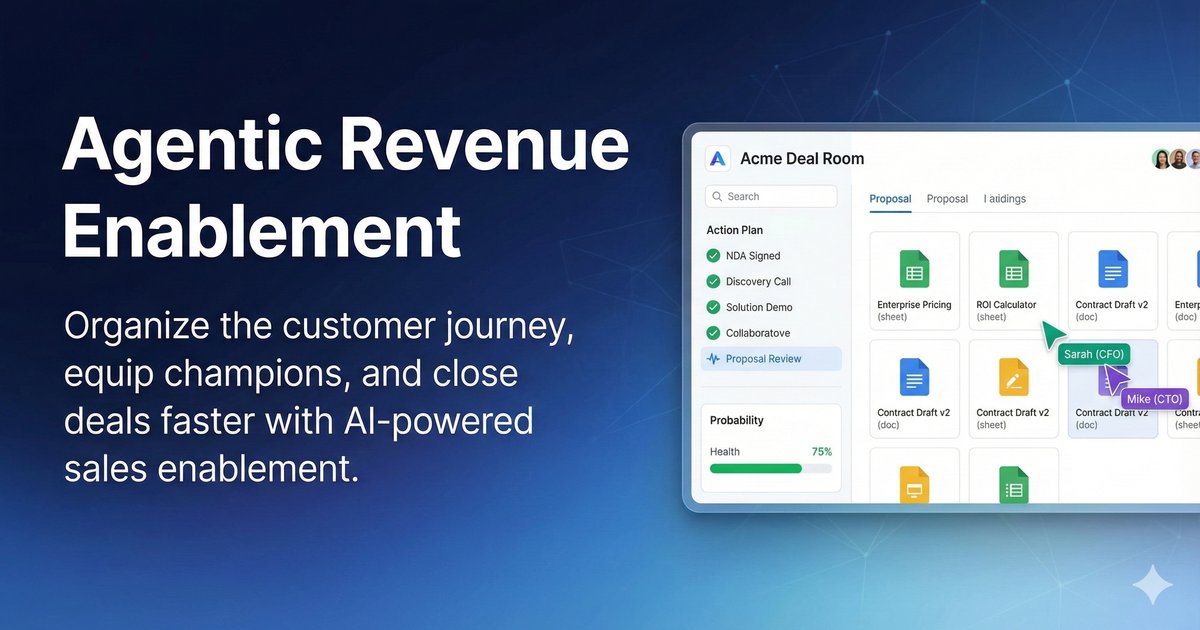
Digital sales room adoption usually drops after onboarding because reps see the room as extra work that duplicates email, not because the tool is hard to use. Adoption sticks when the room is required at one specific deal stage, opens from the CRM, saves the rep time on follow-ups, and managers review it in deal reviews. Measure the share of qualified deals with an active room that the buyer has visited, not the number of rooms created.
Below: why account executives stop using sales rooms, the adoption metrics to track with formulas, a 60-day plan to rebuild usage, and how to tell whether rooms are helping deals. Worked examples use invented numbers and say so.
Last updated: 6 November 2026
What does digital sales room adoption mean?
A digital sales room is a shared, branded page for one deal where the seller and the buying committee keep content, the mutual action plan, meeting notes and next steps. Adoption is not “reps logged in”. A room is adopted when it is the place the deal actually runs: the rep sends the room instead of attachments, buyers come back to it, and the plan in it matches the plan in the CRM.
Why do account executives stop using digital sales rooms after onboarding?
Usage typically peaks in the weeks after launch and then falls back toward email. The reasons are usually the same five:
- No rule for when to use it. “Use rooms where it makes sense” means rooms get used in demos and nowhere else. Reps need a stage where a room is expected.
- It lives outside the CRM. If creating a room means leaving the opportunity, rebuilding contacts and re-uploading files, reps skip it.
- Buyers are not invited properly. A room link pasted at the bottom of an email gets ignored. Rooms work when the rep walks the champion through it on a call.
- Managers never look at it. If deal reviews still run from notes and slides, the room is invisible and reps stop maintaining it.
- Content is out of date. When reps find old decks in the room template, they go back to their own folders.
Which digital sales room adoption metrics should you track?
| Metric | Formula | What it tells you |
|---|---|---|
| Room coverage | Qualified opportunities at or past the target stage with a room ÷ all qualified opportunities at or past that stage | Whether reps create rooms where you asked them to |
| Buyer activation | Rooms with at least one buyer visit in the last 14 days ÷ rooms created | Whether buyers actually use the room |
| Multi-threading | Average number of distinct buyer contacts who visited each room | Whether the room reaches the buying committee beyond the champion |
| Plan freshness | Rooms whose mutual action plan was updated in the last 14 days ÷ open rooms | Whether the room is where the deal runs or a one-off send |
| Outcome comparison | Win rate and cycle length of qualified deals with an activated room versus those without | Whether rooms help deals, once you have enough closed deals to compare |
Room coverage on its own is misleading: reps can create empty rooms to hit a target. Pair it with buyer activation and plan freshness from the first week.
A worked example (invented numbers)
A team has 120 qualified opportunities past discovery. Reps created rooms for 84 of them (70% coverage), but only 42 rooms had a buyer visit in the last two weeks (50% activation), and 21 had a current plan. The usable adoption figure is the 21 deals, about 18% of qualified opportunities, not the 70% the dashboard shows. That gap is where to work.
How do you get account executives to keep using digital sales rooms? A 60-day plan
Days 1-15: set the rule and fix the friction
- Pick one required stage, usually after the first discovery call or before the proposal, and write it into the stage exit criteria in the CRM.
- Make room creation one click from the opportunity, with contacts and the deal name filled in.
- Rebuild the room template with current content only, a three-step starter mutual action plan and a short welcome video slot. The free digital sales room template is a starting point.
Days 16-30: teach the buyer handoff, not the tool
- Run a 30-minute session on how to introduce the room on a live call: share screen, show the plan, ask the champion who else should see it.
- Give reps a two-line follow-up that sends the room instead of attachments.
- Pair each rep with one deal to run fully in a room and review it together.
Days 31-60: inspect it in deal reviews
- Managers open the room during every pipeline review for deals past the required stage. If there is no room or the plan is stale, the deal is not reviewed further.
- Share the room coverage, activation and plan freshness numbers by rep each week.
- Collect three examples where buyer engagement in the room changed the next step, such as a new stakeholder appearing or a silent champion, and share them with the team. Our digital sales room examples show what good rooms look like.
How do you know whether digital sales rooms are helping deals?
Wait until you have enough closed deals on both sides, typically one to two sales cycles, then compare win rate and cycle length of qualified deals with an activated room against similar deals without one. Control for deal size and segment, because reps tend to use rooms on their best deals first. Treat the result as directional; it shows association, not proof. Our digital sales room benchmark and mutual action plan benchmark collect the published research with dates.
Where does Revspire fit?
Revspire’s digital sales rooms give every deal one shared room with buyer engagement tracking, a mutual action plan and an AI-built stakeholder map that flags deal risks, alongside the governed Content Hub that keeps room content current. It is priced by module with unlimited user licenses; about $25,000 USD a year on average (pricing), and the first team is typically live two weeks after signature. To see a room built around one of your deals, book a demo.
Frequently asked questions
What is a good digital sales room adoption rate?
There is no reliable published benchmark for adoption by account executives. Set your own target on the stage where rooms are required, and measure it as qualified deals with an activated room and a current plan, not rooms created.
Why don’t sales reps use digital sales rooms?
Usually because there is no rule for when to use them, creating a room means leaving the CRM, buyers were never walked through the room, managers do not inspect it, or the template content is out of date.
How do you introduce a digital sales room to a buyer?
On a live call: share your screen, show the plan and the content, and ask the champion who else should be invited. Then send the room link as the follow-up instead of attachments.
Should every deal have a digital sales room?
No. Require rooms from one stage onward for qualified, multi-stakeholder deals. Small transactional deals rarely need one, and forcing rooms there creates empty rooms that distort the adoption numbers.
How do digital sales rooms differ from email?
A room keeps the content, plan and conversation for one deal in one place that every stakeholder can see, and it shows the seller who engaged. Our comparison of digital sales rooms and email covers when each works better.