What a deal review is for
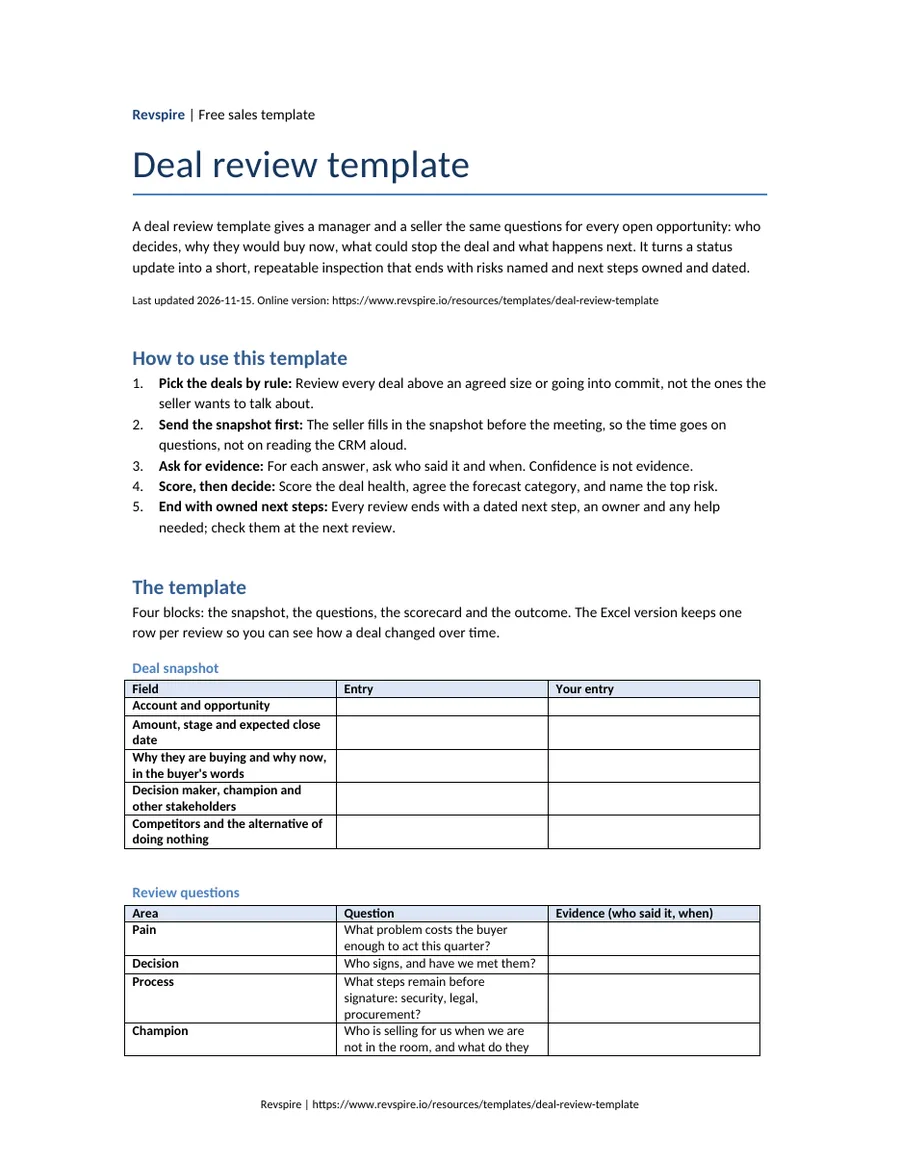
A deal review is a structured conversation about one opportunity, usually between a seller and their manager, sometimes with presales or leadership. Its job is to test the deal against evidence, not to hear the story again.
The template has four parts: the deal snapshot, the review questions grouped by what usually goes wrong, a deal health scorecard, and the risks and next steps that come out of the review. The same questions every time make deals comparable across the team.
Reviews work best on deals that are large, late or stuck. A short review every week on the few deals that matter beats a long pipeline call that covers everything and inspects nothing.
When to run a deal review
- Before a deal moves into the commit forecast category.
- When a large deal has not moved stage in several weeks.
- After a buyer adds a new stakeholder, a procurement step or a competitor.
- Before asking for discounts, legal concessions or executive time.
- For every deal above an agreed size, on a fixed weekly rhythm.
Deal review, pipeline review or forecast call
Three meetings that are often merged into one and then do none of their jobs well.
| Meeting | Question it answers | Scope | Typical rhythm |
|---|---|---|---|
| Deal review | Will this deal close, and what do we do next? | One opportunity in depth | Weekly for key deals |
| Pipeline review | Do we have enough of the right deals at each stage? | A seller's or team's whole pipeline | Every two weeks or monthly |
| Forecast call | What will we close this period? | Committed and best-case numbers | Weekly near quarter end |
The template
Four blocks: the snapshot, the questions, the scorecard and the outcome. The Excel version keeps one row per review so you can see how a deal changed over time.
Deal snapshot
| Field | Entry |
|---|---|
| Account and opportunity | |
| Amount, stage and expected close date | |
| Why they are buying and why now, in the buyer's words | |
| Decision maker, champion and other stakeholders | |
| Competitors and the alternative of doing nothing |
Review questions
| Area | Question | Evidence (who said it, when) |
|---|---|---|
| Pain | What problem costs the buyer enough to act this quarter? | |
| Decision | Who signs, and have we met them? | |
| Process | What steps remain before signature: security, legal, procurement? | |
| Champion | Who is selling for us when we are not in the room, and what do they gain? | |
| Competition | Who else are they looking at, and why would they choose them? | |
| Plan | Is there a mutual action plan the buyer has agreed to? |
Deal health scorecard (0 none, 1 partial, 2 confirmed)
| Criterion | Score | What would raise it |
|---|---|---|
| Pain confirmed by the buyer | ||
| Decision maker engaged | ||
| Decision process mapped | ||
| Champion confirmed | ||
| Mutual action plan agreed | ||
| Total (out of 10) |
Outcome
| Item | Entry |
|---|---|
| Top risk and how we will reduce it | |
| Next step, owner and date | |
| Help needed (presales, executive, legal) and by when | |
| Forecast category after the review |
Prefer a file? We email the Word, Excel and PDF versions to your work address, free.
Email me the filesA worked example
Example: fictional company
One review that moved a deal out of commit, and why that was the right call.
A seller at Harborview Metrics had a large renewal-plus-expansion deal in commit for the quarter. In the review, the manager asked for evidence behind each answer instead of the seller's confidence.
Harborview Metrics: deal health before and after the review
| Criterion | Seller's view | Evidence found | Score |
|---|---|---|---|
| Pain confirmed | Strong | Sponsor described the reporting delays on the last call | 2 |
| Decision maker engaged | Yes | Finance director not met; sponsor "will handle it" | 0 |
| Decision process mapped | Yes | Security review not yet started | 1 |
| Champion confirmed | Yes | Sponsor shared the internal business case | 2 |
| Mutual action plan agreed | Not needed | None | 0 |
| Total | 5 of 10: moved to best case; next step a meeting with the finance director |
Example: fictional company. Ferncastle Analytics, Harborview Metrics, Marlow & Finch Logistics and every person named in this example are invented for illustration. Any resemblance to real companies or people is coincidental.
How to run a good deal review
Pick the deals by rule
Review every deal above an agreed size or going into commit, not the ones the seller wants to talk about.
Send the snapshot first
The seller fills in the snapshot before the meeting, so the time goes on questions, not on reading the CRM aloud.
Ask for evidence
For each answer, ask who said it and when. Confidence is not evidence.
Score, then decide
Score the deal health, agree the forecast category, and name the top risk.
End with owned next steps
Every review ends with a dated next step, an owner and any help needed; check them at the next review.
Where deal reviews go wrong
Storytelling
The seller retells the history of the deal and nothing is tested.
Interrogation
Reviews that feel like trials teach sellers to hide bad news.
Too many deals
Twenty deals in an hour is a pipeline call, not a review.
No written outcome
Without a recorded risk and next step, the same questions come back next week.
Ignoring the buyer's plan
A deal with no agreed plan on the buyer's side is a forecast risk, however warm it feels.
Where Revspire fits
Most of what a deal review asks for lives in the buyer's behaviour: who is engaged, what they read and whether the plan is moving. A Revspire digital sales room keeps the content, the mutual action plan and the stakeholders for a deal in one place, and its stakeholder map is built automatically with AI and flags risks in the deal.
Revspire Conversation Intelligence adds evidence from the calls themselves, with notes and transcripts for every call and seven selling behaviours scored, so a review can rest on what the buyer said rather than on memory.
Deal review template FAQs
What questions should you ask in a deal review?
What pain makes the buyer act now, who signs and whether you have met them, what steps remain before signature, who is your champion, who else they are considering, and whether there is a mutual action plan the buyer has agreed to.
How long should a deal review take?
Ten to twenty minutes per deal when the seller fills in the snapshot beforehand. Longer reviews usually mean the meeting has turned into storytelling.
What is the difference between a deal review and a pipeline review?
A deal review inspects one opportunity in depth and ends with next steps for that deal. A pipeline review looks across all of a seller's or team's deals to judge coverage and stage health.
Who should attend a deal review?
The seller and their manager, with presales or a sales leader for large or complex deals. Keep it small enough that the seller can be candid about risks.
Related templates and reading
- Free templateSales enablement business case templateA one-page sales enablement business case: the problem, what ramp, rep time and turnover cost today, the options, the numbers and a dated decision ask.
- Free templateDigital sales room templateThe sections of a buyer-facing deal room in order: summary, stakeholder map, mutual action plan, content by stage, business case, security, next steps and handoff.
- Free templateProof of concept templateA POC plan with success criteria agreed before the start, owners on both sides, a dated timeline, environment and data, a scorecard and a decision meeting.
- Free templateSales quote templateAn itemised B2B and SaaS quote: header and validity, line items with discounts, commercial terms, an internal approval record and a signature block.
- Template: the plan a deal review checks againstSales close plan template
- Template: the plan agreed with the buyerMutual action plan template
- Template: who decides, who influences, who blocksStakeholder map template
- Glossary: what a deal review isDeal review glossary entry