What a sales certification plan is
Most sales teams can say who completed a course. Few can say who can run discovery with a new persona, give the pricing talk track without discounting, or demo last month's release. A certification plan closes that gap by naming the handful of situations that matter, building one scored scenario for each, and writing down what passing looks like before anyone attempts it.
The plan has four parts. Tracks say which certifications each role must hold: an SDR needs a different set from an enterprise account executive. Scenarios and rubrics say how each certification is assessed and what separates "not yet" from "meets the bar". Rules cover who assesses, how many attempts are allowed and what happens to a seller who does not pass. The calendar says when each certification expires, so it reflects the current product, price list and competitors rather than last year's.
A certification is not the same as a readiness check. Certification proves one skill in one scenario; readiness asks whether a seller has passed every gate for an event such as a launch, including tools, content and live calls. A certification usually sits inside a readiness checklist as one line. This template is the plan for the certifications themselves.
When to use a sales certification plan
- Managers say reps are trained, but the same objections still lose deals and nobody can show who can handle them.
- A product launch or price change is coming and every seller must be able to explain it before the date.
- You are building a certification programme for the first time and need to agree tracks and pass standards with sales leadership.
- Certifications exist but never expire, so the record says a rep is certified on a product version that has since changed.
- Partners or a new segment team need the same proof of skill your direct sellers have.
Certification plan, readiness checklist or skills assessment
Three documents cover similar ground and answer different questions. This page is the certification plan; the other two have their own templates.
| Document | The question it answers | When it is used | What it does not do |
|---|---|---|---|
| Certification plan | Which scored scenarios must each role pass, to what standard, and when are they renewed? | Set once a year, run continuously | Clear a seller for a specific launch on its own |
| Readiness checklist | Has this seller passed every gate for this event, on what evidence, and who signed? | Before solo selling, a launch or recertification | Define how each scenario is scored |
| Skills assessment | Where does each person stand on each skill, against anchored levels? | In a fixed assessment window | Award a pass or set an expiry date |
The template
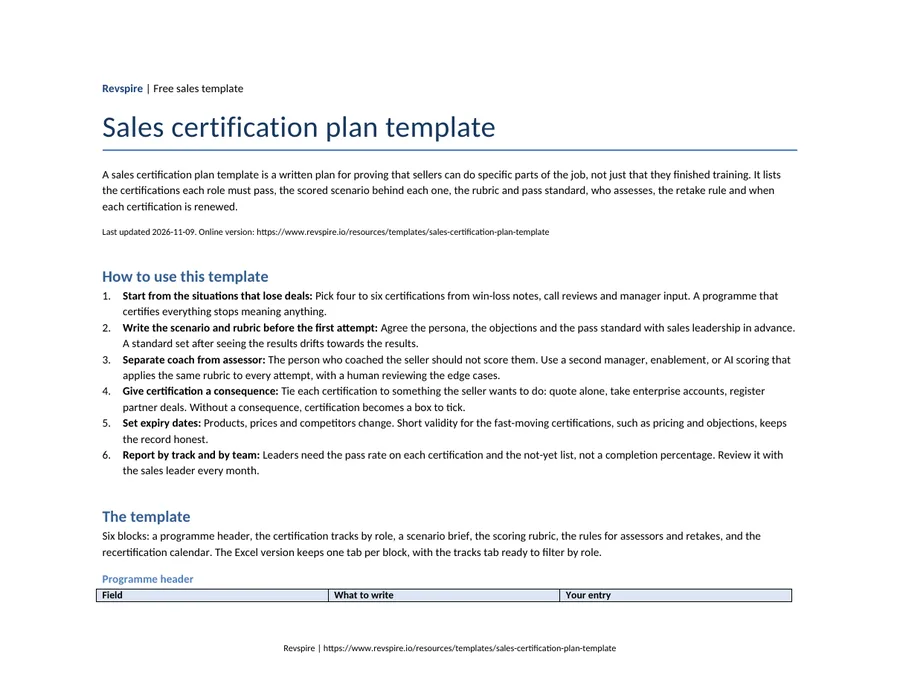
Six blocks: a programme header, the certification tracks by role, a scenario brief, the scoring rubric, the rules for assessors and retakes, and the recertification calendar. The Excel version keeps one tab per block, with the tracks tab ready to filter by role.
Programme header
| Field | What to write |
|---|---|
| Programme owner | Who runs certification day to day, usually sales enablement. |
| Executive sponsor | The sales leader who agrees the pass standards and backs the consequences. |
| Roles in scope | For example SDR, mid-market AE, enterprise AE, sales engineer, partner seller. |
| Programme year | The period the plan covers and the date it is next reviewed. |
| Pass standards version | The rubric version in force, agreed before anyone attempts it. |
| Where results are recorded | The system of record for scores, passes and expiry dates. |
Certification tracks by role
| Certification | Who must pass | What is assessed | Pass standard | Assessor | Due by |
|---|---|---|---|---|---|
| Discovery | SDR, all AEs | A 15-minute role-play with the main persona, from opening to agreed next step | Meets the bar on every essential criterion | Enablement, or AI scoring reviewed by enablement | End of week 4 for new hires |
| Value pitch and demo | All AEs, sales engineers | A recorded demo of the standard storyline, tailored to a sample account | Meets the bar overall; opens with the buyer's problem | Manager | End of week 6 |
| Objection handling | All quota carriers | The five most common objections, including price and the main competitor | Meets the bar on at least four of five | Enablement | End of week 6, then each quarter |
| Pricing and negotiation | AEs who quote | A discount request from a procurement persona, with the approval path | Holds the guardrails; trades rather than concedes | Manager or deal desk | Before quoting alone |
| Product launch | Everyone who will sell the release | The new pitch and its likely objections, in one role-play | Meets the bar before launch day | Enablement with product marketing | Launch date |
| Partner certification | Partner sellers | The partner version of discovery and the value pitch | Meets the bar; partner manager countersigns | Partner enablement | Before deal registration |
Scenario brief (one per certification)
| Field | What to write |
|---|---|
| Buyer persona | Role, company size, industry and what they care about this quarter. |
| Situation | Where the deal stands and what the seller is trying to achieve in this conversation. |
| What the buyer will raise | The objections and questions the buyer is briefed to use, in their words. |
| Materials allowed | Which deck, battlecard or pricing sheet the seller may use. |
| Time limit | How long the conversation runs, and whether the seller may pause. |
| What a strong answer includes | Two or three points the assessor listens for, taken from the current talk track. |
Scoring rubric (example: objection handling)
| Criterion | Not yet (1) | Meets the bar (3) | Strong (5) | Essential? |
|---|---|---|---|---|
| Acknowledges the concern | Talks over it or argues | Restates it in the buyer's words | Restates it and names why it matters to this buyer | Yes |
| Asks before answering | Answers straight away | Asks one question to find the real concern | Asks and uses the answer to reframe | Yes |
| Answers with evidence | Opinion or a feature list | One relevant proof point from approved content | Proof point tied to the buyer's situation | Yes |
| Checks and moves on | Leaves it hanging | Checks the concern is answered | Checks and proposes a next step | No |
| Stays within guardrails | Offers a discount or an unapproved promise | No concession without a trade | Trades for something of value to the deal | Yes |
Rules: assessors, retakes and consequences
| Rule | What to write |
|---|---|
| Who assesses | Someone other than the seller's buddy or coach; calibrate assessors on two recorded attempts each quarter. |
| Attempts | For example, one retake within 10 working days, with coaching in between. |
| After a second miss | A coaching plan agreed with the manager, and a third attempt within 30 days. |
| What certification unlocks | For example, quoting alone, taking enterprise accounts or registering partner deals. |
| Appeals | How a seller asks for a second assessor if they disagree with a score. |
| Reporting | Who sees the pass rate by track and by team, and how often. |
Recertification calendar
| Certification | Valid for | Renewal trigger | Renewal format | Owner |
|---|---|---|---|---|
| Discovery | 12 months | New persona or new segment | One scored role-play | Enablement |
| Value pitch and demo | 12 months, or next major release | Major release or new storyline | Recorded demo of the changed section | Manager |
| Objection handling | 3 months | New competitor tactic or a lost-deal pattern | The two objections losing deals now | Enablement |
| Pricing and negotiation | 6 months, or next price change | Price list or approval path changes | One discount role-play | Deal desk |
| Product launch | Until the next launch | Each launch | Launch role-play | Product marketing |
Prefer a file? We email the Word, Excel and PDF versions to your work address, free.
Email me the filesA worked example
Example: fictional company
One quarter of objection-handling recertification for a 20-seller team. The point of the example is the decision column and what the sales leader did with it.
Harborview Metrics sells analytics software to operations teams. After two quarters of losing deals to a cheaper competitor, Priya Okafor, the enablement lead, made objection handling a quarterly certification and added the competitor's new price objection to the scenario. All names and figures are invented for illustration.
Harborview Metrics: quarterly objection-handling recertification
| Seller group | Sellers | Passed first attempt | Passed on retake | Not yet | What happened next |
|---|---|---|---|---|---|
| Enterprise AEs | 6 | 4 | 1 | 1 | Not-yet seller paired with a peer on two live calls before the third attempt |
| Mid-market AEs | 10 | 6 | 3 | 1 | The price objection was the common miss; a 20-minute talk-track refresh added to the team meeting |
| SDRs | 4 | 3 | 1 | 0 | No change |
What the sales leader read
| Finding | Decision |
|---|---|
| The new price objection was missed in 7 of 9 first-attempt fails | Product marketing rewrites the response and the battlecard by month end |
| Two sellers not yet certified | They do not take new competitive deals alone until they pass |
| Assessor scores differed on "answers with evidence" | Assessors recalibrate on two recordings before the next quarter |
Example: fictional company. Ferncastle Analytics, Harborview Metrics, Marlow & Finch Logistics and every person named in this example are invented for illustration. Any resemblance to real companies or people is coincidental.
How to build and run the certification plan
Start from the situations that lose deals
Pick four to six certifications from win-loss notes, call reviews and manager input. A programme that certifies everything stops meaning anything.
Write the scenario and rubric before the first attempt
Agree the persona, the objections and the pass standard with sales leadership in advance. A standard set after seeing the results drifts towards the results.
Separate coach from assessor
The person who coached the seller should not score them. Use a second manager, enablement, or AI scoring that applies the same rubric to every attempt, with a human reviewing the edge cases.
Give certification a consequence
Tie each certification to something the seller wants to do: quote alone, take enterprise accounts, register partner deals. Without a consequence, certification becomes a box to tick.
Set expiry dates
Products, prices and competitors change. Short validity for the fast-moving certifications, such as pricing and objections, keeps the record honest.
Report by track and by team
Leaders need the pass rate on each certification and the not-yet list, not a completion percentage. Review it with the sales leader every month.
Where sales certification programmes go wrong
Certifying course completion
Watching a module and passing a quiz shows exposure. A certification should require the seller to do the thing: a scored conversation, a recorded demo, a priced quote.
One scenario for every role
An SDR booking a first meeting and an enterprise AE negotiating a renewal need different scenarios and different bars.
Scoring by feel
Without a written rubric, two assessors pass different sellers on the same attempt. Write anchors for each level and calibrate assessors each quarter.
No expiry
A certification from two releases ago says nothing about the current product. Every certification needs a validity period and a renewal trigger.
Hiding the not-yet list
The useful output is who should not take a conversation alone yet, and who coaches them. A report of passes alone hides it.
How Revspire runs the scored scenarios
The slowest part of a certification programme is assessment: finding a manager for every attempt, keeping scores consistent across assessors, and keeping a record of who passed what and when it expires.
Revspire AI Sales Training & Coaching runs AI video role-plays of buyer conversations with instant AI scoring for clarity, confidence and objection handling, and tracks team readiness, improvement and performance, so every seller is scored on the same rubric and the record is kept for you. For channel teams, the Revspire Partner Portal gives partners training tracks, role-plays and certifications.
Sales certification plan template FAQs
What should a sales certification program include?
Tracks that say which certifications each role must hold, a scored scenario and rubric for each certification, a pass standard agreed in advance, rules for assessors and retakes, a consequence for passing such as quoting alone, and an expiry date with a renewal trigger.
How do you certify sales reps?
Give each rep a realistic scenario with a briefed buyer, score the conversation against a written rubric, and pass them only if they meet the standard on the essential criteria. Use an assessor who did not coach them, and record the result with an expiry date.
How often should sales reps be recertified?
Core certifications such as discovery yearly; fast-changing ones such as pricing and objection handling every three to six months, and whenever a product, price list or competitor changes what sellers need to say.
What is the difference between sales certification and sales training?
Training teaches; certification proves. A rep can complete training without being able to handle the situation. Certification asks them to do it in a scored scenario and passes them only against a written standard.
Can AI score sales certification role-plays?
Yes. AI role-play tools can play the buyer and score each attempt against your rubric, which keeps scoring consistent and removes the need to book a manager for every attempt. Keep a human reviewing borderline scores and calibrating the rubric.
Related templates and reading
- Free templateSales call scorecard templateA weighted 1-5 rubric for scoring recorded calls on agenda, discovery, value messaging, objections, next steps and talk/listen balance.
- Free templateSDR onboarding plan templateA week-by-week ramp plan for SDRs and BDRs: ICP, messaging, sequences, cold calls, qualification and the first qualified meeting, with gates.
- Free template30-60-90 day sales onboarding plan templateA 30-60-90 day sales onboarding plan for new account executives: goals, activities, milestones and manager checkpoints for each phase, ending in a first closed-won deal.
- Free templateSales coaching templateOne skill per rep per cycle, the evidence behind it and the date it is reviewed, so coaching survives more than one conversation.
- Glossary: the definitionWhat is sales certification?
- Blog: the method behind this planHow to build a sales certification program
- Blog: tools that run certificationBest sales certification software
- Template: certification as one gate of readinessSales readiness checklist
- Template: anchored levels for each skillSales skills assessment template
- Blog: 18 training platforms comparedBest sales training software and platforms