What an account plan is for
An account plan is a working document for a single strategic account, written by the account owner and reviewed with their manager and the wider account team. It connects what the customer is trying to do with the opportunities you can help with and the relationships you need to win them.
The template has six parts: a business overview, the customer's initiatives, a relationship map scored by influence and sentiment, the whitespace and opportunities, the competitive position and risks, and a ninety-day action plan with owners. Most teams keep plans for their top accounts only, because a good plan takes a few hours and needs updating every quarter.
The relationship map is usually the weakest part of an account plan. Listing names is easy; scoring each person's influence on the decision, their view of you and how often you have talked shows where the account is single-threaded and which relationships need building before an opportunity appears.
When to write an account plan
- For your top accounts by revenue or potential, at the start of each year.
- Before a renewal or expansion conversation with a large customer.
- When a target account opens up, for example after a new executive arrives.
- When several people from your side work the same account and need one plan.
- Before an executive sponsor programme, so sponsors know their role.
Account plan, territory plan or opportunity plan
Three planning documents at different levels.
| Plan | Scope | Time horizon | Main question |
|---|---|---|---|
| Territory plan | All of a seller's accounts | A year | Where should I spend my time? |
| Account plan | One strategic account | A year, reviewed quarterly | How do we grow this relationship? |
| Opportunity or close plan | One deal inside an account | Until signature | How do we win this deal? |
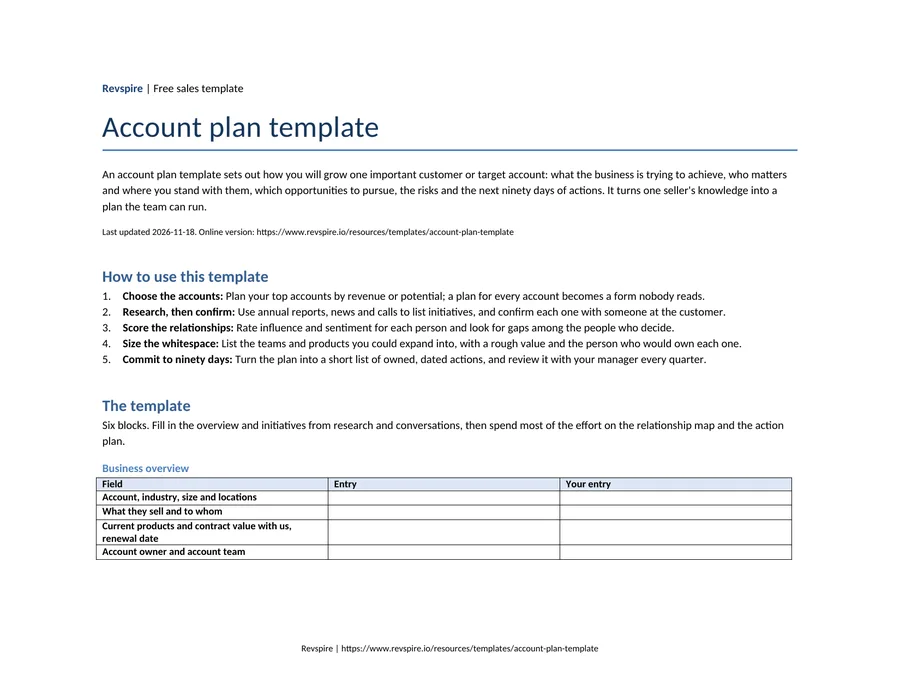
The template
Six blocks. Fill in the overview and initiatives from research and conversations, then spend most of the effort on the relationship map and the action plan.
Business overview
| Field | Entry |
|---|---|
| Account, industry, size and locations | |
| What they sell and to whom | |
| Current products and contract value with us, renewal date | |
| Account owner and account team |
Customer initiatives
| Initiative or priority | Executive who owns it | Source (who said it, when) | How we could help |
|---|---|---|---|
Relationship map (influence and sentiment: 1 low to 3 high)
| Name and role | Influence on decisions | Sentiment towards us | Last contact | Our relationship owner |
|---|---|---|---|---|
Whitespace and opportunities
| Team or business unit | Current products | Opportunity | Estimated value and timing |
|---|---|---|---|
Competition and risks
| Risk or competitor | Likelihood | Impact | How we will reduce it |
|---|---|---|---|
90-day action plan
| Action | Owner | Due date | Outcome we want |
|---|---|---|---|
Prefer a file? We email the Word, Excel and PDF versions to your work address, free.
Email me the filesA worked example
Example: fictional company
A relationship map that showed an expansion opportunity was single-threaded.
Ferncastle Analytics had one team at Marlow & Finch Logistics using its product and saw an opportunity in two other business units. Scoring the relationship map showed every strong relationship sat with one operations manager, who had little influence over the other units' budgets.
Marlow & Finch Logistics: relationship map
| Role | Influence | Sentiment | Last contact | Next step |
|---|---|---|---|---|
| Operations manager (current user) | 1 | 3 | Last week | Ask for an introduction to the finance director |
| Finance director | 3 | Unknown | Never | Executive sponsor to request a short meeting |
| Head of warehousing (second unit) | 2 | 2 | Two months ago | Share the first unit's results |
| IT security lead | 2 | Unknown | Never | Send the security pack before any new deal |
Resulting 90-day actions
| Action | Owner | Due |
|---|---|---|
| Introduction to the finance director through the operations manager | Account executive | Week three |
| Results summary from the first unit for the head of warehousing | Customer success manager | Week four |
| Executive sponsor call with the finance director | Sales director | Week eight |
Example: fictional company. Ferncastle Analytics, Harborview Metrics, Marlow & Finch Logistics and every person named in this example are invented for illustration. Any resemblance to real companies or people is coincidental.
How to build an account plan your team will use
Choose the accounts
Plan your top accounts by revenue or potential; a plan for every account becomes a form nobody reads.
Research, then confirm
Use annual reports, news and calls to list initiatives, and confirm each one with someone at the customer.
Score the relationships
Rate influence and sentiment for each person and look for gaps among the people who decide.
Size the whitespace
List the teams and products you could expand into, with a rough value and the person who would own each one.
Commit to ninety days
Turn the plan into a short list of owned, dated actions, and review it with your manager every quarter.
Where account plans go wrong
A research report
Pages of company facts with no actions do not change what anyone does.
Single-threaded maps
A plan built around one friendly contact collapses when that person leaves.
Our goals, not theirs
Opportunities that do not connect to a customer initiative rarely get funded.
Written once a year
Accounts change every quarter; a stale plan is worse than none.
One person's document
Account plans work when the whole account team knows and owns their actions.
Where Revspire fits
The relationship map in a spreadsheet depends on the account owner remembering to update it. Revspire digital sales rooms include buying-committee stakeholder mapping inside the room the buyer and seller share, built automatically with AI and flagging risks in the deal, alongside the mutual action plan and shared content for each opportunity in the account.
Buyer engagement analytics show which stakeholders opened what, which is evidence for the sentiment and last-contact columns rather than a guess.
Account plan template FAQs
What should be included in an account plan?
A business overview, the customer's initiatives, a relationship map with influence and sentiment, whitespace and opportunities, competition and risks, and a ninety-day action plan with owners and dates.
How many accounts need an account plan?
Only the strategic ones: usually a seller's top few accounts by revenue or potential. Smaller accounts are better served by a territory plan.
What is the difference between an account plan and a territory plan?
A territory plan decides where a seller spends time across all their accounts. An account plan goes deep on one account: its initiatives, relationships and opportunities.
How often should an account plan be updated?
Review it every quarter with your manager and update the relationship map and actions after any major change, such as a new executive or a lost renewal.
Related templates and reading
- Free templateMutual action plan templateA shared, dated plan from discovery to go-live, with a buyer owner and a seller owner on every milestone.
- Free templateSales enablement business case templateA one-page sales enablement business case: the problem, what ramp, rep time and turnover cost today, the options, the numbers and a dated decision ask.
- Free templateDigital sales room templateThe sections of a buyer-facing deal room in order: summary, stakeholder map, mutual action plan, content by stage, business case, security, next steps and handoff.
- Free templateProof of concept templateA POC plan with success criteria agreed before the start, owners on both sides, a dated timeline, environment and data, a scorecard and a decision meeting.
- Template: mapping the buying committee in detailStakeholder map template
- Guide: how top revenue teams plan accountsAccount planning strategies
- Template: the customer review that feeds the planQBR template
- Template: winning one opportunity in the accountSales close plan template