What a QBR is for
A quarterly business review is a scheduled meeting between a vendor and a customer's decision makers to check whether the purchase is delivering what was promised, and to agree what happens next quarter. It is owned by the account manager or customer success manager and attended by people on the customer side who can change priorities, not only the daily users.
The template has six parts: the account snapshot, last quarter's goals and the results against them, a health scorecard, open issues and support, the plan and roadmap for next quarter, and the actions with owners and dates. The Excel version keeps one tab per quarter so the trend is visible from one review to the next.
A QBR that works ends with the customer agreeing next quarter's goals in their own words. That agreement is what makes the renewal conversation short, because the evidence has been collected four times a year instead of being assembled in the month before the contract ends.
When to run a QBR
- Every quarter for accounts above an agreed contract value or strategic tier.
- Ninety days after go-live, to confirm the first goals were met.
- Six months before renewal, so the value case is written before procurement asks for it.
- After a change of sponsor or a reorganisation on the customer side.
- When usage or health drops and the customer needs to recommit to the goals.
QBR, executive business review or check-in call
Three customer meetings that are often confused, with different audiences and different outputs.
| Meeting | Audience | Question it answers | Output |
|---|---|---|---|
| Quarterly business review | Customer sponsor and team leads | Did we deliver last quarter, and what are next quarter's goals? | Agreed goals, scorecard and actions |
| Executive business review | Senior executives on both sides | Is this partnership worth expanding? | Strategic direction, expansion or renewal decision |
| Check-in call | Daily users and admins | What is blocking the team this week? | Fixes and small tasks |
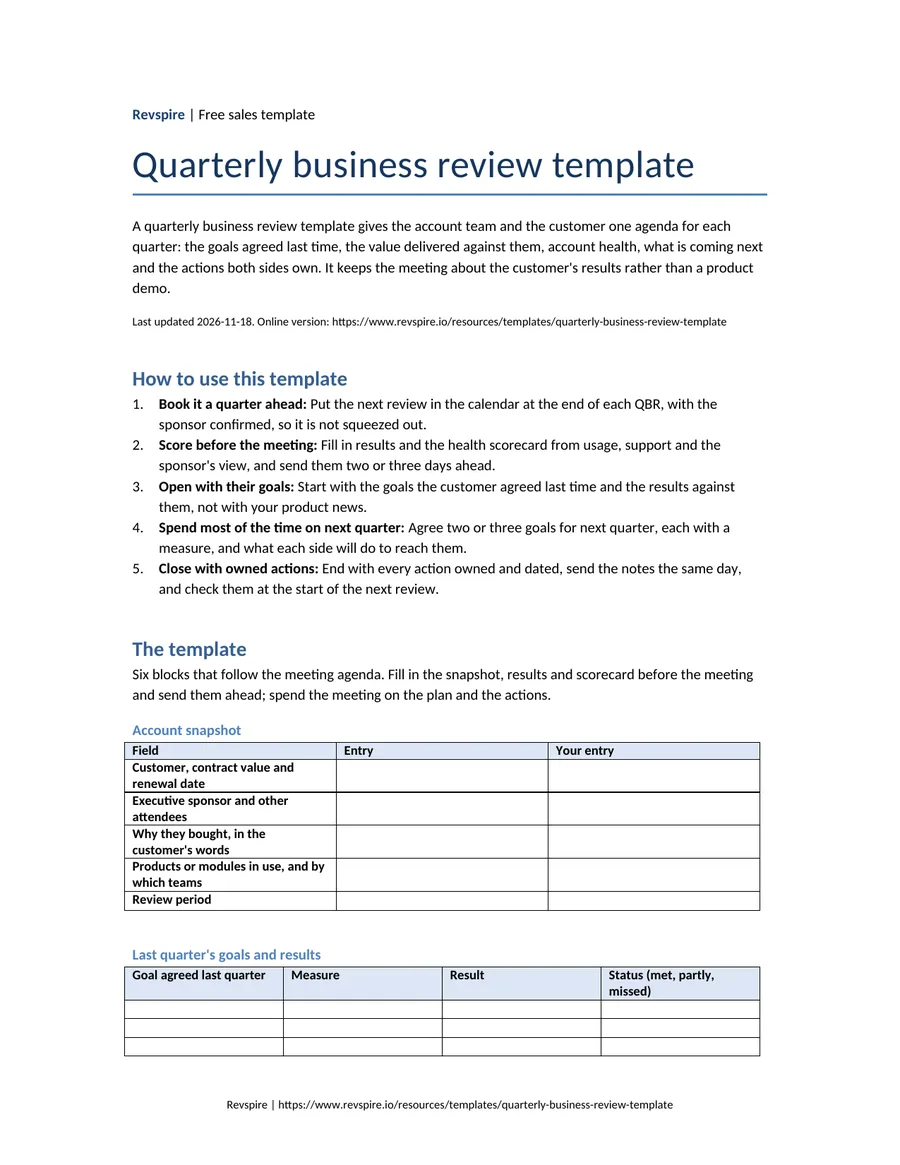
The template
Six blocks that follow the meeting agenda. Fill in the snapshot, results and scorecard before the meeting and send them ahead; spend the meeting on the plan and the actions.
Account snapshot
| Field | Entry |
|---|---|
| Customer, contract value and renewal date | |
| Executive sponsor and other attendees | |
| Why they bought, in the customer's words | |
| Products or modules in use, and by which teams | |
| Review period |
Last quarter's goals and results
| Goal agreed last quarter | Measure | Result | Status (met, partly, missed) |
|---|---|---|---|
Account health scorecard (0 at risk, 1 watch, 2 healthy)
| Area | Score | Evidence | What would raise it |
|---|---|---|---|
| Adoption: the intended teams use it regularly | |||
| Outcomes: the goals are being met | |||
| Sponsor: engaged and still in role | |||
| Support: no unresolved high-priority issues | |||
| Commercial: renewal and expansion path clear | |||
| Total (out of 10) |
Open issues and support
| Issue | Impact on the customer | Owner | Target date |
|---|---|---|---|
Next quarter: goals and roadmap
| Goal for next quarter | Measure | What we will deliver | What the customer will do |
|---|---|---|---|
Actions
| Action | Owner (vendor or customer) | Due date | Status |
|---|---|---|---|
Prefer a file? We email the Word, Excel and PDF versions to your work address, free.
Email me the filesA worked example
Example: fictional company
A QBR where the scorecard changed the agenda, and the customer wrote next quarter's goals.
Ferncastle Analytics sells a reporting product to Marlow & Finch Logistics. Before the third-quarter review, the customer success manager filled in the scorecard and found that adoption was strong in one region and missing in two others, which became the main agenda item instead of the planned feature tour.
Marlow & Finch Logistics: third-quarter scorecard
| Area | Score | Evidence | Next step |
|---|---|---|---|
| Adoption | 1 | Northern region uses weekly reports; two other regions have not logged in since training | Regional leads to nominate one owner each |
| Outcomes | 2 | Month-end reporting moved from five days to two in the northern region (customer's own figure) | Repeat the setup in the other regions |
| Sponsor | 2 | Operations director attended and set the goals | Keep the monthly sponsor call |
| Support | 1 | One open data-connection issue for a month | Fix agreed for the first week of next quarter |
| Commercial | 1 | Renewal in nine months; expansion depends on the other regions | Revisit at the next QBR |
| Total | 7 of 10 | Next quarter's goal, in the customer's words: all three regions on weekly reports by the end of the quarter |
Example: fictional company. Ferncastle Analytics, Harborview Metrics, Marlow & Finch Logistics and every person named in this example are invented for illustration. Any resemblance to real companies or people is coincidental.
How to run a QBR customers want to attend
Book it a quarter ahead
Put the next review in the calendar at the end of each QBR, with the sponsor confirmed, so it is not squeezed out.
Score before the meeting
Fill in results and the health scorecard from usage, support and the sponsor's view, and send them two or three days ahead.
Open with their goals
Start with the goals the customer agreed last time and the results against them, not with your product news.
Spend most of the time on next quarter
Agree two or three goals for next quarter, each with a measure, and what each side will do to reach them.
Close with owned actions
End with every action owned and dated, send the notes the same day, and check them at the start of the next review.
Where QBRs go wrong
A product demo in disguise
A long roadmap tour tells the customer the meeting is about you.
The wrong audience
Without the sponsor, nobody in the room can agree goals or change priorities.
Vanity numbers
Logins and page views are not results; tie each number to a goal the customer set.
Hiding problems
Customers already know about the open issues; naming them with an owner and a date builds trust.
No follow-through
Actions that are never checked teach the customer that the QBR does not matter.
Where Revspire fits
A QBR deck is usually rebuilt every quarter from email threads and memory, then sent as an attachment that nobody opens. A Revspire digital sales room gives each account one shared space where the scorecard, the agreed goals, the mutual action plan with owners and dates, and the supporting content live together for both sides.
Buyer engagement analytics show which stakeholders opened the review material before the meeting, and the stakeholder map shows who on the customer side is engaged, which helps when a sponsor changes between reviews.
Quarterly business review template FAQs
What should be included in a QBR?
The goals agreed last quarter and the results against them, an account health scorecard, open issues with owners, two or three goals for next quarter with measures, and a list of actions with owners and due dates on both sides.
How long should a quarterly business review be?
Forty-five to sixty minutes is enough when the results and scorecard are sent ahead. Keep the product roadmap to a short section tied to the customer's goals.
Who should attend a QBR?
The customer's sponsor and the team leads who own the goals, with the account manager or customer success manager and, for larger accounts, a sales or support lead from the vendor side.
What is the difference between a QBR and an EBR?
A QBR checks last quarter's results and sets next quarter's goals with the sponsor and team leads. An executive business review is a less frequent meeting between senior executives about the direction of the partnership, expansion or renewal.
Is a QBR template better in slides or a document?
Use a document or spreadsheet to prepare and track the scorecard and actions, and present only the parts that need discussion. The Excel version of this template keeps one tab per quarter so trends are easy to show.
Related templates and reading
- Free templateMutual action plan templateA shared, dated plan from discovery to go-live, with a buyer owner and a seller owner on every milestone.
- Free templateStakeholder map templateEvery person in the buying group on one page, with buying role, influence, stance, priorities and a next action.
- Free templateSales enablement business case templateA one-page sales enablement business case: the problem, what ramp, rep time and turnover cost today, the options, the numbers and a dated decision ask.
- Free templateSales close plan templateEvery remaining step between verbal intent and signature, with owners on both sides, the approval chain and the risks the buyer never sees.
- Template: the plan each QBR checks againstCustomer success plan template
- Template: where the first goals come fromSales to CS handoff template
- Guide: tools for health scores and renewalsBest customer success software
- Guide: turning reviews into expansionCustomer expansion strategy guide