What a competitive matrix is for
A competitive matrix is a grid: competitors across the top, buying criteria down the side, and a score or a short fact in every cell. It is the one-page view of a market that product marketing, sales leaders and sellers can all read in a minute.
This template has three parts: a feature and capability grid, a scorecard weighted by what buyers say matters, and a two-axis positioning map. The grid records facts, the scorecard records judgement, and the map shows the story.
A matrix is different from a full competitive analysis. The analysis explains each competitor in depth; the matrix compresses that work into something a seller can use before a call, and it feeds the battlecards for each competitor.
When to build a competitive matrix
- You are launching a product or entering a new segment.
- Win rates against one competitor have dropped and nobody agrees why.
- Sellers keep asking product marketing the same comparison questions.
- Leadership needs a one-page view of the market for planning or a board deck.
- You are about to write or refresh battlecards and need a shared fact base.
Competitive matrix, competitive analysis or battlecard
Three competitive documents that build on each other. Most teams need all three, in this order.
| Document | What it contains | Who reads it | How often it changes |
|---|---|---|---|
| Competitive analysis | Each competitor in depth: strategy, pricing, customers, strengths, weaknesses | Product marketing and leadership | Twice a year or after big moves |
| Competitive matrix | All competitors on one grid against buyer criteria, plus a positioning map | Product marketing, sales leaders, sellers | Each quarter |
| Battlecard | One competitor, the talk tracks, landmines and proof for a live deal | Sellers | Whenever the competitor changes |
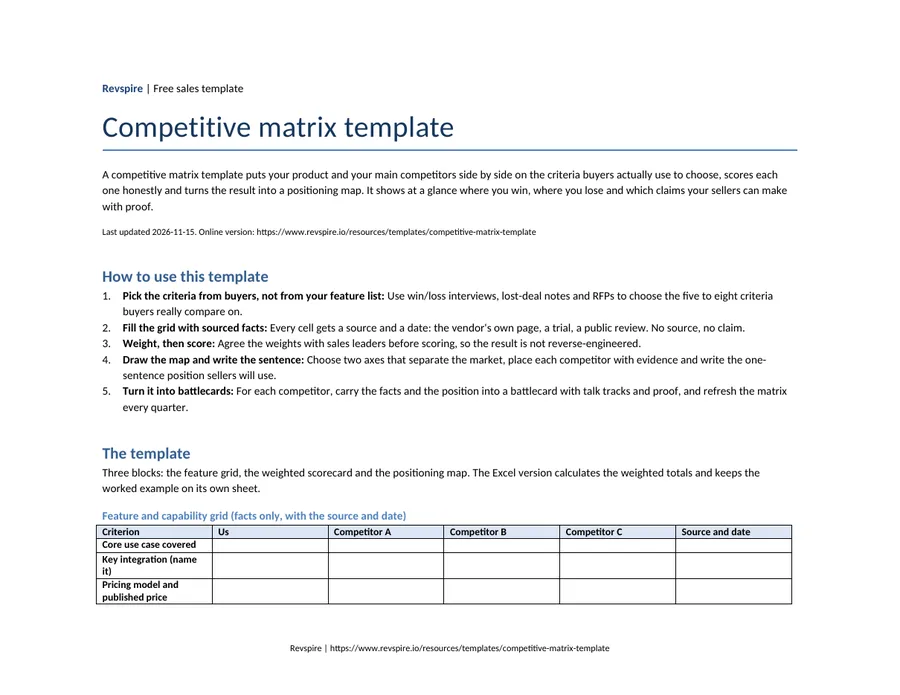
The template
Three blocks: the feature grid, the weighted scorecard and the positioning map. The Excel version calculates the weighted totals and keeps the worked example on its own sheet.
Feature and capability grid (facts only, with the source and date)
| Criterion | Us | Competitor A | Competitor B | Competitor C | Source and date |
|---|---|---|---|---|---|
| Core use case covered | |||||
| Key integration (name it) | |||||
| Pricing model and published price | |||||
| Typical time to go live | |||||
| Security and compliance documentation | |||||
| Support model | |||||
| Segment focus (SMB, mid-market, enterprise) |
Weighted scorecard (weight 1 to 3; score 0 to 3)
| Buyer criterion | Weight | Us | Competitor A | Competitor B | Competitor C |
|---|---|---|---|---|---|
| Fit for the main use case | |||||
| Ease of adoption for end users | |||||
| Integration with the buyer's stack | |||||
| Total cost over the contract | |||||
| Vendor support and direction | |||||
| Weighted total |
Positioning map
| Item | Your entry |
|---|---|
| Horizontal axis (a buyer criterion, for example breadth of platform) | |
| Vertical axis (a second criterion, for example ease of adoption) | |
| Where each competitor sits, with one sentence of evidence | |
| The space you claim, in one sentence a seller can say out loud |
Prefer a file? We email the Word, Excel and PDF versions to your work address, free.
Email me the filesA worked example
Example: fictional company
A weighted scorecard for one vendor and three competitors. The point is how the weights change the order.
Ferncastle Analytics sells a reporting product to mid-market finance teams. Buyers in its last ten lost deals said adoption and total cost mattered more than feature breadth, so product marketing weighted those criteria at 3 and scored four products after hands-on trials.
Ferncastle Analytics: weighted scorecard
| Buyer criterion (weight) | Ferncastle | Competitor A | Competitor B | Competitor C |
|---|---|---|---|---|
| Fit for the main use case (2) | 2 | 3 | 2 | 2 |
| Ease of adoption (3) | 3 | 1 | 2 | 2 |
| Integration with the stack (2) | 2 | 3 | 1 | 2 |
| Total cost over the contract (3) | 3 | 1 | 3 | 2 |
| Vendor support and direction (1) | 2 | 3 | 1 | 2 |
| Weighted total | 28 | 21 | 22 | 22 |
Example: fictional company. Ferncastle Analytics, Harborview Metrics, Marlow & Finch Logistics and every person named in this example are invented for illustration. Any resemblance to real companies or people is coincidental.
How to build the matrix
Pick the criteria from buyers, not from your feature list
Use win/loss interviews, lost-deal notes and RFPs to choose the five to eight criteria buyers really compare on.
Fill the grid with sourced facts
Every cell gets a source and a date: the vendor's own page, a trial, a public review. No source, no claim.
Weight, then score
Agree the weights with sales leaders before scoring, so the result is not reverse-engineered.
Draw the map and write the sentence
Choose two axes that separate the market, place each competitor with evidence and write the one-sentence position sellers will use.
Turn it into battlecards
For each competitor, carry the facts and the position into a battlecard with talk tracks and proof, and refresh the matrix every quarter.
Where competitive matrices go wrong
All green for us
A matrix where you win every row is not believed by sellers or buyers.
Feature counting
Rows of checkmarks hide what buyers actually weigh: fit, adoption and cost.
No sources
Undated claims go stale, and one wrong cell undermines the whole page.
Built once
Competitors ship, reprice and merge; a matrix older than a quarter is a risk.
Kept in a slide
If sellers cannot find it before a call, it does not change any deals.
Where Revspire fits
A matrix captures one moment; keeping it current and in front of sellers is the hard part. Revspire's AI Playbook Engine supports competitive intelligence and AI win/loss analysis of deals and calls, and builds seller-ready battlecards grounded in your approved knowledge, routed for approval before they are published.
Approved battlecards then appear in the places sellers already work, and usage analytics show which competitive plays reps actually open, so you know which part of the matrix to refresh first.
Competitive matrix template FAQs
What should a competitive matrix include?
Your product and three to five competitors, the five to eight criteria buyers compare on, a sourced and dated fact in each cell, weights agreed with sales leaders, and a positioning map with one sentence your sellers can use.
What is the difference between a competitive matrix and a competitive analysis?
A competitive analysis describes each competitor in depth. A competitive matrix compresses that work onto one grid so the whole market can be compared at a glance, and it feeds the battlecard for each competitor.
How do you make a competitive matrix in Excel?
List competitors across the columns and buyer criteria down the rows, add a weight column, score each cell from 0 to 3 and multiply by the weight for a total. The Excel version of this template does the totals for you.
How often should a competitive matrix be updated?
At least every quarter, and straight away when a competitor changes pricing, ships a major feature, merges or exits a segment.
Related templates and reading
- Free templateWin-loss analysis templateA buyer interview guide, a coding sheet for reasons and a quarterly report with actions and owners.
- Free templateMutual action plan templateA shared, dated plan from discovery to go-live, with a buyer owner and a seller owner on every milestone.
- Free templateStakeholder map templateEvery person in the buying group on one page, with buying role, influence, stance, priorities and a next action.
- Free templateSales enablement business case templateA one-page sales enablement business case: the problem, what ramp, rep time and turnover cost today, the options, the numbers and a dated decision ask.
- Template: each competitor in depthCompetitive analysis template
- Template: turn the matrix into seller-ready cardsSales battlecard template
- Blog: tools that keep competitive content currentBest battlecard software
- Glossary: what competitive intelligence coversCompetitive intelligence glossary entry