8 Best Battlecard and Competitive Intelligence Software in 2026
A practical perspective for connecting this idea to your revenue team’s next move.
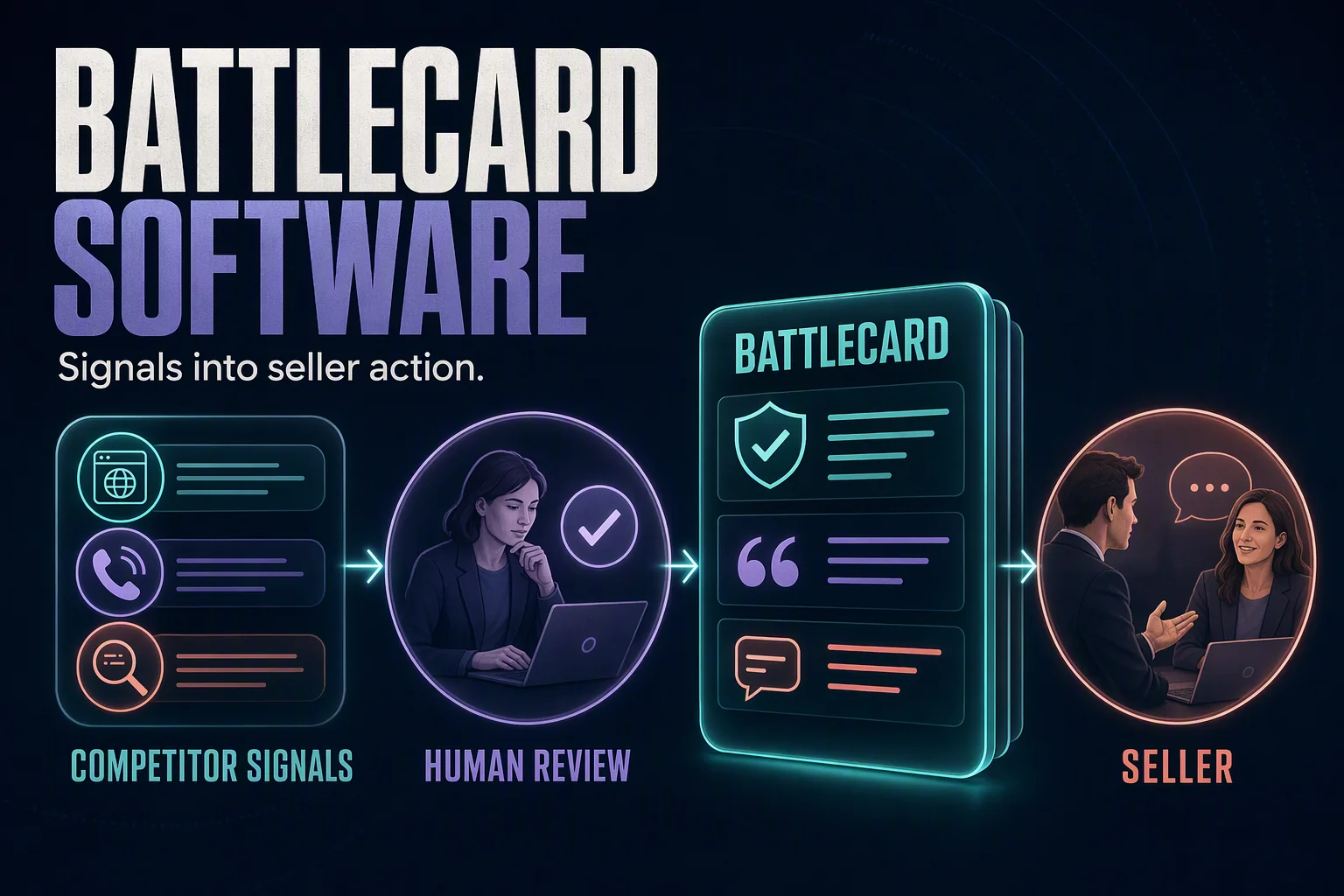
The best battlecard software in 2026 depends on where your competitive program gets stuck. Competitive intelligence platforms (AlphaSense, Contify, Crayon, Klue, Kompyte) collect competitor changes and help you build cards; enablement platforms (Highspot and Seismic, Spekit, Revspire) put battlecards in front of sellers, next to the content, plays and practice they already use.
Most teams need both halves: finding out what changed, and making sure a rep sees it in the deal. Below are eight tools, grouped by which half they cover, each with its published pricing and one limitation.
Last updated: 19 October 2026
Disclosure: Revspire publishes this list and is one of the tools on it. Tools are grouped by type, with each vendor’s own published information checked on 19 October 2026.
What is battlecard software?
Battlecard software helps product marketing, competitive intelligence and enablement teams build, update and deliver battlecards: short, seller-facing guides to winning against a named competitor. Competitive intelligence software is the wider category. It also monitors competitors’ websites, pricing, reviews, news, hiring and sales calls, so the cards rest on current evidence rather than last year’s assumptions (our glossary entry on competitive intelligence covers the practice).
In practice, the software does five jobs:
- Collects competitor signals from the web, review sites, filings, call recordings and win/loss interviews.
- Curates them, filtering noise and summarizing what matters, increasingly with AI.
- Builds cards: differentiators, landmine questions, objection responses, pricing guidance and proof points.
- Delivers them where reps work: the CRM, Slack or Microsoft Teams, a browser extension or an enablement platform.
- Measures which cards reps open and whether competitive deals go better when they do.
How to choose battlecard software
Score every tool against six criteria:
- Sources: which competitor signals it collects (web, reviews, news, filings, calls, win/loss) and in which languages.
- Human review: who approves an AI-drafted card before it reaches a seller.
- Delivery: whether cards appear in your CRM, chat tool and enablement platform, not only in a separate portal.
- Freshness: alerts when a competitor changes, plus review dates and owners for every card.
- Measurement: card opens, the sections reps reach, and win rates with and without the card.
- Pricing model: per user, per program or per module decides what it costs to give every seller and partner access.
Human review is the criterion buyers most often skip. In Klue’s AI in Competitive Intelligence Report 2026 (a vendor survey of 250+ CI and product marketing professionals; page last modified 7 May 2026), 79% of respondents said they do not trust AI outputs going straight to sellers, and 53% said they have a manual review step before anything reaches sellers.
Measurement matters because opening a card is not the same as using it. In Revspire’s battlecard usage benchmark (aggregated Revspire customer data, at least 10 organizations per figure, published October 2026), competitive opportunities where the rep opened the relevant battlecard before close were won 44% of the time, against 31% where the rep did not (6 months to October 2026). That is a correlation, not proof that the card won the deal: reps who prepare may simply be stronger sellers. The same benchmark found that only 43% of battlecard opens reached the proof points and customer evidence, and that a card’s opens fell by half a median of 45 days after an update (12 months to October 2026).
Battlecard software compared
Tool
Best for
Key capabilities
Pricing model as published
One limitation
AlphaSense
Strategy and CI analysts researching markets and public companies
Broker research, expert call transcripts, filings, watchlists, alerts, AI summaries
Two plans, annual subscriptions; contact sales, no prices
CI page does not mention battlecards or CRM delivery
Contify
Global, multilingual and regulated-market monitoring
1 million+ sources, non-English sources, Athena AI battlecards, Slack/Teams/Salesforce delivery
7-day free trial; no per-user licensing fees; no prices
No dedicated battlecard page or battlecard usage analytics described
Crayon
CI teams that push intel into an existing enablement platform
Sparks AI research, Crayon Answers, battlecards, alerts; delivery to Salesforce, Slack, Teams, Highspot, Seismic, Showpad
Tailored to the program; request an estimate
Usage measurement sits in a separate Measure product
Klue
Running competitive intelligence and win-loss as one program
Compete Agent, deal assistant, battlecards, win-loss interviews, Slack/Salesforce/LLM access
No pricing page; demo
Compete Agent page does not list Microsoft Teams
Kompyte by Semrush
Teams without a dedicated CI analyst
Automated tracking, AI daily summaries, battlecard templates, win rates with and without battlecards
No prices on the pages opened; plans page and demo
Integration list names Highspot and Showpad, not Seismic
Highspot and Seismic
Enterprises whose content and plays already live there
Plays with messaging and objection handling, surfaced in the CRM by deal stage; play analytics
Highspot: Good / Better / Best, no prices; Seismic: demo, no pricing page
Pages do not describe collecting competitor intel
Revspire
Battlecards connected to content, objection practice and deal rooms
AI-drafted, approved battlecards; win/loss analysis; role-based publishing; playbook analytics
Per module, unlimited users; quoted by sales
Smaller integration marketplace than the largest suites
Spekit
Salesforce-centric teams wanting cards at the moment of need
Battlecards and objection tips surfaced in Salesforce and via a Chrome extension
No prices on platform pages; demo
No competitor monitoring described
Pricing models as shown on each vendor’s own site, checked 19 October 2026.
Competitive intelligence platforms that research and build battlecards
These tools start from the research: they watch competitors, filter the noise and turn findings into cards and alerts, delivered to reps directly or through an enablement platform.
AlphaSense
AlphaSense is a market intelligence and research platform. Its competitive intelligence page addresses competitive strategists and decision makers rather than sellers, so it sits upstream of the battlecard.
- Standout capabilities: company tearsheets, competitor watchlists, real-time alerts, sentiment analysis and generative AI summaries, including SWOT drafts; content includes 45,000+ expert call transcripts and broker research from 1,000 sell-side and independent firms, across 10,000+ content sources (AlphaSense tech competitive intelligence, checked 19 October 2026).
- Pricing: the AlphaSense pricing page (checked 19 October 2026) lists two plans, Market Intelligence and Enterprise Intelligence, sold as annual subscriptions from enterprise packages to per-seat options, with no prices; buyers contact sales.
- Limitation: the competitive intelligence page does not mention battlecards, sales enablement or CRM delivery, so you still need somewhere to publish seller-ready cards.
- Choose it if: your competitors include public companies and analysts need filings, earnings calls and expert interviews behind each claim.
Contify
Contify describes itself as an AI-native competitive intelligence platform that monitors external and internal sources and turns them into insights for different teams.
- Standout capabilities: monitoring of more than 1 million vetted external sources, including over 200,000 non-English sources translated from more than 117 languages, plus regulatory portals, SEC filings and G2 reviews; internal sources such as Gong and SharePoint; its Athena AI engine drafts SWOTs, competitor profiles and battlecards, with human-in-the-loop checkpoints; delivery through Slack, Microsoft Teams, email and Salesforce (Contify competitive intelligence, checked 19 October 2026).
- Pricing: the same page offers a 7-day free trial and says the platform comes without per-user licensing fees; no tiers or amounts are published.
- Limitation: there is no dedicated battlecard page, and the engagement tracking the page describes is for newsletters and dashboards, so ask how battlecard usage is reported.
- Choose it if: you sell across regions or regulated industries and need non-English, regulatory and private-company monitoring behind your cards.
Crayon
Crayon is a competitive intelligence platform organized into modules for collecting, organizing, publishing and measuring intel. Its Enable product is the battlecard and seller-delivery layer.
- Standout capabilities: battlecards kept current by Sparks, an AI research tool that can run on a schedule to analyze competitor activity such as pricing changes; Crayon Answers, a generative AI assistant reps can ask how to position against a competitor; alerts tailored to accounts or territories; intel submitted by the field through Crayon or Slack; delivery into Salesforce, Slack, Microsoft Teams, Highspot, Seismic, Showpad and SharePoint (Crayon Enable, checked 19 October 2026).
- Pricing: Crayon’s pricing page (checked 19 October 2026) says pricing is tailored to each competitive intelligence program and asks buyers to request an estimate; no figures.
- Limitation: the Enable page does not describe battlecard analytics; measurement is a separate Measure module, so check which modules your quote includes.
- Choose it if: your sellers already work in Highspot, Seismic or Showpad and you want CI delivered there as well as in Slack or Teams.
Klue
Klue positions itself as an AI platform for competitive intelligence and win-loss, run as one program in one platform (Klue homepage, checked 19 October 2026).
- Standout capabilities: Compete Agent, an AI research analyst that continuously collects and analyzes intel and builds competitor profiles; a competitive deal assistant that watches competitive activity in open opportunities and sends sellers guidance; battlecards for priority competitors, which curators can also update from within Claude; seller access through Slack, Salesforce, email and AI assistants (Klue Compete Agent, checked 19 October 2026). According to the Klue homepage, its win-loss suite adds expert interviews, an AI interviewer and interviews with buyers from evaluations you were not part of.
- Pricing: not published; the Klue homepage has no pricing link in its navigation or footer and routes buyers to a demo (checked 19 October 2026).
- Limitation: the Compete Agent page names Slack, Salesforce, email and AI assistants as delivery points, not Microsoft Teams, so Teams-first companies should confirm support.
- Choose it if: you want win-loss interviews and competitive intelligence feeding the same battlecards, run by a dedicated product marketing or CI team.
Kompyte by Semrush
Kompyte is competitive intelligence automation software for sales and marketing teams. Semrush announced its plan to acquire Kompyte in a Business Wire release in February 2022, and Kompyte’s site now carries Semrush branding.
- Standout capabilities: tracking of competitors’ websites, reviews, content, social posts, ads and job postings, with AI filtering and AI daily summaries; battlecard templates; automated win/loss calculations, including win rates with and without battlecards; integrations with HubSpot, Salesforce, Slack, Microsoft Teams, Google Drive, OneDrive, Highspot and Showpad (Kompyte homepage, checked 19 October 2026). Its battlecards page adds rep adoption reporting.
- Pricing: no prices on the Kompyte homepage or battlecards page (checked 19 October 2026); the site links to a separate plans page and offers a demo and an ROI calculator.
- Limitation: the homepage integration list includes Highspot and Showpad but not Seismic, so Seismic customers should confirm how cards would reach their library.
- Choose it if: you have no full-time CI analyst. Kompyte’s Kompyte GPT announcement (launch set for 1 June 2023) says the AI battlecard generator is usable by companies without a dedicated battlecard owner.
Enablement platforms that deliver battlecards to sellers
These platforms do not lead with competitor monitoring. Their strength is putting competitive guidance where sellers already work, next to approved content, plays and training, and measuring its use. Many teams pair one with a CI platform from the group above.
Highspot and Seismic
Highspot is now part of Seismic: Highspot’s merger page (announced 18 August 2026) says the merger is complete and the two are one company under the Seismic name. Both platforms still have their own sites and packaging.
- Standout capabilities: Highspot plays combine role-specific guidance, messaging, objection handling, content and training, surface in Salesforce or Microsoft Dynamics 365 by persona, industry and deal stage, and report usage on scorecards (Highspot sales playbook software, checked 19 October 2026). Seismic’s sales plays include a compete stage with tailored resources, objection handling and messaging for winning against competitors (Seismic sales plays, checked 19 October 2026).
- Pricing: the Highspot pricing page (checked 19 October 2026) lists Good, Better and Best packages with no prices and a contact-sales link; the Seismic homepage (checked 19 October 2026) has no pricing page and offers a demo.
- Limitation: neither page describes collecting competitor intel or uses the word battlecard. Highspot’s own Klue integration listing presents Klue as the source of truth for competitive intel and Highspot as the sellers’ single point of access.
- Choose it if: your content and plays already live in Highspot or Seismic, and you plan to feed competitive intel in from a CI platform.
Revspire
Revspire is an AI sales enablement platform. Its AI Playbook Engine builds battlecards, objection plays, win/loss insights and messaging with AI grounded in approved revenue knowledge, alongside Content Hub, AI Sales Training & Coaching and Digital Sales Rooms.
- Standout capabilities: AI playbook drafting with grounding and approval routing; competitive intelligence turned into seller-ready battlecards; AI win/loss analysis of deals and calls; role-specific messaging published across seller workflows; playbook usage and performance analytics (Revspire AI Playbook Engine page, checked 19 October 2026). In the AI Sales Training & Coaching module, reps practice deal-specific objections with battle cards in AI role-play.
- Pricing: priced per module rather than per seat, with unlimited user licenses; Content Hub is the base module. Pricing is quoted by sales.
- Limitation: a newer vendor with a smaller third-party integration marketplace than the largest suites.
- Choose it if: you want battlecards connected to approved content, objection practice and deal rooms, without cost rising for every seller or partner who needs access.
Spekit
Spekit calls itself a rep acceleration platform: enablement content, coaching and deal context delivered inside the tools reps already use rather than in a separate portal (Spekit platform, checked 19 October 2026).
- Standout capabilities: competitive battle cards, objection-handling tips and decision criteria revealed in the moment of need (Spekit for sales playbooks, checked 19 October 2026); guidance attached to Salesforce fields, picklist values and stage transitions, with a Chrome extension for other web apps (Spekit embedded enablement, checked 19 October 2026); a governed knowledge engine with owners, version history and decay detection.
- Pricing: no plan names or prices on Spekit’s platform pages (checked 19 October 2026); buyers book a demo.
- Limitation: Spekit does not describe competitor monitoring, so the research behind each card has to come from your team or a CI platform.
- Choose it if: your reps live in Salesforce and you want a short card to appear at the stage or field where a competitor comes up.
Which battlecard tool fits which team?
Your situation
Start with
Why
Dedicated PMM or CI team tracking many competitors
Klue or Crayon
Collection, AI research and battlecards in one CI program
No full-time CI analyst
Kompyte
Automated tracking and AI-generated cards aimed at teams without a card owner
Global or regulated markets
Contify
Non-English, regulatory and filing sources; free trial to test coverage
Strategy or corporate development research
AlphaSense
Broker research, filings and expert calls on public competitors
Content and plays already in Highspot or Seismic
Your existing suite plus a CI feed
Sellers keep one place to look; Klue, Crayon and Kompyte list integrations
Salesforce-centric team that wants in-the-moment cards
Spekit
Cards triggered by Salesforce fields and stages
Cards that should drive practice and deal rooms
Revspire
Battlecards, objection role-play and deal rooms share one approved source
A good card format matters as much as the software. Our free sales battlecard template gives you a one-page structure to load into any of these tools, and the complete guide to competitive battle cards covers how to build and maintain cards reps actually use.
Frequently asked questions
What is the difference between Klue and Crayon?
Both are competitive intelligence platforms that collect competitor intel and turn it into battlecards and alerts. Klue pairs competitive intelligence with a win-loss suite (interviews, an AI interviewer and a story agent), while Crayon’s Enable product emphasizes delivering intel into Salesforce, Slack, Microsoft Teams and enablement platforms such as Highspot, Seismic and Showpad. Neither publishes prices.
How much does Klue or Crayon cost?
Neither vendor publishes a price. Klue’s site routes buyers to a demo, and Crayon’s pricing page says pricing is tailored to each competitive intelligence program and asks you to request an estimate (both checked 19 October 2026). Budget for a quote, and ask which modules (research, enablement, measurement, win-loss) it covers.
Which competitive intelligence tool is best for small teams?
For a team without a full-time CI analyst, look for automated collection and AI-drafted cards a person can review quickly. Kompyte says its AI battlecard generator suits companies without a dedicated battlecard owner, and Contify offers a 7-day free trial to test coverage before you buy. If your sellers already use an enablement platform, check whether it can host the cards before adding another tool.
Can AI write battlecards?
Yes: Contify, Crayon, Klue, Kompyte and Revspire all describe AI that drafts or updates battlecard content. The risk is unreviewed claims reaching buyers. In Klue’s 2026 survey, 79% of CI and product marketing respondents said they do not trust AI outputs going straight to sellers, so keep an owner who approves every card before publication.
How often should battlecards be updated?
Review each card on a schedule, such as quarterly, and whenever a competitor changes pricing, packaging or positioning. Attention fades faster than most review cycles: in Revspire’s battlecard usage benchmark, a card’s opens fell by half a median of 45 days after an update, so remind reps about a card around six weeks after you change it.
Where should battlecards live?
Where reps already work: the CRM opportunity, Slack or Teams, and the enablement platform that holds the rest of their content, rather than a separate portal sellers must remember to visit. Make sure the card stays useful late in the deal too: in Revspire’s battlecard usage benchmark, 47% of battlecard opens came in the security and procurement or negotiation stages (12 months to October 2026).
Want to see battlecards connected to approved content, objection practice and digital sales rooms? Request a Revspire demo.
Sources
- Competitive intelligence for tech, AlphaSense, undated page, accessed 19 October 2026.
- Pricing, AlphaSense, undated page, accessed 19 October 2026.
- Competitive intelligence solution, Contify, undated page, accessed 19 October 2026.
- Crayon Enable, Crayon, undated page, accessed 19 October 2026.
- Pricing inquiry, Crayon, undated page, accessed 19 October 2026.
- The AI platform for competitive intelligence and win-loss, Klue, n.d. (homepage), accessed 19 October 2026.
- Compete Agent, Klue, undated page, accessed 19 October 2026.
- AI in Competitive Intelligence Report 2026, Klue, last modified 7 May 2026, accessed 19 October 2026.
- Kompyte homepage, Kompyte by Semrush, undated page, accessed 19 October 2026.
- Battle cards, Kompyte, undated page, accessed 19 October 2026.
- Kompyte GPT press release, Kompyte, 2023, accessed 19 October 2026.
- Semrush to acquire Kompyte, Business Wire, 28 February 2022 (date from the release ID), accessed 19 October 2026.
- Highspot and Seismic merger, Highspot by Seismic, announced 18 August 2026, accessed 19 October 2026.
- Sales playbook software, Highspot by Seismic, undated page, accessed 19 October 2026.
- Pricing, Highspot by Seismic, undated page, accessed 19 October 2026.
- Klue integration listing, Highspot Exchange, undated page, accessed 19 October 2026.
- Implement sales playbooks, Seismic, undated page, accessed 19 October 2026.
- Seismic homepage, Seismic, undated page, accessed 19 October 2026.
- Platform, Spekit, undated page, accessed 19 October 2026.
- Spekit for sales playbooks, Spekit, undated page, accessed 19 October 2026.
- Embedded enablement, Spekit, undated page, accessed 19 October 2026.