What win-loss analysis is for
Win-loss analysis asks buyers why they chose you or someone else, soon after the decision, and looks for patterns across many deals. The CRM loss reason, chosen by the seller from a drop-down, rarely tells the same story as the buyer.
The template has three parts: an interview guide for wins and losses, a coding sheet that sorts every reason into one theme with a quote, and a quarterly report that ranks the themes and assigns an action and an owner to each.
The value comes from consistency. The same questions, the same themes and the same report every quarter let you see whether a fix to pricing, messaging or the product actually changed what buyers say.
When to run win-loss analysis
- Win rates have moved and nobody can explain why.
- A new competitor keeps appearing in late-stage deals.
- You changed pricing, packaging or positioning and want to know if it worked.
- Product and sales disagree about why deals are lost.
- You are refreshing battlecards and need buyer evidence, not opinions.
Buyer interviews, seller debriefs or CRM reasons
Three sources of win-loss evidence. Use all three, but trust them in this order.
| Source | Strength | Weakness | Use it for |
|---|---|---|---|
| Buyer interviews | The buyer's own reasons, in their words | Slower and needs a neutral interviewer | The quarterly themes and the quotes |
| Seller debriefs | Fast, rich in deal detail | Sellers tend to blame price and product | Context for each interview |
| CRM loss reasons | Covers every deal | One drop-down chosen by the seller | Spotting deals worth an interview |
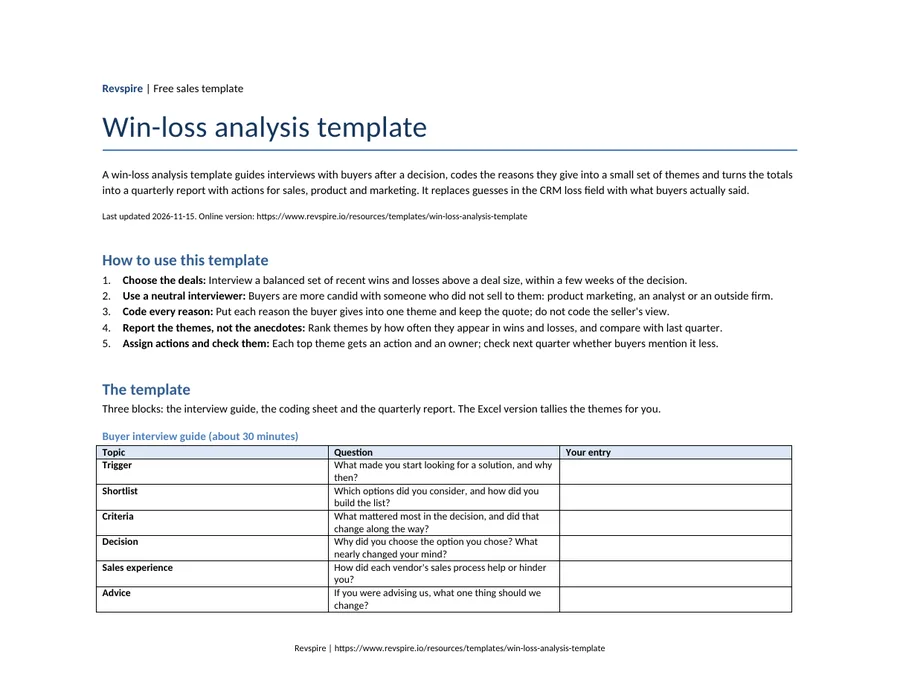
The template
Three blocks: the interview guide, the coding sheet and the quarterly report. The Excel version tallies the themes for you.
Buyer interview guide (about 30 minutes)
| Topic | Question |
|---|---|
| Trigger | What made you start looking for a solution, and why then? |
| Shortlist | Which options did you consider, and how did you build the list? |
| Criteria | What mattered most in the decision, and did that change along the way? |
| Decision | Why did you choose the option you chose? What nearly changed your mind? |
| Sales experience | How did each vendor's sales process help or hinder you? |
| Advice | If you were advising us, what one thing should we change? |
Coding sheet (one row per reason)
| Deal | Won or lost | Competitor | Theme | Buyer quote |
|---|---|---|---|---|
| Product fit | ||||
| Price or commercial terms | ||||
| Ease of adoption | ||||
| Sales experience | ||||
| Trust, proof or references | ||||
| Timing or no decision |
Quarterly report
| Theme | Wins citing it | Losses citing it | Change from last quarter | Action and owner |
|---|---|---|---|---|
| Product fit | ||||
| Price or commercial terms | ||||
| Ease of adoption | ||||
| Sales experience | ||||
| Trust, proof or references |
Prefer a file? We email the Word, Excel and PDF versions to your work address, free.
Email me the filesA worked example
Example: fictional company
One quarter's coded interviews, and the action that came out of them.
Ferncastle Analytics interviewed twelve buyers from the last quarter, six wins and six losses. Sellers had logged most losses as price. The coded interviews told a different story.
Ferncastle Analytics: themes from 12 interviews
| Theme | Wins citing it | Losses citing it | Action and owner |
|---|---|---|---|
| Ease of adoption | 5 | 1 | Lead demos with the first-week experience (product marketing) |
| Trust, proof or references | 2 | 4 | Build three reference stories by segment (customer marketing) |
| Price or commercial terms | 1 | 2 | No change; price was rarely the deciding reason |
| Sales experience | 3 | 3 | Add a mutual action plan to every deal over the threshold (sales) |
Example: fictional company. Ferncastle Analytics, Harborview Metrics, Marlow & Finch Logistics and every person named in this example are invented for illustration. Any resemblance to real companies or people is coincidental.
How to run a win-loss programme
Choose the deals
Interview a balanced set of recent wins and losses above a deal size, within a few weeks of the decision.
Use a neutral interviewer
Buyers are more candid with someone who did not sell to them: product marketing, an analyst or an outside firm.
Code every reason
Put each reason the buyer gives into one theme and keep the quote; do not code the seller's view.
Report the themes, not the anecdotes
Rank themes by how often they appear in wins and losses, and compare with last quarter.
Assign actions and check them
Each top theme gets an action and an owner; check next quarter whether buyers mention it less.
Where win-loss analysis goes wrong
Only losses
Without wins you cannot tell what to keep doing.
The seller interviews the buyer
Buyers soften their reasons to spare the relationship.
Trusting the loss field
A drop-down chosen by the seller is a starting point, not a finding.
Too many themes
Twenty themes produce no pattern; six to eight do.
No owner for the actions
A report that changes nothing stops getting interviews.
Where Revspire fits
Interviews give you the buyer's reasons; the deals and calls give you the evidence behind them. Revspire's AI Playbook Engine supports AI win/loss analysis of deals and calls, so patterns across many opportunities show up without waiting for a quarterly project.
What you learn then flows into the battlecards and objection plays sellers use, published into their workflow and routed for approval, so a finding becomes a change in the next deal rather than a slide in a review.
Win-loss analysis template FAQs
What questions should you ask in a win-loss interview?
Why the buyer started looking and why then, which options they considered, what mattered most in the decision, why they chose the winner, how each vendor's sales process helped or hindered, and the one thing they would advise you to change.
How many win-loss interviews do you need?
Enough wins and losses each quarter for themes to repeat. Many teams start with a balanced set of ten to twenty and add more for their most important segment or competitor.
Who should run win-loss interviews?
Someone who did not sell the deal, such as product marketing, an analyst or an outside firm, so the buyer can be candid.
What should a win-loss report include?
The themes ranked by how often they appear in wins and in losses, the change from last quarter, two or three buyer quotes per theme, and an action and owner for each top theme.
Related templates and reading
- Free templateCompetitive matrix templateA sourced feature grid, a scorecard weighted by buyer criteria and a positioning map for your market.
- Free templateMutual action plan templateA shared, dated plan from discovery to go-live, with a buyer owner and a seller owner on every milestone.
- Free templateStakeholder map templateEvery person in the buying group on one page, with buying role, influence, stance, priorities and a next action.
- Free templateSales enablement business case templateA one-page sales enablement business case: the problem, what ramp, rep time and turnover cost today, the options, the numbers and a dated decision ask.
- Blog: tools for interviews and AI analysisBest win-loss analysis software
- Template: each competitor in depthCompetitive analysis template
- Template: where win-loss findings end upSales battlecard template
- Glossary: what win-loss analysis isWin-loss analysis glossary entry