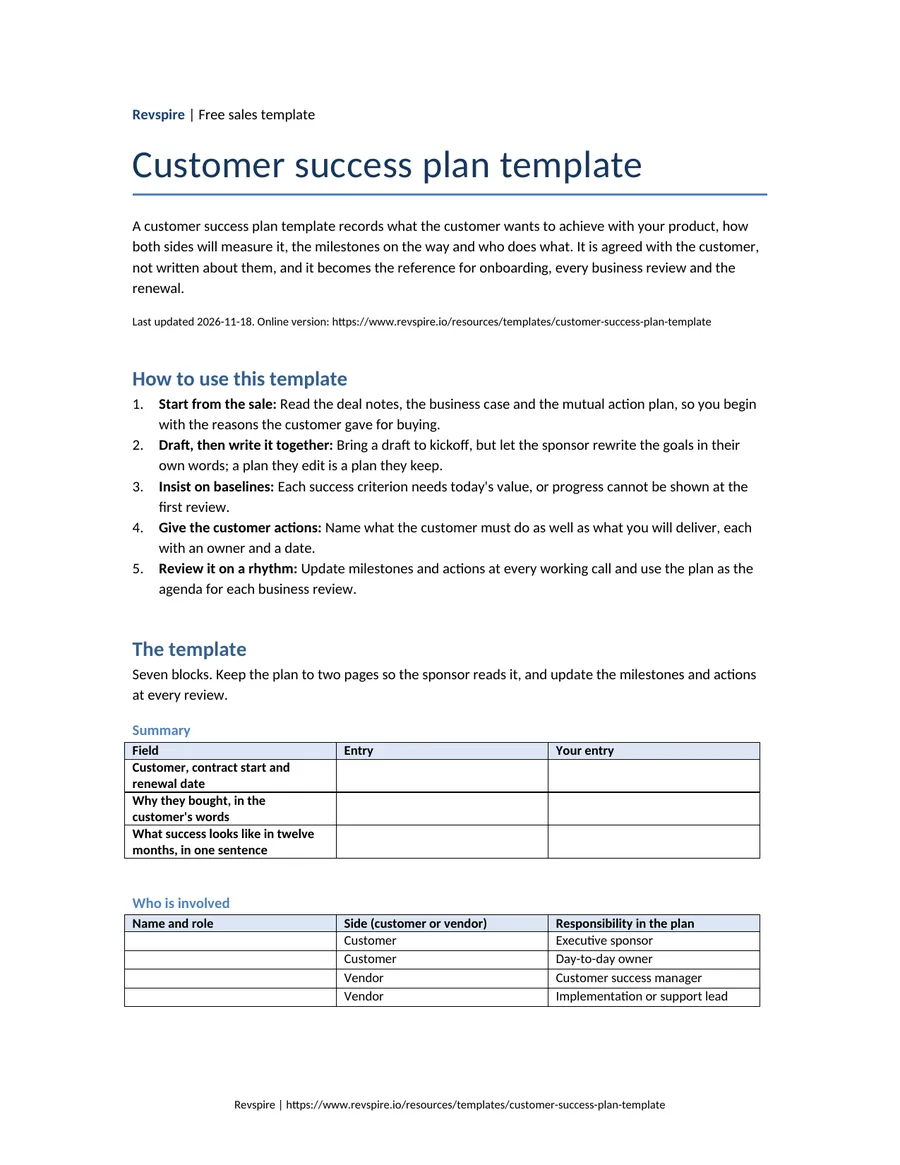
What a customer success plan is for
A customer success plan is a short, shared document that turns the reasons a customer bought into goals, measures and dated milestones. It is usually owned by the customer success manager and agreed with the customer's sponsor, so both sides work towards the same definition of success.
Some teams call it a mutual success plan or a joint execution plan, because the customer owns actions in it too. The template has seven parts: the summary, who is involved, the challenges and how the product addresses them, success criteria with measures, milestones and dates, shared actions, and the communication rhythm.
A sales mutual action plan gets a deal to signature. A customer success plan starts where that plan ends and runs until the goals are met and renewed, so the two should share the same stakeholders and the same language about why the customer bought.
When to write a customer success plan
- At the handoff from sales to customer success, before the kickoff meeting.
- For every account above an agreed contract value, and for any account with a named sponsor.
- When a customer expands to a new team or product, which needs its own goals.
- When a new sponsor takes over and the original reasons for buying need restating.
- Before a renewal where the value delivered has not been written down.
Customer success plan, mutual action plan or onboarding plan
Three plans that cover different parts of the customer journey and are easy to mix up.
| Plan | Covers | Ends when | Owner |
|---|---|---|---|
| Mutual action plan | The steps both sides take to reach a signed contract | The contract is signed | Seller, with the buyer's champion |
| Onboarding plan | Setup, configuration, training and go-live | The customer is live and using the product | Onboarding or implementation lead |
| Customer success plan | The business goals, measures and milestones after purchase | The goals are met and renewed, then reset | Customer success manager, with the sponsor |
The template
Seven blocks. Keep the plan to two pages so the sponsor reads it, and update the milestones and actions at every review.
Summary
| Field | Entry |
|---|---|
| Customer, contract start and renewal date | |
| Why they bought, in the customer's words | |
| What success looks like in twelve months, in one sentence |
Who is involved
| Name and role | Side (customer or vendor) | Responsibility in the plan |
|---|---|---|
| Customer | Executive sponsor | |
| Customer | Day-to-day owner | |
| Vendor | Customer success manager | |
| Vendor | Implementation or support lead |
Challenges and how we will address them
| Customer challenge | How the product addresses it | What the customer must change |
|---|---|---|
Success criteria
| Goal | Measure | Baseline today | Target and date |
|---|---|---|---|
Milestones
| Milestone | Target date | Owner | Status |
|---|---|---|---|
| Kickoff held and plan agreed | |||
| Live for the first team | |||
| First success criterion met | |||
| First business review | |||
| All success criteria met |
Shared actions
| Action | Owner | Side | Due date |
|---|---|---|---|
Communication rhythm
| Item | Entry |
|---|---|
| Working call (who, how often) | |
| Sponsor check-in (who, how often) | |
| Business review (dates for the year) | |
| Escalation path on each side |
Prefer a file? We email the Word, Excel and PDF versions to your work address, free.
Email me the filesA worked example
Example: fictional company
Success criteria written with the customer, with baselines, so the first business review had something to measure.
Harborview Metrics bought a customer analytics product from Ferncastle Analytics to cut the time its account managers spent building renewal reports. At kickoff, the customer success manager asked the sponsor to state each goal as a measure with today's baseline, rather than accepting "better reporting".
Harborview Metrics: success criteria agreed at kickoff
| Goal | Measure | Baseline | Target and date |
|---|---|---|---|
| Faster renewal reports | Hours to build one renewal report | About six hours (customer estimate) | Under one hour by the end of month three |
| Account managers use it | Account managers running a report each week | None | All twelve by the end of month four |
| Earlier risk warnings | At-risk accounts flagged before the renewal notice period | Flagged ad hoc | Every at-risk account flagged by month six |
Shared actions from the same meeting
| Action | Owner | Side | Due |
|---|---|---|---|
| Connect the CRM and billing data | Implementation lead | Vendor | Week two |
| Name one report owner per region | Day-to-day owner | Customer | Week two |
| Two training sessions for account managers | Customer success manager | Vendor | Week four |
Example: fictional company. Ferncastle Analytics, Harborview Metrics, Marlow & Finch Logistics and every person named in this example are invented for illustration. Any resemblance to real companies or people is coincidental.
How to build a success plan the customer owns
Start from the sale
Read the deal notes, the business case and the mutual action plan, so you begin with the reasons the customer gave for buying.
Draft, then write it together
Bring a draft to kickoff, but let the sponsor rewrite the goals in their own words; a plan they edit is a plan they keep.
Insist on baselines
Each success criterion needs today's value, or progress cannot be shown at the first review.
Give the customer actions
Name what the customer must do as well as what you will deliver, each with an owner and a date.
Review it on a rhythm
Update milestones and actions at every working call and use the plan as the agenda for each business review.
Where customer success plans go wrong
Written about the customer, not with them
A plan the sponsor never agreed to is an internal note, not a success plan.
Goals without measures
"Improve efficiency" cannot be shown as met; agree a measure and a baseline.
Vendor-only actions
If only the vendor owns actions, the customer is not committed to the outcome.
Filed after kickoff
A plan that is not reviewed goes stale within a quarter.
Lost at the handoff
Starting again after the sale throws away what the buyer already told the seller.
Where Revspire fits
A success plan in a shared drive is easy to forget. In a Revspire digital sales room, the plan the buyer and seller used during the evaluation can carry on after signature: the mutual action plan with owners and due dates, the stakeholder map and the content each stakeholder read stay in one room that both sides can open.
A customer success manager who takes over the room starts from the buyer's own record of why they bought, and buyer engagement analytics show whether the customer's team is opening the material for each milestone.
Customer success plan template FAQs
What is a customer success plan?
A shared document, agreed with the customer, that records their goals for the product, how success will be measured, the milestones and dates, and the actions each side owns. It guides onboarding, business reviews and the renewal.
What should a customer success plan include?
A summary of why the customer bought, the people involved on both sides, the challenges and how the product addresses them, success criteria with baselines and targets, milestones, shared actions and the meeting rhythm.
What is a mutual success plan?
Another name for a customer success plan in which both sides own actions. The word mutual signals that the customer has commitments too, not only the vendor.
Who owns the customer success plan?
The customer success manager owns keeping it current, and the customer's sponsor owns the goals. Both should agree the plan at kickoff and review it at every business review.
Related templates and reading
- Free templateStakeholder map templateEvery person in the buying group on one page, with buying role, influence, stance, priorities and a next action.
- Free templateSales enablement business case templateA one-page sales enablement business case: the problem, what ramp, rep time and turnover cost today, the options, the numbers and a dated decision ask.
- Free templateSales close plan templateEvery remaining step between verbal intent and signature, with owners on both sides, the approval chain and the risks the buyer never sees.
- Free templateDigital sales room templateThe sections of a buyer-facing deal room in order: summary, stakeholder map, mutual action plan, content by stage, business case, security, next steps and handoff.
- Template: the review that checks the plan each quarterQBR template
- Template: the plan before signatureMutual action plan template
- Template: the steps to go-liveCustomer onboarding checklist
- Template: what sales passes to customer successSales to CS handoff template