What a discovery call is for
A discovery call is the meeting where a seller learns whether a buyer has a problem worth solving, what it costs them, who decides and how. It usually follows a first contact and comes before any demo, so the demo can be built around what the buyer said.
The template has five parts: the call agenda, a question bank grouped by topic (situation, problem, impact, decision, timing), a notes sheet that captures the buyer's words, a qualification score, and the agreed next step. The question bank is a menu, not a script; a good call uses a handful of questions and spends most of the time listening.
The notes sheet is what makes discovery useful to the rest of the deal. A problem written down in the buyer's words, with the people they named, becomes the opening of the demo, the business case and the mutual action plan.
When to use the template
- Before every first discovery call, to prepare questions for this buyer.
- During the call, as a notes sheet that captures the buyer's words.
- After the call, to score the opportunity and agree whether to continue.
- When onboarding new sellers, as the standard for how discovery is run.
- In call coaching, to compare what the seller asked with what the template expects.
Discovery call, qualification call or demo
Three early-stage calls with different goals.
| Call | Goal | Who talks most |
|---|---|---|
| Qualification call | Check basic fit: role, size, need, timing | Both, briefly |
| Discovery call | Understand the problem, its impact and how they decide | The buyer |
| Demo | Show how the product solves what the buyer described | The seller, guided by discovery |
The template
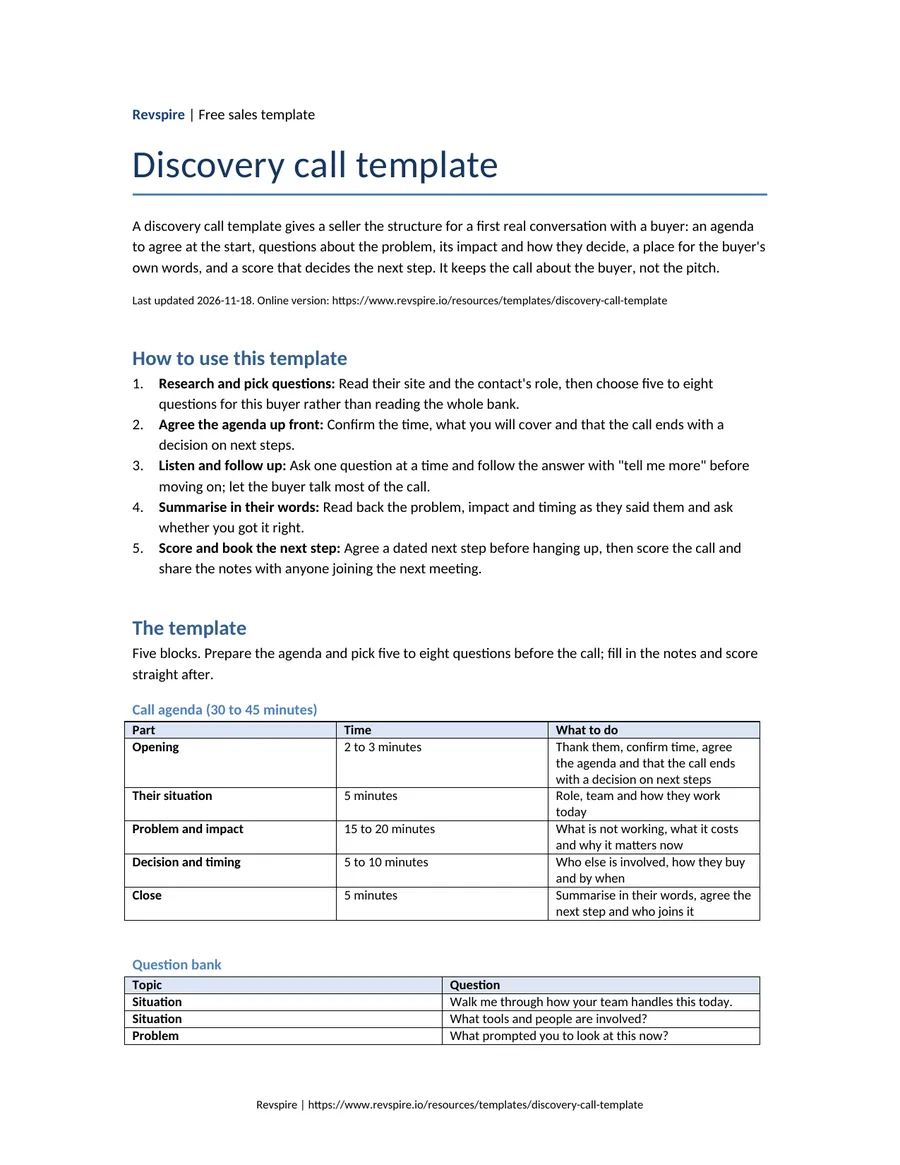
Five blocks. Prepare the agenda and pick five to eight questions before the call; fill in the notes and score straight after.
Call agenda (30 to 45 minutes)
| Part | Time | What to do |
|---|---|---|
| Opening | 2 to 3 minutes | Thank them, confirm time, agree the agenda and that the call ends with a decision on next steps |
| Their situation | 5 minutes | Role, team and how they work today |
| Problem and impact | 15 to 20 minutes | What is not working, what it costs and why it matters now |
| Decision and timing | 5 to 10 minutes | Who else is involved, how they buy and by when |
| Close | 5 minutes | Summarise in their words, agree the next step and who joins it |
Question bank
| Topic | Question |
|---|---|
| Situation | Walk me through how your team handles this today. |
| Situation | What tools and people are involved? |
| Problem | What prompted you to look at this now? |
| Problem | Where does the current approach break down? |
| Impact | What does that cost you in time, revenue or risk? |
| Impact | What happens if nothing changes this year? |
| Decision | Who else will be involved in choosing a solution? |
| Decision | How have you bought something like this before? |
| Timing | Is there a date or event this needs to be solved by? |
| Timing | What would need to happen for this to be a priority this quarter? |
Notes (in the buyer's words)
| Field | Entry |
|---|---|
| The problem, as they described it | |
| The impact and why now | |
| People named and their roles | |
| How they will decide, and by when | |
| Alternatives they mentioned, including doing nothing |
Qualification score (0 unknown, 1 partial, 2 confirmed)
| Criterion | Score | Evidence |
|---|---|---|
| A problem we solve, confirmed by the buyer | ||
| Impact large enough to act on | ||
| A reason to act now | ||
| Decision makers and process named | ||
| Agreed next step with a date | ||
| Total (out of 10) |
Next step
| Item | Entry |
|---|---|
| Next meeting, date and attendees | |
| What we will prepare | |
| What the buyer will do or send |
Prefer a file? We email the Word, Excel and PDF versions to your work address, free.
Email me the filesA worked example
Example: fictional company
Notes and a score from one discovery call, and the next step they led to.
A seller at Ferncastle Analytics ran a discovery call with the head of sales operations at Marlow & Finch Logistics. Instead of presenting slides, the seller used six questions from the bank and wrote down the buyer's answers as close to word for word as possible.
Marlow & Finch Logistics: discovery notes and score
| Criterion | What the buyer said | Score |
|---|---|---|
| Problem | "Our regional managers each build their own forecast spreadsheet and none of them match." | 2 |
| Impact | "Finance spends the first week of every month reconciling them." | 2 |
| Why now | "The new CFO wants one number by the next board meeting." | 2 |
| Decision | "I recommend; the CFO signs. IT will want a security review." | 1: CFO not yet met |
| Next step | Demo built on their forecast process, with the CFO's chief of staff, in ten days | 2 |
| Total | 9 of 10: continue; ask the buyer to introduce the CFO before the proposal |
Example: fictional company. Ferncastle Analytics, Harborview Metrics, Marlow & Finch Logistics and every person named in this example are invented for illustration. Any resemblance to real companies or people is coincidental.
How to run a good discovery call
Research and pick questions
Read their site and the contact's role, then choose five to eight questions for this buyer rather than reading the whole bank.
Agree the agenda up front
Confirm the time, what you will cover and that the call ends with a decision on next steps.
Listen and follow up
Ask one question at a time and follow the answer with "tell me more" before moving on; let the buyer talk most of the call.
Summarise in their words
Read back the problem, impact and timing as they said them and ask whether you got it right.
Score and book the next step
Agree a dated next step before hanging up, then score the call and share the notes with anyone joining the next meeting.
Where discovery calls go wrong
Pitching too early
Jumping to the product after the first pain point ends the discovery.
Interrogating
Twenty questions read from a list feel like a survey, not a conversation.
Not asking about impact
A problem without a cost or a deadline rarely becomes a deal.
Skipping the decision process
Learning about procurement and the real signer late is a common cause of slipped deals.
Ending without a next step
"I will send some information" is not a next step; a dated meeting is.
Where Revspire fits
A discovery template helps when sellers can practise it before a real buyer hears it. Revspire's AI Playbook Engine creates playbooks with AI grounded in your approved revenue knowledge, so discovery questions and talk tracks for each segment stay current and in front of sellers.
Revspire AI Sales Training & Coaching lets sellers rehearse a discovery call against an AI buyer persona by video or a live voice call before the real one, and Revspire Conversation Intelligence records notes and transcripts for every call and scores seven selling behaviours, so coaching can compare the call with the template.
Discovery call template FAQs
What should be on a discovery call agenda?
An opening that agrees the agenda and time, the buyer's current situation, the problem and its impact, who decides and by when, and a close that summarises in the buyer's words and agrees the next step.
How many questions should you ask on a discovery call?
Prepare five to eight for the specific buyer and follow up on their answers rather than working through a long list. The buyer should do most of the talking.
How long should a discovery call be?
Thirty to forty-five minutes is typical for B2B. Longer calls are fine if the buyer is engaged, but agree the time at the start.
What is the goal of a discovery call?
To learn whether the buyer has a problem you can solve that matters enough to act on now, who decides and how, and to agree a next step such as a tailored demo.
Related templates and reading
- Free templateSales playbook templateA B2B sales playbook outline: ICP, personas, stages with exit criteria, discovery questions, plays for common situations and objection responses.
- Free templateMessaging framework templateA B2B message house: positioning statement, value proposition, three pillars with proof, persona messages and answers to the questions buyers ask.
- Free templateSales content audit templateOne row per asset, with the usage evidence and the verdict beside it: retire, fix or keep, each with an owner and a date.
- Free templateSales one-pager templateA one-page sales sheet in eight blocks, from headline to call to action, with a proof register and product, executive, competitive and industry variants.
- Guide: more questions for every stage20 must-ask sales discovery questions
- Template: notes for any sales callSales call notes template
- Template: what to say on each call typeTalk track template
- Glossary: what a discovery call isDiscovery call glossary entry