What a documented sales process is for
A sales process is the agreed sequence of stages your team uses to take a buyer from first conversation to signed contract. Documenting it means each stage has a goal, the actions that move it forward and exit criteria: the evidence a deal needs before it can move to the next stage.
Exit criteria are the part most process maps leave out. Without them, stages describe the seller's activity ("demo done") rather than the buyer's progress ("the buyer confirmed the problem and named the people who decide"), and the pipeline fills with deals that look further along than they are.
The template has three parts: a stage map with goals, seller and buyer actions and exit criteria; the content and CRM fields for each stage; and the roles involved. It works for most B2B teams selling to a buying committee, and you can rename or merge stages to fit your own motion.
When to document your sales process
- When new sellers ramp slowly because the process lives in people's heads.
- When managers disagree about what a stage means and forecasts swing late in the quarter.
- Before rebuilding CRM stages or rolling out a new sales methodology.
- When adding a new segment, region or partner channel that needs its own variant.
- Before writing a sales playbook, which hangs plays on these stages.
Sales process, sales methodology or sales playbook
Three terms used interchangeably that answer different questions.
| Term | Question it answers | Example |
|---|---|---|
| Sales process | What stages does a deal move through, and what proves each one? | Discovery, evaluation, proposal, negotiation, closed |
| Sales methodology | How do sellers qualify and run a conversation? | MEDDICC, value selling, consultative selling |
| Sales playbook | What exactly should a seller do in this situation? | Plays, talk tracks, objection responses and content per stage |
The template
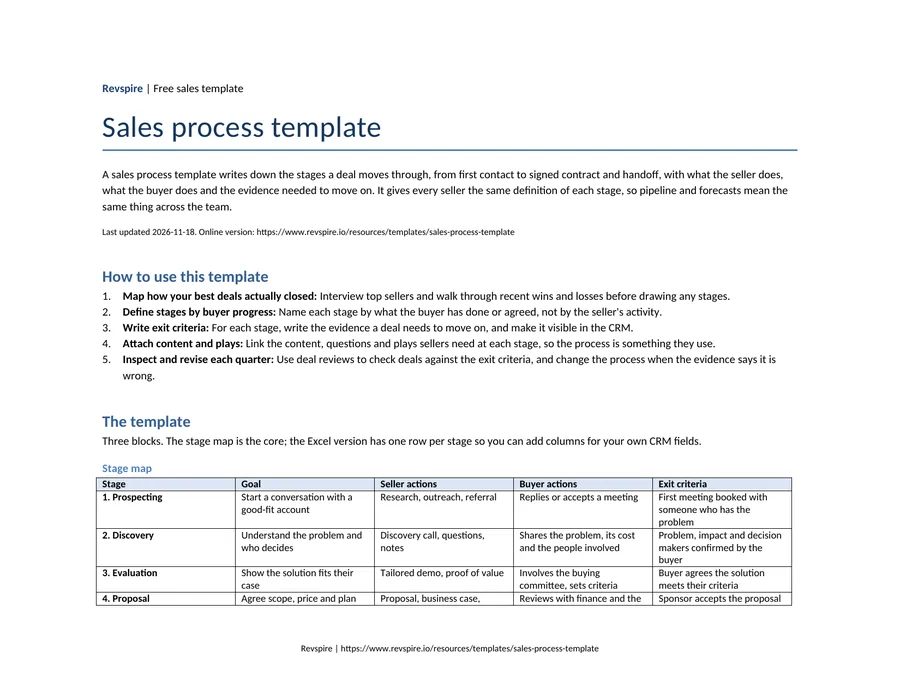
Three blocks. The stage map is the core; the Excel version has one row per stage so you can add columns for your own CRM fields.
Stage map
| Stage | Goal | Seller actions | Buyer actions | Exit criteria |
|---|---|---|---|---|
| 1. Prospecting | Start a conversation with a good-fit account | Research, outreach, referral | Replies or accepts a meeting | First meeting booked with someone who has the problem |
| 2. Discovery | Understand the problem and who decides | Discovery call, questions, notes | Shares the problem, its cost and the people involved | Problem, impact and decision makers confirmed by the buyer |
| 3. Evaluation | Show the solution fits their case | Tailored demo, proof of value | Involves the buying committee, sets criteria | Buyer agrees the solution meets their criteria |
| 4. Proposal | Agree scope, price and plan | Proposal, business case, mutual action plan | Reviews with finance and the sponsor | Sponsor accepts the proposal in principle; plan agreed |
| 5. Negotiation | Reach signature | Commercial and legal terms, security review | Procurement, legal and security sign-off | Final terms agreed; signature date confirmed |
| 6. Closed won | Sign and hand off | Order form, handoff to customer success | Signs; names the onboarding owner | Signed contract and handoff meeting held |
Content and CRM fields by stage
| Stage | Content to use | CRM fields to complete |
|---|---|---|
| Prospecting | ||
| Discovery | ||
| Evaluation | ||
| Proposal | ||
| Negotiation | ||
| Closed won |
Roles
| Role | Stages they own or join | Hands off to |
|---|---|---|
| SDR or BDR | ||
| Account executive | ||
| Sales engineer or presales | ||
| Sales manager | ||
| Customer success manager |
Prefer a file? We email the Word, Excel and PDF versions to your work address, free.
Email me the filesA worked example
Example: fictional company
Rewriting exit criteria so a stage measured the buyer, not the seller.
Ferncastle Analytics had a large number of deals sitting in its evaluation stage that rarely closed. The sales leader rewrote the exit criteria for discovery and evaluation as buyer actions, then moved every open deal back to the stage its evidence supported.
Ferncastle Analytics: exit criteria before and after
| Stage | Old exit criterion | New exit criterion | Evidence the seller records |
|---|---|---|---|
| Discovery | Discovery call held | Buyer has described the problem, its cost and who decides | Call notes with the buyer's words and named decision makers |
| Evaluation | Demo delivered | Buyer's evaluation criteria written down and agreed as met | Criteria list sent to and confirmed by the champion |
| Proposal | Proposal sent | Sponsor has reviewed the proposal and agreed the plan | Mutual action plan with the sponsor's dates |
Example: fictional company. Ferncastle Analytics, Harborview Metrics, Marlow & Finch Logistics and every person named in this example are invented for illustration. Any resemblance to real companies or people is coincidental.
How to document a sales process that sellers follow
Map how your best deals actually closed
Interview top sellers and walk through recent wins and losses before drawing any stages.
Define stages by buyer progress
Name each stage by what the buyer has done or agreed, not by the seller's activity.
Write exit criteria
For each stage, write the evidence a deal needs to move on, and make it visible in the CRM.
Attach content and plays
Link the content, questions and plays sellers need at each stage, so the process is something they use.
Inspect and revise each quarter
Use deal reviews to check deals against the exit criteria, and change the process when the evidence says it is wrong.
Where sales processes go wrong
Seller-activity stages
Stages like "demo done" fill the pipeline with deals the buyer has not progressed.
Too many stages
Ten stages with fine distinctions are ignored; five to seven is easier to use.
No exit criteria
Without evidence for each stage, the forecast depends on optimism.
A document nobody opens
A process that is not in the CRM and the playbook stays a slide from the kickoff meeting.
One process for every motion
Small inbound deals and large enterprise deals often need different variants.
Where Revspire fits
A sales process becomes useful when each stage tells the seller what to do next. Revspire's AI Playbook Engine creates playbooks with AI grounded in your approved revenue knowledge, so the plays, questions, objection handling and messaging for each stage sit alongside the process sellers already follow, with drafts routed for approval and usage analytics that show which plays get used.
Revspire digital sales rooms support the later stages with the mutual action plan and stakeholder map in one room shared with the buyer, so the exit criteria for proposal and negotiation are visible to both sides.
Sales process template FAQs
What are the stages of a B2B sales process?
Most B2B teams use five to seven stages: prospecting, discovery, evaluation, proposal, negotiation and closed, sometimes with qualification separated from discovery and a handoff stage after signature.
What are exit criteria in a sales process?
The evidence a deal needs before it moves to the next stage, written as something the buyer has done or confirmed, such as naming the decision makers or agreeing the evaluation criteria.
What is the difference between a sales process and a sales playbook?
The sales process defines the stages and what proves each one. The playbook tells sellers what to do inside each stage: the plays, questions, talk tracks and content.
How often should a sales process be updated?
Review it each quarter against deal reviews and win-loss findings, and change it when deals keep stalling at the same stage or the exit criteria no longer predict a close.
Related templates and reading
- Free templateSales call scorecard templateA weighted 1-5 rubric for scoring recorded calls on agenda, discovery, value messaging, objections, next steps and talk/listen balance.
- Free templateSDR onboarding plan templateA week-by-week ramp plan for SDRs and BDRs: ICP, messaging, sequences, cold calls, qualification and the first qualified meeting, with gates.
- Free template30-60-90 day sales onboarding plan templateA 30-60-90 day sales onboarding plan for new account executives: goals, activities, milestones and manager checkpoints for each phase, ending in a first closed-won deal.
- Free templateSales coaching templateOne skill per rep per cycle, the evidence behind it and the date it is reviewed, so coaching survives more than one conversation.
- Template: the plays that hang on these stagesSales playbook template
- Template: running the discovery stageDiscovery call template
- Template: inspecting deals against exit criteriaDeal review template
- Guide: tools that put the process in front of sellersBest sales playbook software