Revspire blog
Sales Coaching Templates: Evidence Log, Feedback Form, and Action Tracker
Copy an evidence log, feedback form, action tracker, and review record that keep sales coaching grounded, specific, traceable, and ready for human review.
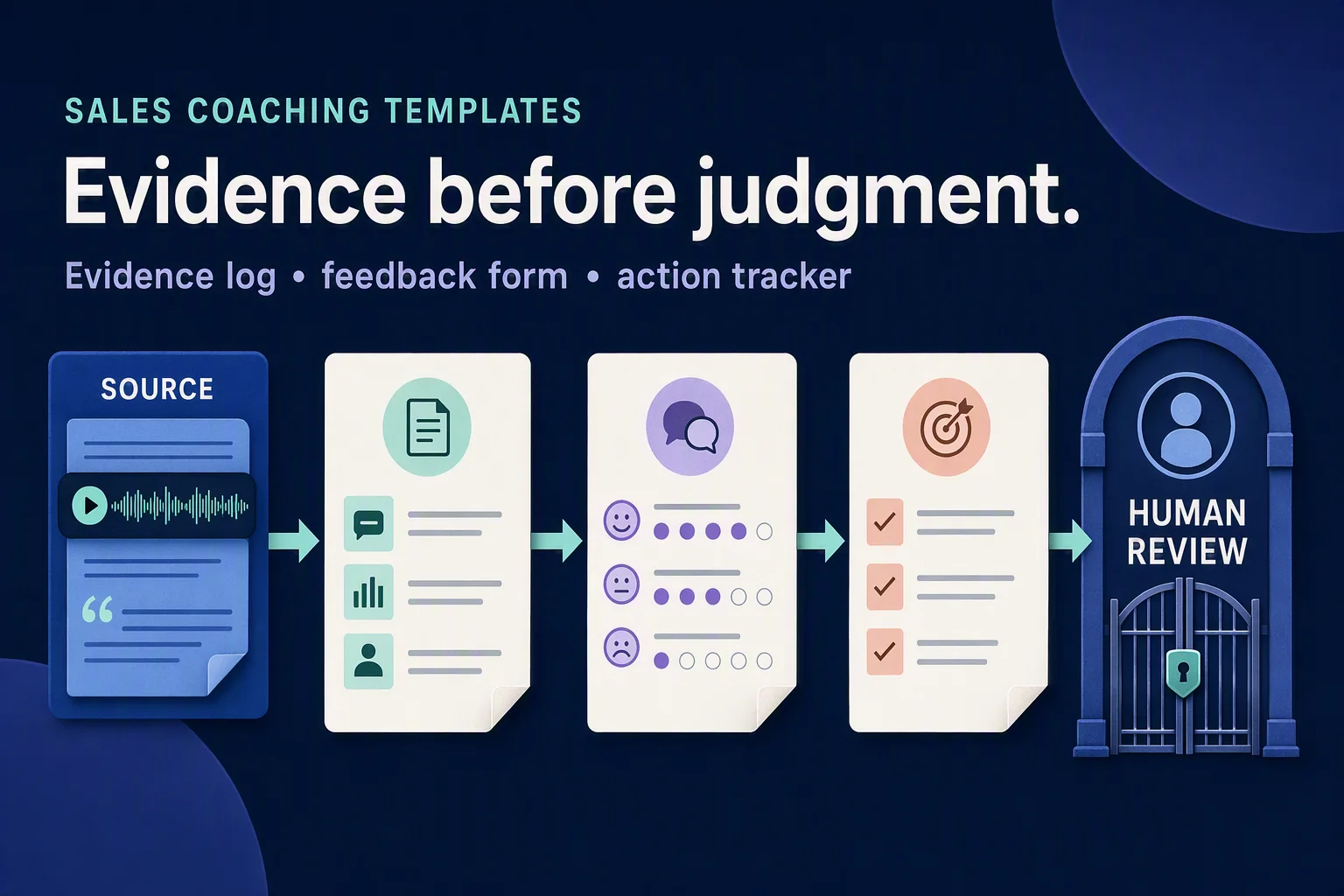
A sales coaching template should preserve one decision from evidence to follow-through
A useful sales coaching template is not a page of generic prompts. It is a connected record of what happened, what feedback was given, what the seller agreed to try, and what a reviewer confirmed. Coaching notes lose meaning when an observation moves into a message, an action moves into a task list, and the original evidence disappears.
The practical answer is a small set of reusable artifacts: an evidence log, a feedback form, an action tracker, and a review record. The log protects facts from hindsight, the form creates a bounded recommendation, the tracker makes ownership explicit, and the review record preserves corrections and closure.
This guide provides copyable fields and completed examples. It does not prescribe a coaching philosophy, operating cadence, measurement system, or technology-selection process. Those decisions belong in separate resources such as Revspire’s guide to sales coaching frameworks and its explanation of sales coaching ROI. Here, the narrower goal is to make every coaching handoff clear enough that another authorized person can understand it without reconstructing the conversation.
Three linked records prevent evidence, feedback, and action from drifting apart
The three core forms should share a coaching record ID. That simple key lets a manager move from a source moment to a feedback statement and then to a next action without merging all three into an unreadable document. NIST’s AI Risk Management Framework treats documentation, transparency, accountability, and defined human roles as parts of trustworthy AI risk management. [1] The same discipline is useful even when a person, not AI, drafts the feedback.
Artifact
Question it answers
Required handoff
Keep out
Evidence log
What was directly observed, where, and under what context?
Evidence ID and source locator move into the feedback form.
Personality judgments, causes, ratings, and proposed consequences.
Feedback form
What may the evidence mean, and which behavior should change?
One agreed action and its intended use case move into the tracker.
Uncited claims, several competing priorities, and hidden AI inference.
Action tracker
Who will try what, in which opportunity, and what closes the action?
Application evidence and status move into the review record.
Broad goals, permanent performance labels, and unrelated tasks.
Review record
Was the record accepted, corrected, deferred, or closed?
Decision, rationale, owner, and retained version return to the shared record.
Silent edits and approvals without evidence.
Use the same neutral identifier everywhere, such as SC-2026-014 . Avoid putting a seller’s name, account name, or performance judgment in the identifier. The ID should connect authorized records, not expose sensitive context when it appears in a notification or export.
The evidence log should describe what happened before anyone judges it
Shared identifiers preserve the path from a source moment to reviewed action without collapsing evidence and judgment into one field.
The evidence log records a bounded moment a reviewer can locate: an exact call turn, practice response, submitted email, or documented deal update. It should say what was present, not why the seller behaved that way. “Moved to pricing after the buyer named two implementation concerns” is observable; “did not care about risk” is an inference.
Record only the minimum context needed for the coaching use. Article 5 of the EU General Data Protection Regulation establishes principles including data minimization, accuracy, purpose limitation, and storage limitation. [2] Organizations should apply their own legal, privacy, access, and retention requirements, especially when a source includes customer or employee information.
Field
Copyable entry prompt
Example
Coaching record ID
[Neutral unique ID]
SC-2026-014
Source type
[Call / practice / written artifact / deal record / direct observation]
Recorded discovery call
Source locator
[Authorized link, file, record, timestamp, or section]
Call record C-482, 14:08 to 16:31
Relevant context
[Role, stated objective, approved scenario, or known constraint]
Technical buyer evaluating implementation risk
Observed evidence
[Exact words, actions, sequence, or documented change]
Buyer named data migration and access-control concerns; seller moved to pricing without confirming either concern.
Evidence limits
[Missing audio, disputed speaker, stale field, incomplete artifact, or none]
Two minutes of audio before the excerpt were unavailable.
Captured by
[Person or approved system, plus date]
Manager review, 25 Sep 2026
Access and retention note
[Policy reference or approved location]
Team coaching workspace; standard call-record retention applies.
For call-based entries, use the existing conversation intelligence guide for capture context and the call coaching and review guide for the wider review process. The template itself should retain only the precise source locator and necessary context.
The feedback form should make interpretation visible and the request specific
Feedback becomes contestable when the form separates observation, interpretation, and recommendation. The source can remain intact when a manager changes the interpretation, so reasoning can be corrected without rewriting history. The UK Information Commissioner’s Office advises that explanations of AI-assisted decisions should be meaningful to the affected person and appropriate to the context. [3] A coaching record should therefore show the evidence, limits, and role of human judgment.
Field
Copyable entry prompt
Example
Coaching record ID
[Match the evidence log]
SC-2026-014
Evidence reference
[Evidence ID plus source locator]
Evidence entry 01; call 14:08 to 16:31
Observation
[One factual sentence copied or summarized from the log]
Two named risks were not confirmed before the conversation moved to price.
Interpretation
[Why this may matter; label uncertainty]
The buyer may not yet know how either risk will be resolved.
Requested behavior
[One observable behavior, stated as a verb]
Restate both risks and ask which one could block approval.
Example language
[Optional phrase, question, or model response]
“You mentioned migration and access control. Which is most likely to delay approval?”
Confidence and limits
[High / medium / low, with reason]
Medium; opening context is missing.
Seller response
[Accept / add context / dispute / request review, plus note]
Add context: access-control owner joins the next meeting.
Reviewer
[Named accountable person or role]
Frontline manager
Keep the requested behavior small enough to rehearse and recognize. Do not add a second issue because the form has space. If feedback depends on approved messaging, cite the exact source version; Revspire’s guide to turning sales playbooks into practice and coaching explains the adjacent content workflow. Broader decisions about the division of work between AI and managers belong in the AI sales coaching guide.
The action tracker should convert feedback into one observable next move
“Improve discovery” is not a trackable action. A usable record names the behavior, the situation in which it will be tried, the evidence that will show an attempt, and who will review it. Closure means the agreed action was tried and reviewed; it does not mean the seller has permanently mastered a skill or that one commercial outcome proves causation.
Field
Copyable entry prompt
Example
Coaching record ID
[Match evidence and feedback records]
SC-2026-014
Agreed action
[One behavior beginning with a verb]
Confirm and prioritize named implementation risks before presenting price.
Application opportunity
[Specific suitable call, practice, draft, or review]
Next technical evaluation call for opportunity O-317
Owner
[Person performing the action]
Seller
Support artifact
[Approved example, prompt, or practice link, if needed]
Risk-confirmation question card, version 3
Completion evidence
[What the reviewer can inspect]
Timestamp showing both risks restated and one prioritized
Reviewer and review point
[Authorized reviewer and event or date]
Manager; after the identified call
Status
[Planned / attempted / blocked / reviewed / closed]
Planned
Outcome note
[Observed result, uncertainty, and follow-up record ID]
[Complete after review]
If the action will be rehearsed first, choose a suitable example from the AI sales role-play scenario library. If it is part of a formal readiness decision, move that decision into a separate sales readiness scorecard. The coaching tracker should not quietly become a certification record.
A review record should preserve corrections instead of silently replacing them
Evidence may be incomplete, feedback may be disputed, and an application opportunity may disappear. The workflow needs valid outcomes for each case. NIST’s AI RMF Playbook organizes suggested actions around Govern, Map, Measure, and Manage and repeatedly emphasizes documentation, responsibility, monitoring, and feedback from affected people. [4] A short review record gives those responsibilities a concrete home.
Field
Copyable entry prompt
Allowed example
Coaching record ID
[Shared ID]
SC-2026-014
Item reviewed
[Evidence / feedback / action / completion evidence]
Feedback interpretation
Review reason
[Normal review / seller context / source error / AI uncertainty / policy question]
Seller added missing meeting context
Decision
[Accept / correct / defer / dismiss / escalate / close]
Correct
Rationale
[Evidence-based explanation]
Risk owner was scheduled for the next meeting; request remains useful but urgency was overstated.
Authorized owner
[Person or role making the decision]
Frontline manager
Version change
[Old version, new version, editor, date]
Feedback v1 retained; v2 approved 25 Sep 2026
Next state
[Return for context / issue action / await evidence / close]
Issue corrected action
Never edit the original evidence to make later feedback appear correct. Append a correction, identify who made it, and retain the relevant earlier version under the organization’s policy. When the coaching moment concerns an active opportunity, the deal-level coaching guide provides the surrounding commercial context; the review record here remains limited to the coaching artifact.
AI assistance should draft fields without becoming the invisible approver
AI can locate a candidate passage, extract exact words, suggest a neutral observation, draft example language, or flag a missing field. Every generated entry should point to the source, identify AI assistance, show uncertainty, and name the human responsible for acceptance. A confident paragraph without provenance is not a completed form.
Restrict generation field by field. The system may propose an observation from a cited excerpt, but it should not invent buyer intent, diagnose personality, assign employment consequences, or mark an action complete. Uncertain identity, context, or source quality should produce “review required” or “insufficient evidence.” A manager must be able to reject the draft while retaining the original suggestion.
Use the rep-performance coaching mistakes guide to identify common human failure patterns that forms alone cannot solve. Templates improve the record; they do not guarantee sound judgment.
Copyable forms should remain understandable outside their original tool
A template is reusable only if it survives copying into a document, spreadsheet, approved knowledge base, or CRM note. Keep one concept per field, use plain labels, write dates unambiguously, and avoid instructions that depend only on color. Put the field name in every exported row and retain the coaching record ID when views are filtered.
Check
Pass condition
Headers
Every column has a visible header, and row labels remain attached when copied.
Reading order
The record makes sense from top to bottom without a drag-and-drop layout.
Status
Status is written in text, not communicated by color or an icon alone.
Links
Anchor text identifies the source or destination; raw links are retained in exports where needed.
Required fields
Required and optional fields are explicitly labeled rather than inferred from styling.
Sensitive data
Instructions state what must not be copied and where the approved record belongs.
WCAG 2.2 requires information, structure, and relationships conveyed through presentation to be programmatically determinable or available in text. [5] The captions and scoped headers in these tables support that principle. When supporting language comes from controlled content, apply the version and ownership practices in the sales content governance framework.
One completed example should prove that the records form a traceable chain
Before distributing a blank template, complete it with a realistic, sanitized example. Reviewers can then see the intended level of detail, the boundary between fact and inference, and how an action closes. The example below compresses the earlier entries without replacing their full records.
Record stage
Completed entry
Reviewer question
Evidence
At 14:08 and 16:31 the buyer named migration and access-control risks; the seller moved to price without confirming either. Earlier audio is incomplete.
Can an authorized reviewer locate the moment and see its limit?
Feedback
The buyer may lack a clear resolution path. Restate both risks and ask which could block approval. Confidence: medium.
Are observation, interpretation, and request distinct?
Action
Use the risk-confirmation question on opportunity O-317; completion evidence is a cited call moment.
Is there one suitable opportunity and observable behavior?
Review
Seller added that the risk owner would attend next. Manager reduced urgency, retained the request, and approved feedback v2.
Was the correction appended with owner and rationale?
Closure
On the next call, the seller restated both risks and the buyer prioritized migration. Action closed; any further coaching receives a new ID.
Does closure describe evidence rather than a permanent rating?
A new issue should receive a new coaching record ID even when it concerns the same seller or opportunity. That boundary prevents one record from accumulating unrelated judgments and makes each action understandable on its own.
A short handoff sequence keeps every artifact accountable
- Capture: create the evidence log, identify the source, and record known limitations.
- Draft: complete the feedback form with observation, interpretation, one requested behavior, and any AI-assistance disclosure.
- Respond: let the seller accept, add context, dispute, or request review without changing the source entry.
- Assign: move only the agreed behavior and application opportunity into the action tracker.
- Review: record the decision, rationale, owner, and version; route policy or evidence issues to the appropriate authorized owner.
- Close: cite the completion evidence, state what was observed, and open a new record for a materially different issue.
This is a record flow, not a prescribed meeting schedule or coaching program. Teams can fit it into their own approved process while preserving the same evidence-to-action handoffs.
Reusable sales coaching templates should make good judgment inspectable
The best sales coaching template is modest: it does not claim to diagnose a seller, prove business impact, or automate accountability. It preserves a specific source, a transparent interpretation, one agreed action, and a review decision. Shared identifiers and explicit version history keep those artifacts connected while still allowing people to correct them.
Copy the four templates into an approved workspace and complete one sanitized example. Remove fields without a clear user, add only fields required by policy, and test whether an authorized reviewer can follow the record without explanation. If the chain remains clear after export, correction, and closure, the template is doing its job.
Sources
- National Institute of Standards and Technology, “AI Risk Management Framework”. NIST’s voluntary framework describes characteristics and risk-management functions for trustworthy and responsible AI.
- European Union, “Regulation (EU) 2016/679 (General Data Protection Regulation)”. Article 5 states principles including purpose limitation, data minimization, accuracy, storage limitation, integrity, and accountability.
- UK Information Commissioner’s Office, “Explaining Decisions Made With AI”. The guidance addresses meaningful, context-appropriate explanations for people affected by AI-assisted decisions.
- National Institute of Standards and Technology, “AI RMF Playbook”. The playbook supplies suggested actions across the Govern, Map, Measure, and Manage functions.
- World Wide Web Consortium, “Web Content Accessibility Guidelines (WCAG) 2.2”. The standard defines testable accessibility requirements, including programmatically determinable information and relationships.
Frequently asked questions
What should a sales coaching template include?
It should include a neutral record ID, source locator, observable evidence, evidence limits, a separate interpretation, one requested behavior, an application opportunity, completion evidence, owner, status, and review decision. Access, retention, and version notes should follow the organization’s policy.
Can the evidence log, feedback form, and action tracker be one document?
Yes, if each remains a clearly labeled section and corrections do not overwrite the original evidence. Separate tabs or records are often easier to permission and export. In either design, use one shared coaching record ID and keep evidence, interpretation, action, and review distinct.
Which fields can AI complete safely?
AI can assist with source location, exact extraction, neutral summaries, example wording, and missing-field checks when its output is reviewable and traceable. A human should approve interpretations and actions. AI should not infer protected traits, invent intent, assign employment consequences, or close an action without inspectable evidence.
What should stay out of a sales coaching record?
Exclude unnecessary personal or customer data, unsupported motive or personality claims, unrelated performance history, hidden ratings, and information the intended users are not authorized to access. Do not use a developmental coaching form as a substitute for a governed certification or employment process.
How do I make a coaching template easy to copy?
Use plain field labels, scoped table headers, text-based statuses, unambiguous dates, neutral IDs, and one concept per field. Include a completed sanitized example, preserve source links in exports, and verify that the record remains understandable when pasted into the team’s approved document or spreadsheet tool.
Want to see evidence-linked coaching records in practice? Request a Revspire demo with one sanitized coaching moment you want to turn into a clear next action.