What a go-to-market plan is for
A go-to-market plan turns a product decision into a commercial one. It names the segments to win first, the message for each, the price, the channels that will carry it and the date, and it puts an owner next to every part. Product marketing usually writes it, with sales, enablement and product as co-owners.
Most templates stop at launch day: the announcement, the campaign, the web page. The part that decides whether a launch produces revenue is what happens in sales conversations afterwards, so this template includes a sales readiness checklist, with a ready-by date for the pitch, the battlecard, the demo, pricing guidance and certification.
It also asks for a launch tier. Not every release deserves a full campaign, and deciding the tier first keeps a small feature from consuming the effort a new product needs.
When to use the template
- For a new product or a move into a new market.
- For a major feature that changes how you sell.
- For a pricing or packaging change.
- When repositioning against a new competitor.
- At annual planning, as the plan for each product line.
Go-to-market strategy, go-to-market plan or launch plan
Three documents that are often given the same name.
| Document | Horizon | What it answers |
|---|---|---|
| Go-to-market strategy | One to three years | Which markets, which motions and why |
| Go-to-market plan | Two to four quarters | Who does what, by when, for this product or release |
| Launch plan | Six to twelve weeks | The tasks and dates around launch day |
The template
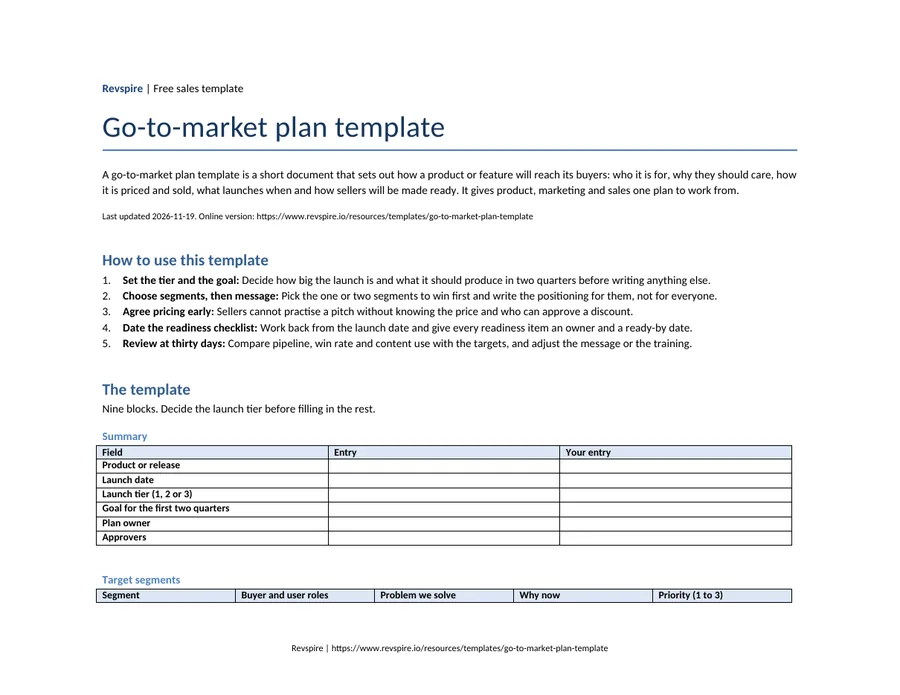
Nine blocks. Decide the launch tier before filling in the rest.
Summary
| Field | Entry |
|---|---|
| Product or release | |
| Launch date | |
| Launch tier (1, 2 or 3) | |
| Goal for the first two quarters | |
| Plan owner | |
| Approvers |
Target segments
| Segment | Buyer and user roles | Problem we solve | Why now | Priority (1 to 3) |
|---|---|---|---|---|
Positioning and messaging
| Field | Entry |
|---|---|
| For (target buyer) | |
| Who needs (the problem) | |
| Our product is (category) | |
| That (main benefit) | |
| Unlike (the alternative) | |
| Three proof points |
Pricing and packaging
| Package | Who it is for | Pricing model | What is included |
|---|---|---|---|
Channels and motions
| Channel | Role in this launch | Owner | Target |
|---|---|---|---|
| Direct sales | |||
| Partners | |||
| Existing customers | |||
| Website and content | |||
| Events and webinars |
Launch tiers
| Tier | What qualifies | What it gets |
|---|---|---|
| Tier 1 | A new product or a new market | Full campaign, seller certification, customer and analyst outreach |
| Tier 2 | A major feature | Announcement, an enablement session and updated content |
| Tier 3 | An improvement | A release note and a short update for sellers |
Sales readiness checklist
| Item | Owner | Ready by | Done |
|---|---|---|---|
| Pitch deck and one-pager | |||
| Battlecard against the main alternative | |||
| Demo script and environment | |||
| Pricing guidance and approval rules | |||
| Objection responses | |||
| Training session and certification | |||
| Customer-facing questions and answers |
Timeline
| Milestone | Date | Owner |
|---|---|---|
| Positioning approved | ||
| Pricing approved | ||
| Content ready | ||
| Sellers certified | ||
| Internal launch | ||
| Public launch | ||
| 30-day review |
Measures
| Measure | Target | Reviewed |
|---|---|---|
| Pipeline created | ||
| Win rate on launch deals | ||
| Sellers certified before launch | ||
| Launch content used in deals | ||
| Customer adoption |
Prefer a file? We email the Word, Excel and PDF versions to your work address, free.
Email me the filesA worked example
Example: fictional company
A tier 1 launch with sales readiness dated before the public announcement.
Ferncastle Analytics was launching a forecasting module to its existing mid-market customers and to new enterprise buyers. Product marketing classed it as tier 1, set the internal launch two weeks before the public one, and made seller certification the gate between them: no public announcement until most account executives had passed the pitch.
Ferncastle Analytics: sales readiness before launch
| Item | Owner | Ready by |
|---|---|---|
| Pitch deck and one-pager | Product marketing | Six weeks before public launch |
| Battlecard against the main alternative | Product marketing | Five weeks before |
| Demo script and environment | Sales engineering | Four weeks before |
| Pricing guidance and approval rules | Revenue operations | Four weeks before |
| Training session and certification | Sales enablement | Internal launch, two weeks before |
| Public launch | Marketing | Only after certification gate is met |
Example: fictional company. Ferncastle Analytics, Harborview Metrics, Marlow & Finch Logistics and every person named in this example are invented for illustration. Any resemblance to real companies or people is coincidental.
How to build the plan
Set the tier and the goal
Decide how big the launch is and what it should produce in two quarters before writing anything else.
Choose segments, then message
Pick the one or two segments to win first and write the positioning for them, not for everyone.
Agree pricing early
Sellers cannot practise a pitch without knowing the price and who can approve a discount.
Date the readiness checklist
Work back from the launch date and give every readiness item an owner and a ready-by date.
Review at thirty days
Compare pipeline, win rate and content use with the targets, and adjust the message or the training.
Where go-to-market plans go wrong
A plan that ends on launch day
Revenue arrives in the quarters after the announcement. Plan for them.
Every release as tier 1
Treating each feature as a major launch exhausts sellers' attention.
Sales hears last
If sellers learn about the launch from the press release, the first buyer questions go unanswered.
Messaging for everyone
A message written for all segments persuades none of them.
No measure after launch
Without targets for pipeline and win rate, nobody can say whether the plan worked.
Looking at tools for this job? We compare the options in our guide to revenue enablement platforms.
Where Revspire fits
The readiness checklist is where a go-to-market plan most often slips, because the pitch, the battlecard and the training are owned by different teams. Revspire's AI Playbook Engine builds messaging and positioning playbooks with AI grounded in your approved revenue knowledge, routes drafts for approval and publishes role-specific messaging across seller workflows.
With AI Sales Training & Coaching, sellers practise the new pitch in AI role-play by video or a live voice call and certify before launch, and Revspire Content Hub keeps the launch deck and one-pagers in one governed repository, with usage visible by asset for the thirty-day review.
Go-to-market plan template FAQs
What should a go-to-market plan include?
Target segments, positioning and messaging, pricing and packaging, channels, the launch tier, a sales readiness checklist, a timeline and measures for the first two quarters.
Who owns the go-to-market plan?
Product marketing usually owns the document. Sales, enablement, product and revenue operations each own parts of it and should approve it.
What is the difference between a go-to-market strategy and a plan?
The strategy sets which markets and motions the company will pursue over several years. The plan says who does what, by when, for one product or release.
What is a launch tier?
A way to size a launch. Tier 1 is a new product or market and gets a full campaign and certification; tier 3 is an improvement and gets a release note and a short seller update.
How does sales enablement fit into a go-to-market plan?
Enablement owns the readiness checklist: the training, certification and content sellers need before launch day, and the measures that show they are using it afterwards.
Related templates and reading
- Free templateSales playbook templateA B2B sales playbook outline: ICP, personas, stages with exit criteria, discovery questions, plays for common situations and objection responses.
- Free templateSales content audit templateOne row per asset, with the usage evidence and the verdict beside it: retire, fix or keep, each with an owner and a date.
- Free templateSales one-pager templateA one-page sales sheet in eight blocks, from headline to call to action, with a proof register and product, executive, competitive and industry variants.
- Free templateTalk track templateOpener, discovery questions, value points, objection responses and the close for one type of sales call.
- Template: the positioning block in fullMessaging framework template
- Template: the card sellers need at launchSales battlecard template
- Blog: getting sellers ready for a launchProduct launch sales readiness
- Glossary: the term definedGo-to-market