What a partner programme document is for
A partner programme is the structure behind a channel: who can partner, what they must do and what they receive in return. Written down, it becomes the reference for recruiting partners, approving tier changes and answering the question every partner asks: what do I get if I do more?
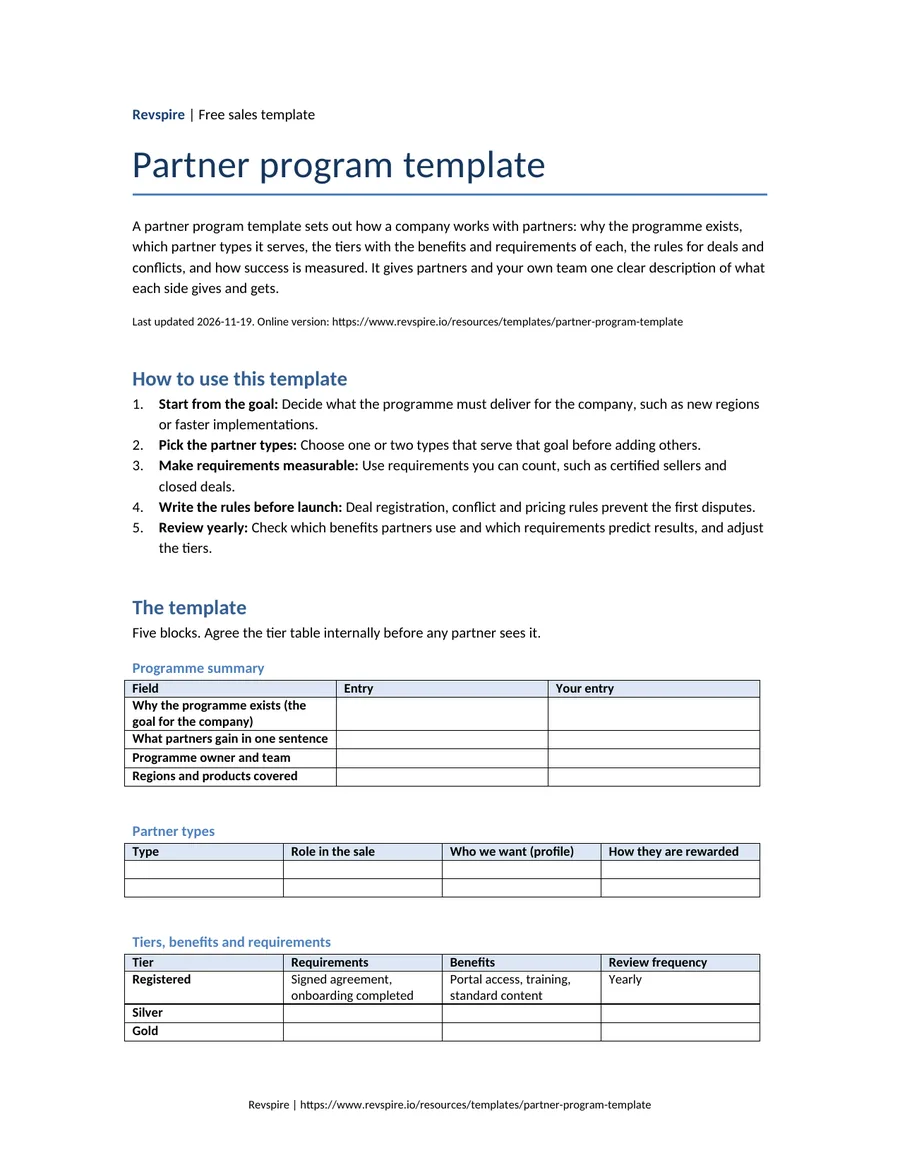
The template has five parts: a programme summary, partner types, a tier table with benefits and requirements, rules of engagement, and measures. The tier table is the core. Benefits should rise with requirements, and every requirement should be something you can measure.
Start simple. Many programmes launch with two tiers and one or two partner types, then add tiers once enough partners are active to show what the top performers do differently.
When to use the template
- When launching a first partner programme.
- When adding a new partner type, such as agencies or technology partners.
- When partners ask what it takes to move up a tier.
- Before choosing a partner portal or PRM, to know what it must support.
- At the annual programme review.
Common partner types
Most programmes serve one or more of these, with different benefits for each.
| Partner type | What they do | How they are usually rewarded |
|---|---|---|
| Referral partner | Introduces leads; you run the sale | Referral fee or commission |
| Reseller | Sells and often contracts with the customer | Discount or margin |
| Agency or services partner | Implements, customises or advises | Services revenue, referrals, co-marketing |
| Technology partner | Integrates their product with yours | Joint listings, co-selling, marketplace exposure |
The template
Five blocks. Agree the tier table internally before any partner sees it.
Programme summary
| Field | Entry |
|---|---|
| Why the programme exists (the goal for the company) | |
| What partners gain in one sentence | |
| Programme owner and team | |
| Regions and products covered |
Partner types
| Type | Role in the sale | Who we want (profile) | How they are rewarded |
|---|---|---|---|
Tiers, benefits and requirements
| Tier | Requirements | Benefits | Review frequency |
|---|---|---|---|
| Registered | Signed agreement, onboarding completed | Portal access, training, standard content | Yearly |
| Silver | |||
| Gold |
Rules of engagement
| Topic | Rule |
|---|---|
| Deal registration and protection period | |
| Conflicts between partners or with direct sales | |
| Pricing and discounts | |
| Use of brand and co-marketing |
Measures
| Measure | Target | Owner |
|---|---|---|
| Active partners (at least one opportunity a quarter) | ||
| Partner-sourced pipeline | ||
| Partners certified | ||
| Time from signature to first deal |
Prefer a file? We email the Word, Excel and PDF versions to your work address, free.
Email me the filesA worked example
Example: fictional company
A two-tier launch with measurable requirements.
Ferncastle Analytics launched a reseller programme with Harborview Metrics as one of its first partners. It kept two paid tiers above a registered level, and tied every requirement to something its CRM and training platform could count.
Ferncastle Analytics: reseller tiers
| Tier | Requirements | Benefits |
|---|---|---|
| Registered | Signed agreement; onboarding checklist complete | Portal, training, standard discount |
| Silver | Two certified sellers; two closed deals a year | Higher discount, co-branded content, quarterly review |
| Gold | Five certified sellers; six closed deals a year; one joint case study | Highest discount, joint events, named partner manager, leads from Ferncastle |
Example: fictional company. Ferncastle Analytics, Harborview Metrics, Marlow & Finch Logistics and every person named in this example are invented for illustration. Any resemblance to real companies or people is coincidental.
How to design a partner programme
Start from the goal
Decide what the programme must deliver for the company, such as new regions or faster implementations.
Pick the partner types
Choose one or two types that serve that goal before adding others.
Make requirements measurable
Use requirements you can count, such as certified sellers and closed deals.
Write the rules before launch
Deal registration, conflict and pricing rules prevent the first disputes.
Review yearly
Check which benefits partners use and which requirements predict results, and adjust the tiers.
Where partner programmes go wrong
Too many tiers at launch
Four tiers with five partners confuses everyone.
Benefits partners do not value
Ask partners what they need before designing benefits.
Requirements nobody tracks
A requirement you cannot measure will not be enforced.
No rules of engagement
Unclear deal registration and conflict rules cost partner trust quickly.
Recruiting without enabling
Partners who are signed but not trained rarely sell.
Looking at tools for this job? We compare the options in our guide to partner portal software.
Where Revspire fits, and where it does not
Revspire is not a PRM: deal registration, MDF and payouts are not among its listed capabilities, so programmes that need them run them in a PRM or the CRM. Our guide to the best PRM software compares the options.
The Revspire Partner Portal covers the enablement side of the programme: training tracks, role-plays and certifications for partner sellers, alongside the governed content, playbooks and deal rooms each tier should see, with unlimited user licenses.
Partner program template FAQs
What should a partner programme include?
A programme summary, the partner types you serve, tiers with benefits and requirements, rules of engagement for deals and conflicts, and measures such as active partners and partner-sourced pipeline.
How many tiers should a partner programme have?
Two or three at launch is usually enough. Add tiers once you have enough active partners to see what distinguishes the best ones.
What benefits do partners value most?
It varies by partner type, but margin or fees, leads, training and certification, co-marketing and a named contact are common. Ask your partners before designing benefits.
Do I need a PRM to run a partner programme?
Not at first. Small programmes run on the CRM and a shared space for content and training. A PRM helps once deal registration, payouts and many partners make manual tracking hard.
Related templates and reading
- Free templateSales call scorecard templateA weighted 1-5 rubric for scoring recorded calls on agenda, discovery, value messaging, objections, next steps and talk/listen balance.
- Free templateSDR onboarding plan templateA week-by-week ramp plan for SDRs and BDRs: ICP, messaging, sequences, cold calls, qualification and the first qualified meeting, with gates.
- Free template30-60-90 day sales onboarding plan templateA 30-60-90 day sales onboarding plan for new account executives: goals, activities, milestones and manager checkpoints for each phase, ending in a first closed-won deal.
- Free templateSales coaching templateOne skill per rep per cycle, the evidence behind it and the date it is reviewed, so coaching survives more than one conversation.
- Template: each new partner's first ninety daysPartner onboarding checklist
- Template: training and content for partnersPartner enablement plan template
- Guide: tools for deal registration and payoutsBest PRM software
- Template: choosing a partner portalPartner portal requirements checklist