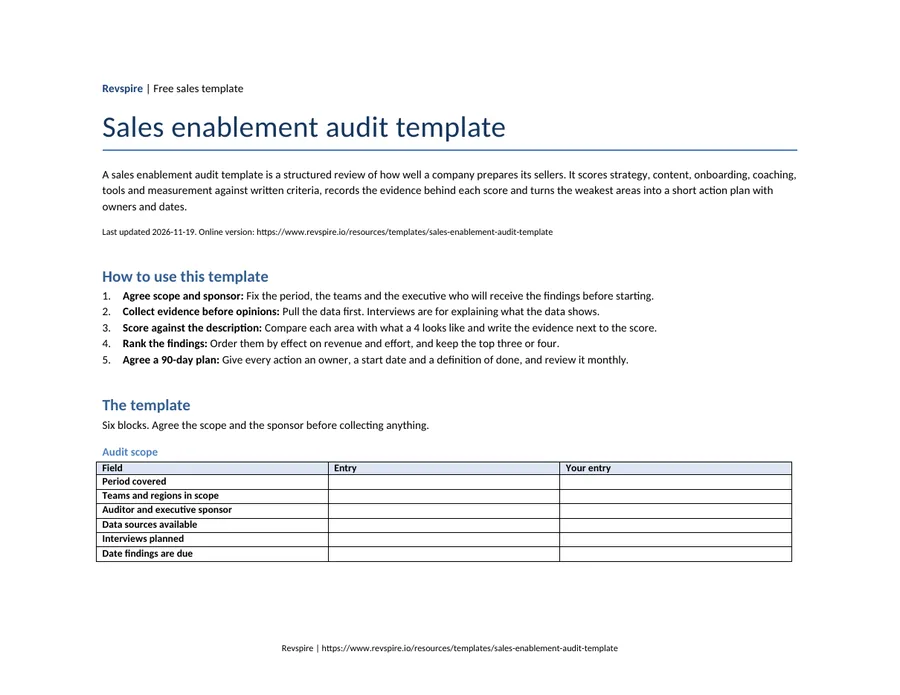
What a sales enablement audit is for
An audit answers a question that opinion cannot: how well does enablement work here, and how do we know? It replaces "sellers say they cannot find anything" with a score, the evidence for it and a finding that someone can act on.
The template covers six areas. Each is scored from 1 to 4 against a written description of what a 4 looks like, and no score is accepted without evidence: a report from the CRM, usage data from the content library, training records, call recordings or notes, a survey and a small number of interviews.
The output is not the scorecard. It is a ranked list of findings and a 90-day plan for the top three or four, agreed with the sales leader. An audit that ends in a slide deck and no owners has cost a month and changed nothing.
When to run an audit
- Once a year, before planning and budgets.
- When a new enablement or sales leader arrives.
- Before replacing or buying an enablement platform.
- After a merger, when two ways of working meet.
- When win rate or ramp time moves and nobody can say why.
Enablement audit, content audit or readiness assessment
Three reviews with different scopes.
| Review | Scope | Typical output |
|---|---|---|
| Sales enablement audit | The whole function across six areas | Scores with evidence, ranked findings and a 90-day plan |
| Sales content audit | Every asset in the library | Keep, update, merge or retire for each asset |
| Readiness assessment | Individual sellers' knowledge and skills | Gaps by person and a training plan |
The template
Six blocks. Agree the scope and the sponsor before collecting anything.
Audit scope
| Field | Entry |
|---|---|
| Period covered | |
| Teams and regions in scope | |
| Auditor and executive sponsor | |
| Data sources available | |
| Interviews planned | |
| Date findings are due |
Scorecard
| Area | What a 4 looks like | Score (1 to 4) | Evidence |
|---|---|---|---|
| Strategy and governance | Written charter, goals tied to revenue measures, sponsor reviews quarterly | ||
| Content | One governed library, owners and review dates, usage known by asset | ||
| Onboarding and training | Role-based plan with milestones and certification before buyer contact | ||
| Coaching and practice | Regular coaching, one scorecard, practice before live calls | ||
| Tools and process | Documented process, playbooks in use, tools connected to the CRM | ||
| Measurement | Leading and lagging measures reviewed and acted on each quarter |
Evidence to collect
| Source | What to pull | Who has it |
|---|---|---|
| CRM | Win rate, cycle length and ramp time by team | Sales operations |
| Content library | Assets by age and owner, usage and shares | Enablement or marketing |
| Training records | Completion, scores and certifications | Enablement or HR |
| Call recordings or notes | A sample of calls scored against the scorecard | Sales managers |
| Survey | Seller and manager ratings of content, training and coaching | Enablement |
| Interviews | Six to ten conversations across roles and tenure | Auditor |
Interview questions
| Question | Ask |
|---|---|
| What do you look for most often and fail to find? | Sellers |
| What did onboarding not prepare you for? | Sellers in their first year |
| When did you last practise a conversation before having it? | Sellers |
| How do you decide what to coach each person on? | Managers |
| Which enablement work would you miss if it stopped? | Managers and leaders |
Findings
| Finding | Area | Effect on revenue (high / medium / low) | Effort | Priority |
|---|---|---|---|---|
90-day action plan
| Action | Owner | Start | Done when |
|---|---|---|---|
Prefer a file? We email the Word, Excel and PDF versions to your work address, free.
Email me the filesA worked example
Example: fictional company
A four-week audit before annual planning.
Harborview Metrics ran an enablement audit before setting next year's budget. The enablement lead and a sales operations analyst pulled data for the last four quarters, surveyed sixty sellers and interviewed eight people. Content and measurement scored lowest, and the plan that followed had three actions, each with an owner from outside enablement as well as inside it.
Harborview Metrics: scores and main evidence
| Area | Score | Main evidence |
|---|---|---|
| Strategy and governance | 3 | Charter exists; sponsor has not reviewed progress in two quarters |
| Content | 1 | Three shared drives; more than half of assets have no owner |
| Onboarding and training | 3 | Plan in place; no certification before first buyer call |
| Coaching and practice | 2 | Coaching depends on the manager; no shared scorecard |
| Tools and process | 2 | Process documented; playbooks rarely opened |
| Measurement | 1 | Completion counted; no link to ramp time or win rate |
Example: fictional company. Ferncastle Analytics, Harborview Metrics, Marlow & Finch Logistics and every person named in this example are invented for illustration. Any resemblance to real companies or people is coincidental.
How to run the audit
Agree scope and sponsor
Fix the period, the teams and the executive who will receive the findings before starting.
Collect evidence before opinions
Pull the data first. Interviews are for explaining what the data shows.
Score against the description
Compare each area with what a 4 looks like and write the evidence next to the score.
Rank the findings
Order them by effect on revenue and effort, and keep the top three or four.
Agree a 90-day plan
Give every action an owner, a start date and a definition of done, and review it monthly.
Where audits go wrong
Auditing your own work alone
Involve sales operations or a peer so the scores are believed.
Scores without evidence
A score nobody can trace back to data starts an argument instead of a plan.
Too many findings
Twenty findings are ignored. Three with owners get done.
Stopping at content
Content is the easiest area to measure, so audits often go no further.
No follow-up date
Book the review of the 90-day plan when the findings are presented.
Looking at tools for this job? We compare the options in our guide to sales enablement platforms.
Where Revspire fits
The slowest part of an audit is the evidence. Reconstructing what sellers used from share links and memory, and collecting training records by hand, takes most of the four weeks.
Revspire Content Hub is a governed repository: each asset has an owner and a version, and the record of what was shared, opened and attached to a deal is already there, so the content score comes from a report. Revspire AI Sales Training & Coaching tracks courses, certifications and scored AI role-plays, so the training and practice lines have records behind them too.
Sales enablement audit template FAQs
What does a sales enablement audit include?
A scope, a scorecard across strategy, content, onboarding, coaching, tools and measurement, the evidence for each score, a ranked list of findings and a 90-day action plan.
How long does an audit take?
Two to four weeks for most mid-sized teams: one week to collect data, one to two for the survey and interviews, and one to score, rank and agree the plan.
Who should run a sales enablement audit?
The enablement lead with sales operations, sponsored by the sales leader. Some companies ask a peer from another function to score so the result is seen as independent.
How is an audit different from a content audit?
A content audit reviews every asset. An enablement audit reviews the whole function, of which content is one of six areas.
Related templates and reading
- Free templateSales call scorecard templateA weighted 1-5 rubric for scoring recorded calls on agenda, discovery, value messaging, objections, next steps and talk/listen balance.
- Free templateSDR onboarding plan templateA week-by-week ramp plan for SDRs and BDRs: ICP, messaging, sequences, cold calls, qualification and the first qualified meeting, with gates.
- Free template30-60-90 day sales onboarding plan templateA 30-60-90 day sales onboarding plan for new account executives: goals, activities, milestones and manager checkpoints for each phase, ending in a first closed-won deal.
- Free templateSales coaching templateOne skill per rep per cycle, the evidence behind it and the date it is reviewed, so coaching survives more than one conversation.
- Template: the quick version before an auditSales enablement checklist
- Template: audit every assetSales content audit template
- Template: the survey behind the evidenceSales enablement survey template
- Template: measures to track afterwardsSales enablement dashboard template