What a sales enablement checklist is for
Sales enablement covers a lot of ground: the content sellers use, how new hires are brought up to speed, how managers coach, the tools that hold it together and the numbers that show whether any of it works. A checklist puts the whole function on two pages so the gaps are visible at once.
It is most useful at three moments: when someone takes on enablement for the first time and needs to know where to start, when a leader asks what the team should be doing that it is not, and before a budget or tool decision, when it helps to know which gaps a purchase would close.
The checklist asks for a status on every line and a count of yes answers at the end. It is a quick self-assessment. For scored criteria with evidence, use an audit; the two fit together, and the checklist usually comes first.
When to use the checklist
- In the first month of a new enablement role.
- Before annual planning, to choose next year's priorities.
- Before evaluating a sales enablement platform.
- After a reorganisation or a change of sales leader.
- Twice a year, to see what has moved.
Checklist, audit or maturity model
Three ways to assess an enablement function, from quickest to deepest.
| Tool | Question it answers | Effort |
|---|---|---|
| Checklist | What do we have and what is missing? | An hour, one person |
| Audit | How well does each area work, and what is the evidence? | Two to four weeks, with interviews and data |
| Maturity model | What stage are we at and what comes next? | A workshop, usually with leadership |
The template
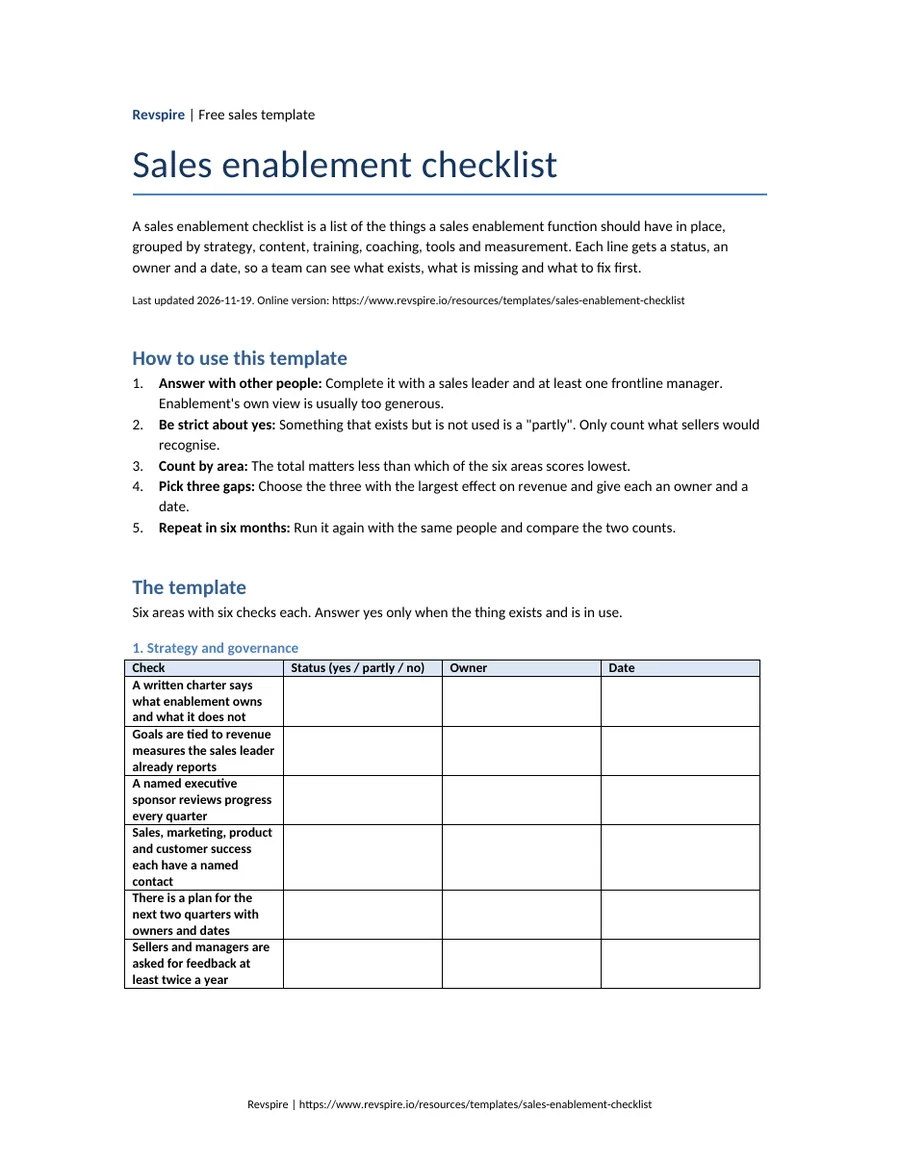
Six areas with six checks each. Answer yes only when the thing exists and is in use.
1. Strategy and governance
| Check | Status (yes / partly / no) | Owner | Date |
|---|---|---|---|
| A written charter says what enablement owns and what it does not | |||
| Goals are tied to revenue measures the sales leader already reports | |||
| A named executive sponsor reviews progress every quarter | |||
| Sales, marketing, product and customer success each have a named contact | |||
| There is a plan for the next two quarters with owners and dates | |||
| Sellers and managers are asked for feedback at least twice a year |
2. Content
| Check | Status (yes / partly / no) | Owner | Date |
|---|---|---|---|
| One library holds the approved version of every asset | |||
| Every asset has an owner and a review date | |||
| Sellers can find an asset by stage, persona, industry or competitor | |||
| Out-of-date assets are archived, not left in search | |||
| You can see which assets are used and shared with buyers | |||
| Each stage of the sales process has the content it needs |
3. Onboarding and training
| Check | Status (yes / partly / no) | Owner | Date |
|---|---|---|---|
| New hires follow a 30-60-90 day plan with milestones | |||
| Product, market and process training exist for each role | |||
| Sellers certify on the pitch and the demo before meeting buyers | |||
| Lessons are short enough to finish between calls | |||
| Every launch comes with training, not only an announcement | |||
| Completion and scores are visible to managers |
4. Coaching and practice
| Check | Status (yes / partly / no) | Owner | Date |
|---|---|---|---|
| Managers hold coaching conversations on a set rhythm | |||
| Calls are reviewed against one shared scorecard | |||
| Sellers practise key conversations before live calls | |||
| Each seller has one skill in focus at a time | |||
| Managers are trained to coach, not only to inspect deals | |||
| Good calls are saved as examples for others |
5. Tools and process
| Check | Status (yes / partly / no) | Owner | Date |
|---|---|---|---|
| The sales process is written down with exit criteria for each stage | |||
| Playbooks and battlecards exist for the main selling situations | |||
| Enablement tools connect to the CRM sellers already use | |||
| Buyers receive content through one trackable channel | |||
| There is one place to ask a question and get an approved answer | |||
| New tools are piloted with one team before a full rollout |
6. Measurement
| Check | Status (yes / partly / no) | Owner | Date |
|---|---|---|---|
| A dashboard shows leading and lagging measures together | |||
| Time to first deal and time to quota are tracked for new hires | |||
| Content use is linked to deals where the data allows | |||
| Win rate and cycle length are reviewed by segment | |||
| Results are reported to leadership every quarter | |||
| Measures that nobody acts on are dropped |
Reading your score
| Yes answers | Where you are | What to do next |
|---|---|---|
| 28 to 36 | Established | Tune what exists and tighten measurement |
| 16 to 27 | Developing | Close the gaps in order of effect on revenue |
| 0 to 15 | Starting | Begin with the charter, one content library and onboarding |
Prefer a file? We email the Word, Excel and PDF versions to your work address, free.
Email me the filesA worked example
Example: fictional company
A first enablement hire runs the checklist in week two.
Ferncastle Analytics hired its first sales enablement manager after growing to forty sellers. In her second week she completed the checklist with the head of sales and two frontline managers. The count came to fourteen yes answers, with content and measurement the weakest areas, and she used the result to set her first two quarters.
Ferncastle Analytics: result by area
| Area | Yes (of 6) | First action |
|---|---|---|
| Strategy and governance | 2 | Write a one-page charter and agree it with the head of sales |
| Content | 1 | Move approved assets into one library with owners |
| Onboarding and training | 4 | Add a pitch certification before first buyer meetings |
| Coaching and practice | 3 | Introduce one shared call scorecard |
| Tools and process | 3 | Write exit criteria for each sales stage |
| Measurement | 1 | Track time to first deal for every new hire |
Example: fictional company. Ferncastle Analytics, Harborview Metrics, Marlow & Finch Logistics and every person named in this example are invented for illustration. Any resemblance to real companies or people is coincidental.
How to use the checklist
Answer with other people
Complete it with a sales leader and at least one frontline manager. Enablement's own view is usually too generous.
Be strict about yes
Something that exists but is not used is a "partly". Only count what sellers would recognise.
Count by area
The total matters less than which of the six areas scores lowest.
Pick three gaps
Choose the three with the largest effect on revenue and give each an owner and a date.
Repeat in six months
Run it again with the same people and compare the two counts.
Where checklists mislead
Ticking documents, not behaviour
A playbook nobody opens is not a yes.
Trying to fix everything
Thirty-six lines are a map, not a to-do list for one quarter.
Skipping measurement
Teams that leave area six until last cannot show that the other five worked.
No owner on a gap
A gap without a name and a date stays a gap.
Treating a tool as the answer
A platform helps with content, practice and reporting. It does not write the charter or run the coaching.
Looking at tools for this job? We compare the options in our guide to sales enablement platforms.
Where Revspire fits
Several lines on the checklist are hard to answer yes to without a system behind them: one approved library, owners and review dates, usage by asset, practice before live calls and scores visible to managers.
Revspire Content Hub gives content its measure: one approved library, versions that stay current in links already shared, and usage visible by asset. Revspire AI Sales Training & Coaching does the same for readiness, with courses, certifications and instantly scored AI role-plays by video or a live voice call, so managers can see who has practised and who has passed.
Sales enablement checklist FAQs
What should a sales enablement checklist cover?
Six areas: strategy and governance, content, onboarding and training, coaching and practice, tools and process, and measurement. Each line should have a status, an owner and a date.
Who should complete the checklist?
The enablement lead together with a sales leader and one or two frontline managers. Sellers' feedback helps on the content and coaching lines.
How often should you run it?
Twice a year is enough for most teams, and again after a change of sales leader, a reorganisation or a major product launch.
What is the difference between a checklist and an audit?
A checklist asks whether something exists. An audit scores how well it works and records the evidence. Run the checklist first; audit the areas that score lowest.
Related templates and reading
- Free templateSales call scorecard templateA weighted 1-5 rubric for scoring recorded calls on agenda, discovery, value messaging, objections, next steps and talk/listen balance.
- Free templateSDR onboarding plan templateA week-by-week ramp plan for SDRs and BDRs: ICP, messaging, sequences, cold calls, qualification and the first qualified meeting, with gates.
- Free template30-60-90 day sales onboarding plan templateA 30-60-90 day sales onboarding plan for new account executives: goals, activities, milestones and manager checkpoints for each phase, ending in a first closed-won deal.
- Free templateSales coaching templateOne skill per rep per cycle, the evidence behind it and the date it is reviewed, so coaching survives more than one conversation.
- Template: score each area with evidenceSales enablement audit template
- Template: the first line on the checklistSales enablement charter template
- Template: turn the gaps into a planSales enablement plan template
- Blog: when a gap needs a platformSales enablement RFP requirements and scorecard