What sales role play scenarios are for
A role play is a rehearsal of one sales conversation with someone playing the buyer. The scenario is the brief for that rehearsal: the stage of the sale, who the buyer is, what they want, what worries them and what the seller is trying to achieve in the next few minutes.
Most role plays fail because the brief is vague. "Pretend to be a difficult customer" gives the person playing the buyer nothing to work with, so the conversation drifts and the feedback is about style. A written scenario card fixes the situation, so the only thing that varies is how the seller handles it.
The template has four parts: a blank scenario card, twelve scenarios to start from that run from the first cold call to a renewal, a scoring rubric with six skills, and debrief questions. Scripts have a place too, as the buyer's opening line and the objection wording, but the seller should not be reading one.
When to use the scenarios
- In weekly team meetings, as a fifteen-minute practice slot.
- During onboarding, before a new seller takes live calls.
- Before a product launch or a pricing change reaches buyers.
- After call reviews show the same objection being lost.
- Before a certification, as the practice round.
Role play, call shadowing or call review
Three ways to build selling skills. They work best together.
| Method | What it builds | Limit |
|---|---|---|
| Role play | A specific skill, practised safely before it matters | Only as good as the scenario and the feedback |
| Call shadowing | A picture of what a good call sounds like | Watching is not doing |
| Call review | Awareness of habits on real calls | The deal has already been affected |
The template
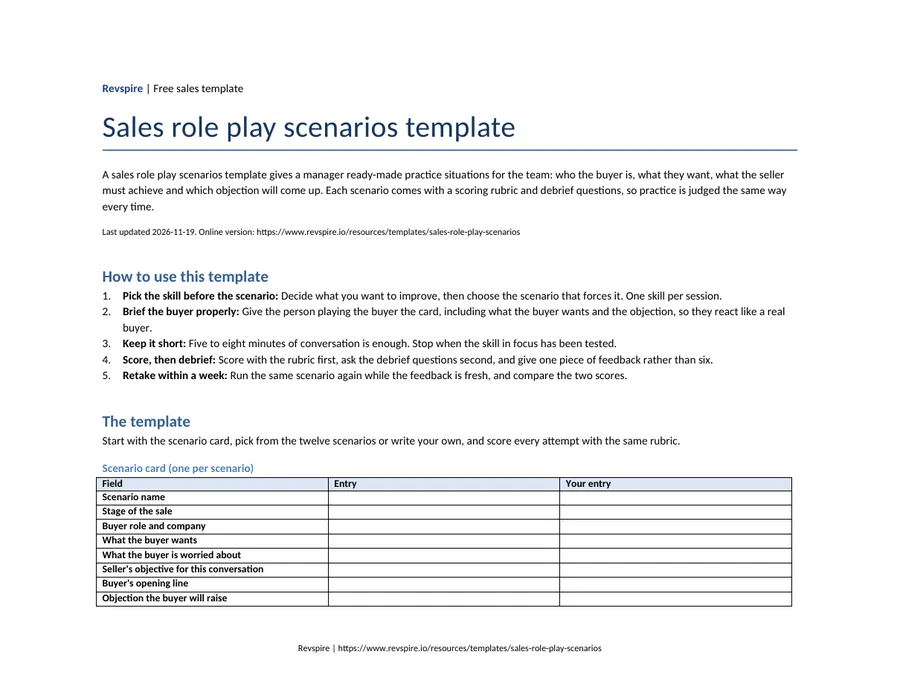
Start with the scenario card, pick from the twelve scenarios or write your own, and score every attempt with the same rubric.
Scenario card (one per scenario)
| Field | Entry |
|---|---|
| Scenario name | |
| Stage of the sale | |
| Buyer role and company | |
| What the buyer wants | |
| What the buyer is worried about | |
| Seller's objective for this conversation | |
| Buyer's opening line | |
| Objection the buyer will raise | |
| What good looks like | |
| Time limit |
Twelve scenarios to start from
| Scenario | Stage | Buyer | Seller's objective | Objection to raise |
|---|---|---|---|---|
| Cold call to a busy executive | Prospecting | VP of sales with thirty seconds to spare | Earn a twenty-minute meeting | "Just send me an email" |
| Getting past the gatekeeper | Prospecting | Executive assistant | Be routed to the right person | "She does not take sales calls" |
| Discovery with a vague buyer | Discovery | Head of operations, polite and non-committal | Uncover the problem, its cost and who decides | "We are just looking at what is out there" |
| Discovery with a technical evaluator | Discovery | IT or security lead | Learn the requirements and the review process | "We built something like this in-house" |
| Demo that drifts into a feature tour | Demo | Four attendees with different interests | Tie three moments to the problems they named | "Can it also do this other thing?" |
| Pricing objection | Proposal | CFO | Defend the value before discussing price | "This costs more than what we use today" |
| Competitor already in the account | Evaluation | Champion who likes the rival | Change the criteria the decision is made on | "They are cheaper and we already know them" |
| The decision to do nothing | Evaluation | Economic buyer | Make the cost of waiting concrete | "It is not a priority this year" |
| Procurement negotiation | Negotiation | Procurement manager | Trade for something, never concede for nothing | "We need a further reduction to sign this quarter" |
| Champion goes quiet | Late stage | Champion, two weeks without a reply | Re-open the conversation and find the new blocker | "Things have changed on our side" |
| Renewal with a new stakeholder | Renewal | New VP who did not choose the product | Re-establish the value in their terms | "I am reviewing every vendor we use" |
| Partner seller pitching your product | Partner | Reseller's account manager | Position the joint offer correctly | "Why would I not lead with our own product?" |
Scoring rubric (score each skill 1 to 4)
| Skill | 1: needs work | 4: strong | Score |
|---|---|---|---|
| Opening | Launches straight into the pitch | States the purpose, checks the time and agrees an agenda | |
| Questions | Closed or leading questions | Open questions that uncover impact and the decision process | |
| Listening | Talks over the buyer or ignores the answer | Reflects back what was said and builds on it | |
| Handling the objection | Argues, or offers a discount at once | Acknowledges it, asks what is behind it and answers with evidence | |
| Value | Lists features | Links each point to a problem the buyer stated | |
| Next step | Ends with "I will follow up" | Agrees a dated next step with named people |
Debrief questions
| Ask the seller | Why |
|---|---|
| What did the buyer care about most? | Checks whether they listened |
| Where did the conversation turn? | Finds the moment worth replaying |
| What would you say differently to the objection? | Turns feedback into wording |
| What is the next step and who owns it? | Tests the close |
| Which one skill will you practise before the retake? | Keeps the focus on one thing |
Session plan
| Field | Entry |
|---|---|
| Date and length of the session | |
| Scenario | |
| Who plays the buyer | |
| Who observes and scores | |
| Skill in focus | |
| Retake date |
Prefer a file? We email the Word, Excel and PDF versions to your work address, free.
Email me the filesA worked example
Example: fictional company
One scenario, two attempts a week apart.
A Ferncastle Analytics sales manager noticed her team discounting as soon as a finance buyer pushed back on price. She ran the pricing objection scenario with one seller, playing the CFO of Marlow & Finch Logistics herself, scored it with the rubric and booked a retake for the following week with objection handling as the single skill in focus.
Pricing objection: first attempt and retake
| Skill | First attempt | Retake | Manager's note |
|---|---|---|---|
| Opening | 3 | 3 | Clear agenda both times |
| Questions | 2 | 3 | Asked what the current tools cost to run before answering |
| Listening | 2 | 3 | Repeated the CFO's concern in her words |
| Handling the objection | 1 | 3 | First attempt offered a discount in the second sentence; retake compared total cost |
| Value | 2 | 3 | Tied the answer to month-end reconciliation, the CFO's stated problem |
| Next step | 2 | 4 | Agreed a working session with the finance lead on a named date |
Example: fictional company. Ferncastle Analytics, Harborview Metrics, Marlow & Finch Logistics and every person named in this example are invented for illustration. Any resemblance to real companies or people is coincidental.
How to run a role play that changes behaviour
Pick the skill before the scenario
Decide what you want to improve, then choose the scenario that forces it. One skill per session.
Brief the buyer properly
Give the person playing the buyer the card, including what the buyer wants and the objection, so they react like a real buyer.
Keep it short
Five to eight minutes of conversation is enough. Stop when the skill in focus has been tested.
Score, then debrief
Score with the rubric first, ask the debrief questions second, and give one piece of feedback rather than six.
Retake within a week
Run the same scenario again while the feedback is fresh, and compare the two scores.
Where role plays go wrong
Scenarios that are too easy
A buyer who agrees with everything teaches nothing. Every card needs a real objection.
Feedback on everything
Six notes after one attempt are forgotten. Pick the one that matters most.
No retake
Without a second attempt, practice is a performance and nothing more.
Only the manager plays the buyer
Practice then waits for the manager's calendar. Peers and AI buyers remove the queue.
Reading a script
A script is a starting line, not the conversation. Sellers who read one stop listening.
Looking at tools for this job? We compare the options in our guide to AI sales role-play software.
Where Revspire fits
The limit on role play is usually the manager's time. Revspire AI Sales Training & Coaching lets sellers practise a scenario against an AI buyer persona by video or a live voice call and get scored feedback straight away, so a seller can run the pricing objection five times before the manager hears it once.
Revspire's AI Playbook Engine creates playbooks with AI grounded in your approved revenue knowledge, so the objection responses sellers practise are the ones the company wants used in the field, and attempts are recorded so the retake can be compared with the first try.
Sales role play scenarios template FAQs
What are good sales role play scenarios?
Scenarios that match the conversations your team loses: a cold call to a busy executive, vague discovery, a pricing objection from a CFO, a competitor already in the account, a procurement negotiation and a renewal with a new stakeholder are common starting points.
How long should a sales role play last?
Five to eight minutes for the conversation and about the same again for scoring and the debrief. Short sessions on one skill work better than a long one that covers everything.
How do you score a sales role play?
Use the same rubric every time. Score the opening, questions, listening, objection handling, value and next step from 1 to 4, with a written description of what a 1 and a 4 look like.
What is the difference between a scenario and a script?
A scenario describes the situation and the buyer. A script is exact wording. Give the person playing the buyer an opening line and an objection to say, and let the seller respond in their own words.
Can sales role plays be done with AI?
Yes. AI role-play tools play the buyer, so sellers can practise on their own and get a score after each attempt. Managers then spend their time on the debrief rather than on playing the buyer.
Related templates and reading
- Free templateSDR onboarding plan templateA week-by-week ramp plan for SDRs and BDRs: ICP, messaging, sequences, cold calls, qualification and the first qualified meeting, with gates.
- Free template30-60-90 day sales onboarding plan templateA 30-60-90 day sales onboarding plan for new account executives: goals, activities, milestones and manager checkpoints for each phase, ending in a first closed-won deal.
- Free templateSales competency framework templateCompetencies, levels and observable behaviour anchors in one grid, so a rating can be evidenced rather than argued.
- Free templateSales enablement charter templateMission, scope lines, team structure models by company size, a RACI with neighbouring teams and the metrics the function answers for.
- Blog: scenarios written for AI practiceAI sales role-play scenarios
- Template: score real calls the same waySales call scorecard template
- Template: the coaching plan behind the practiceSales coaching template
- Listicle: tools comparedBest AI sales role-play software