What an ABM plan is for
Account based marketing treats a defined list of target accounts as markets of one, with marketing and sales running coordinated plays to reach the people in each buying committee. The plan is usually owned by a marketing lead with the sales leaders whose accounts are on the list.
The template has five parts: goals and the agreed account list, tiers (one-to-one, one-to-few and one-to-many), plays per tier with an owner on each team, the content each play needs, and the measures you will review. The owner columns matter most: a play with only a marketing owner rarely reaches the buyer.
Tiers set the depth. A handful of one-to-one accounts get bespoke research, content and executive outreach; a few dozen one-to-few accounts share plays by industry or use case; the one-to-many tier gets targeted advertising and nurture at scale.
When to write an ABM plan
- When sales has a named list of strategic or target accounts.
- When deal sizes justify coordinated effort on each account.
- When marketing and sales disagree about which leads matter.
- Before a push into a new industry or region with a known account list.
- At the start of each quarter, to agree the plays for the next three months.
One-to-one, one-to-few or one-to-many
The three ABM tiers and what each usually involves.
| Tier | Accounts | Typical plays | Effort per account |
|---|---|---|---|
| One-to-one | A handful of strategic accounts | Bespoke research, custom content, executive events, account plan | High |
| One-to-few | Groups of similar accounts | Industry or use-case content, small events, targeted outreach | Medium |
| One-to-many | A larger target list | Targeted advertising, nurture, webinars | Low |
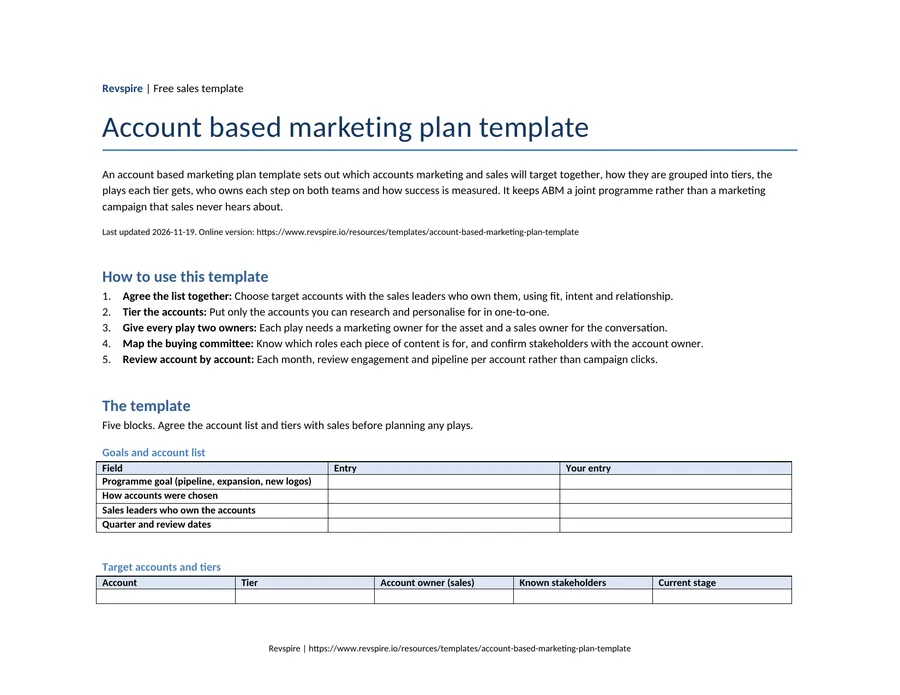
The template
Five blocks. Agree the account list and tiers with sales before planning any plays.
Goals and account list
| Field | Entry |
|---|---|
| Programme goal (pipeline, expansion, new logos) | |
| How accounts were chosen | |
| Sales leaders who own the accounts | |
| Quarter and review dates |
Target accounts and tiers
| Account | Tier | Account owner (sales) | Known stakeholders | Current stage |
|---|---|---|---|---|
Plays per tier
| Tier | Play | Marketing owner | Sales owner | Timing |
|---|---|---|---|---|
| One-to-one | ||||
| One-to-one | ||||
| One-to-few | ||||
| One-to-many |
Content needed
| Play | Content | Audience (role) | Owner | Ready by |
|---|---|---|---|---|
Measures
| Measure | Baseline | Target | Owner |
|---|---|---|---|
| Target accounts with engaged stakeholders | |||
| Meetings with new stakeholders in target accounts | |||
| Pipeline created in target accounts | |||
| Closed won in target accounts |
Prefer a file? We email the Word, Excel and PDF versions to your work address, free.
Email me the filesA worked example
Example: fictional company
Plays with an owner on each team, for one tier.
Ferncastle Analytics chose five logistics companies, including Marlow & Finch Logistics, as one-to-one accounts for a quarter. Each play had a marketing owner and a sales owner, and the sales owner confirmed the stakeholders before anything was sent.
Ferncastle Analytics: one-to-one plays for the quarter
| Play | Marketing owner | Sales owner | Timing |
|---|---|---|---|
| Account research brief per company | Product marketing manager | Account executive reviews and adds stakeholders | Week 1 to 2 |
| Industry report personalised with each company's context | Content marketer | Account executive sends with a personal note | Week 3 |
| Invitation to a small operations leaders dinner | Events manager | Sales director invites the economic buyer | Week 6 |
| Follow-up room with the report, dinner notes and a proposed plan | Product marketing manager builds the content | Account executive shares and runs the follow-up | Week 7 |
Example: fictional company. Ferncastle Analytics, Harborview Metrics, Marlow & Finch Logistics and every person named in this example are invented for illustration. Any resemblance to real companies or people is coincidental.
How to run ABM with sales
Agree the list together
Choose target accounts with the sales leaders who own them, using fit, intent and relationship.
Tier the accounts
Put only the accounts you can research and personalise for in one-to-one.
Give every play two owners
Each play needs a marketing owner for the asset and a sales owner for the conversation.
Map the buying committee
Know which roles each piece of content is for, and confirm stakeholders with the account owner.
Review account by account
Each month, review engagement and pipeline per account rather than campaign clicks.
Where ABM plans go wrong
Marketing-only ABM
Ads and content that sales does not follow up are just a narrower campaign.
Too many one-to-one accounts
If you cannot personalise for every account in the tier, the tier is too big.
One contact per account
Buying committees decide; plays must reach several roles.
Measuring clicks
Engagement and pipeline per account matter more than impressions.
No end date
Run plays in quarters and decide what changes based on results.
Where Revspire fits
ABM plays end in a conversation with several people at the account. A Revspire digital sales room gives each target account one shared space for the personalised content, the proposed plan and the follow-up, with an AI-built stakeholder map that flags risks and buyer engagement analytics that show which stakeholders opened what.
Revspire Content Hub keeps the approved assets behind each play in one governed library, so the personalised versions start from current content.
Account based marketing plan template FAQs
What should an account based marketing plan include?
Goals and the agreed account list, tiers, plays for each tier with a marketing and a sales owner, the content each play needs, and measures per account such as engaged stakeholders and pipeline.
What are the three tiers of ABM?
One-to-one for a few strategic accounts with bespoke plays, one-to-few for groups of similar accounts, and one-to-many for a larger list reached with targeted advertising and nurture.
Who owns an ABM plan?
Usually a marketing lead, with the sales leaders whose accounts are on the list as co-owners of the plays and the results.
How do you measure ABM?
Per account: how many stakeholders are engaged, meetings with new stakeholders, pipeline created and deals won, compared with similar accounts outside the programme.
Related templates and reading
- Free templateMutual action plan templateA shared, dated plan from discovery to go-live, with a buyer owner and a seller owner on every milestone.
- Free templateSales enablement business case templateA one-page sales enablement business case: the problem, what ramp, rep time and turnover cost today, the options, the numbers and a dated decision ask.
- Free templateSales close plan templateEvery remaining step between verbal intent and signature, with owners on both sides, the approval chain and the risks the buyer never sees.
- Free templateDigital sales room templateThe sections of a buyer-facing deal room in order: summary, stakeholder map, mutual action plan, content by stage, business case, security, next steps and handoff.
- Guide: tools for targeting and intentBest ABM platforms
- Guide: mapping buying committeesBest stakeholder mapping software
- Template: the plan for each one-to-one accountAccount plan template
- Template: the people in each accountStakeholder map template