What an LMS RFP is for
A request for proposal asks several vendors the same questions in the same format. For a learning management system that matters, because products that look alike in a demo differ in what they charge for, how they handle certification and practice, and how much work the rollout puts on your team.
The template has five parts: background and scope, a requirements table where each line is marked must, should or could, a short list of questions every vendor answers in writing, scoring weights agreed before any response is opened, and a timeline. Vendors answer yes, partly or no to each requirement, which makes the first comparison quick.
Keep the document short. A focused RFP of a few pages gets better answers than a hundred-line spreadsheet copied from another company, and it tells vendors you know what you need.
When to use the template
- When replacing an LMS at the end of a contract.
- When buying a first LMS and comparing three or more vendors.
- When procurement requires a formal, documented selection.
- When training for sellers or partners is being added to an existing system.
- When two business units need to agree on one platform.
RFI, RFP or requirements checklist
Three documents used at different points in a purchase.
| Document | Use it when | What you get back |
|---|---|---|
| Request for information (RFI) | You are still learning what the market offers | General capabilities from a long list of vendors |
| Request for proposal (RFP) | You know your requirements and want comparable offers | Written answers, pricing and a plan from a shortlist |
| Requirements checklist | You are aligning internally before talking to vendors | An agreed list of must, should and could |
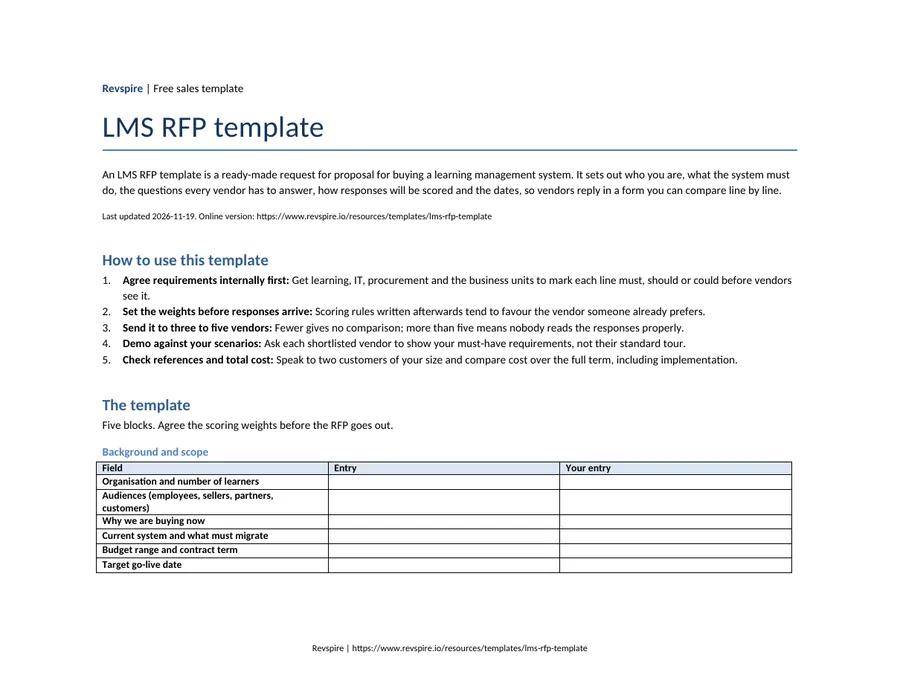
The template
Five blocks. Agree the scoring weights before the RFP goes out.
Background and scope
| Field | Entry |
|---|---|
| Organisation and number of learners | |
| Audiences (employees, sellers, partners, customers) | |
| Why we are buying now | |
| Current system and what must migrate | |
| Budget range and contract term | |
| Target go-live date |
Requirements
| Area | Requirement | Priority (must / should / could) | Vendor response (yes / partly / no) | Notes |
|---|---|---|---|---|
| Content | Supports SCORM packages, video and PDF | |||
| Content | Courses can be built inside the product | |||
| Learning paths | Paths by role, with prerequisites and due dates | |||
| Assessment | Quizzes with pass marks and retakes | |||
| Certification | Certificates with expiry and renewal | |||
| Practice | Scenario or role-play practice with scoring | |||
| Live sessions | Scheduling and attendance for live training | |||
| Reporting | Completion and scores by team, manager and course | |||
| Integrations | Single sign-on and user provisioning | |||
| Integrations | Connects to the HR system and the CRM | |||
| Administration | Roles, groups and delegated administration | |||
| Access | Works on phones and tablets | |||
| Security | Hosting region options and data export on exit | |||
| Support | Named contact and stated response times |
Questions for every vendor
| Topic | Question |
|---|---|
| Pricing | How is the product priced (per learner, per active user or flat), and what costs extra? |
| Implementation | What does a typical rollout look like, how long does it take and who does the work? |
| Migration | How will existing courses, records and certificates be moved? |
| Roadmap | What is planned for the next twelve months, and how are customers consulted? |
| References | Which customers of our size and sector can we speak to? |
| Security | Which security documents can you share under a confidentiality agreement? |
| Exit | How do we get our content and records out if we leave? |
Scoring weights
| Criterion | Weight (of 100) | Vendor A | Vendor B | Vendor C |
|---|---|---|---|---|
| Fit to must-have requirements | 35 | |||
| Ease of use for learners and administrators | 20 | |||
| Integrations and security | 15 | |||
| Total cost over three years | 15 | |||
| Reporting | 10 | |||
| Implementation and support | 5 |
Timeline
| Step | Date | Owner |
|---|---|---|
| RFP issued | ||
| Vendor questions due | ||
| Responses due | ||
| Shortlist and demos | ||
| Reference calls | ||
| Decision | ||
| Contract signed |
Prefer a file? We email the Word, Excel and PDF versions to your work address, free.
Email me the filesA worked example
Example: fictional company
A mid-sized company replacing its LMS with sellers as a priority audience.
Marlow & Finch Logistics needed to replace its LMS before the contract ended. Most learners were operations staff taking compliance courses, but the sales director wanted certification and practice for the sales team in the same purchase. The learning lead sent the RFP to four vendors, marked practice and certification as must-haves, and scored the three complete responses with the weights agreed in advance.
Marlow & Finch Logistics: how the shortlist scored
| Criterion | Weight | Vendor A | Vendor B | Vendor C |
|---|---|---|---|---|
| Fit to must-have requirements | 35 | 30 | 24 | 33 |
| Ease of use | 20 | 14 | 17 | 16 |
| Integrations and security | 15 | 12 | 13 | 12 |
| Total cost over three years | 15 | 11 | 13 | 10 |
| Reporting | 10 | 8 | 6 | 8 |
| Implementation and support | 5 | 4 | 4 | 3 |
| Total | 100 | 79 | 77 | 82 |
Example: fictional company. Ferncastle Analytics, Harborview Metrics, Marlow & Finch Logistics and every person named in this example are invented for illustration. Any resemblance to real companies or people is coincidental.
How to run an LMS RFP
Agree requirements internally first
Get learning, IT, procurement and the business units to mark each line must, should or could before vendors see it.
Set the weights before responses arrive
Scoring rules written afterwards tend to favour the vendor someone already prefers.
Send it to three to five vendors
Fewer gives no comparison; more than five means nobody reads the responses properly.
Demo against your scenarios
Ask each shortlisted vendor to show your must-have requirements, not their standard tour.
Check references and total cost
Speak to two customers of your size and compare cost over the full term, including implementation.
Where LMS RFPs go wrong
A copied requirements list
Hundreds of lines borrowed from another company hide the ten that matter to you.
Everything marked must
If every line is a must-have, nothing is. Limit musts to what would stop the purchase.
Forgetting who the learners are
Sellers and partners need practice and certification on skills, which compliance-led systems often lack.
Ignoring the exit
Ask how content and records leave the system before you sign, not at renewal.
Price per learner only
Compare what is charged for inactive users, extra audiences and add-on modules.
Looking at tools for this job? We compare the options in our guide to sales LMS platforms.
Where Revspire fits
Most general LMSs cover content, paths and completion well and leave practice, certification on selling skills and selling content to other tools. If sellers or partners are a priority audience in your RFP, score those lines separately.
Revspire AI Sales Training & Coaching runs courses built from video, PDF, SCORM packages, quizzes and live sessions, AI role-play with instant scores, and certifications with pass marks, manager approval, expiry, renewals and a public verification page, beside the content reps sell with. It is priced by module with unlimited user licenses; about $25,000 USD a year on average.
LMS RFP template FAQs
What should an LMS RFP include?
Background and scope, requirements marked must, should or could, a short list of questions every vendor answers in writing, the scoring weights and a timeline with dates for questions, responses, demos and the decision.
How many vendors should receive an LMS RFP?
Three to five. That is enough to compare and few enough for the team to read every response and run proper demos with a shortlist of two or three.
How long does an LMS selection take?
Six to ten weeks is common: two for vendors to respond, two to three for demos and references, and the rest for the decision and contract.
What is the difference between an LMS RFI and an RFP?
An RFI gathers general information from a long list while you learn the market. An RFP asks a shortlist for specific answers, pricing and a plan against your stated requirements.
Do sales teams need different LMS requirements?
Usually. Sellers need practice on conversations, certification on skills and training placed next to the content they sell with, so add those lines to the requirements table.
Related templates and reading
- Free templateSales call scorecard templateA weighted 1-5 rubric for scoring recorded calls on agenda, discovery, value messaging, objections, next steps and talk/listen balance.
- Free templateSDR onboarding plan templateA week-by-week ramp plan for SDRs and BDRs: ICP, messaging, sequences, cold calls, qualification and the first qualified meeting, with gates.
- Free template30-60-90 day sales onboarding plan templateA 30-60-90 day sales onboarding plan for new account executives: goals, activities, milestones and manager checkpoints for each phase, ending in a first closed-won deal.
- Free templateSales coaching templateOne skill per rep per cycle, the evidence behind it and the date it is reviewed, so coaching survives more than one conversation.
- Template: requirements when sellers are the learnersSales LMS requirements checklist
- Listicle: LMS options for sales teamsBest sales LMS
- Blog: which one a sales team needsCorporate LMS or sales readiness platform
- Template: what certification should coverSales certification plan template