What a sales strategy is for
A sales strategy is the set of choices a sales leader makes about which customers to pursue, how to reach them and what the team needs to win. It is usually written once a year by the head of sales with finance, marketing and product, and revisited when the market or the product changes.
The template has six parts: goals and context, target segments scored by priority, the sales motion for each segment, team and coverage, enablement and tools, and the measures you will review each quarter. The segment table does most of the work, because a strategy that tries to serve every segment equally is not a strategy.
Strategy and plan are often confused. The strategy says where and how you will compete; the plan says who does what by when, with quotas, territories and activity targets. Write the strategy first, keep it to a page or two, and build the plan from it.
When to write a sales strategy
- During annual planning, before quotas and territories are set.
- When a new head of sales or CRO starts and needs to set direction.
- When moving into a new segment, region or price point.
- After a launch that changes who the product is for.
- When win rates or deal sizes fall and the team needs to refocus.
Sales strategy, sales plan or sales process
Three documents that sit at different levels and are often mixed up.
| Document | Question it answers | Horizon | Owner |
|---|---|---|---|
| Sales strategy | Where will we win, and how? | One to three years, reviewed yearly | Head of sales or CRO |
| Sales plan | Who does what, by when, against which targets? | One year, tracked quarterly | Sales leadership and RevOps |
| Sales process | Which stages does a deal move through, and what proves each one? | Ongoing | Sales leadership and enablement |
The template
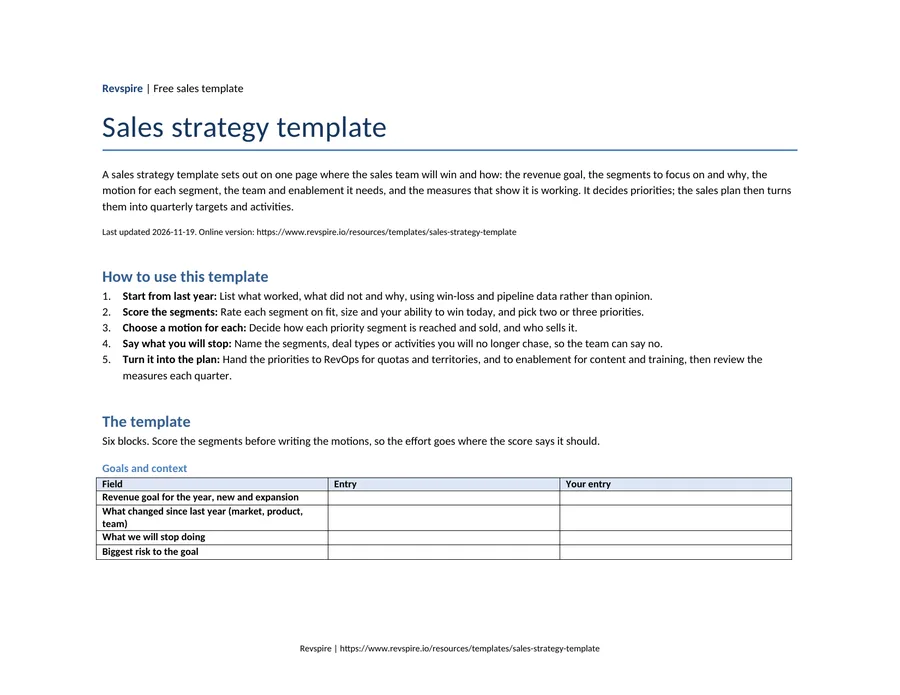
Six blocks. Score the segments before writing the motions, so the effort goes where the score says it should.
Goals and context
| Field | Entry |
|---|---|
| Revenue goal for the year, new and expansion | |
| What changed since last year (market, product, team) | |
| What we will stop doing | |
| Biggest risk to the goal |
Target segments (score each 1 low to 3 high)
| Segment | Fit with the product | Size of opportunity | Ability to win today | Total and priority |
|---|---|---|---|---|
Sales motion by priority segment
| Segment | How we reach them | Who sells | Typical deal and cycle | Why we win |
|---|---|---|---|---|
Team and coverage
| Field | Entry |
|---|---|
| Roles and headcount by segment | |
| Partner or channel coverage | |
| Hiring needed and by when |
Enablement and tools
| Field | Entry |
|---|---|
| What sellers must learn for each priority segment | |
| Content and plays needed | |
| Tools to add, change or retire |
Measures reviewed each quarter
| Measure | Baseline | Target | Owner |
|---|---|---|---|
| Pipeline created in priority segments | |||
| Win rate in priority segments | |||
| Average deal size | |||
| Sales cycle length |
Prefer a file? We email the Word, Excel and PDF versions to your work address, free.
Email me the filesA worked example
Example: fictional company
A segment table that moved effort away from the largest segment.
Ferncastle Analytics sold reporting software to companies of every size. Scoring the segments showed that mid-sized logistics companies, not the enterprise accounts the team chased most, combined good fit with a high ability to win.
Ferncastle Analytics: segment scores
| Segment | Fit | Size | Ability to win | Total and decision |
|---|---|---|---|---|
| Mid-sized logistics companies | 3 | 2 | 3 | 8: priority one, two account executives and a logistics playbook |
| Enterprise retailers | 2 | 3 | 1 | 6: keep two strategic accounts, no new pursuit this year |
| Small agencies | 2 | 1 | 2 | 5: inbound only, self-serve trial |
| Public sector | 1 | 2 | 1 | 4: stop; no security accreditation yet |
Example: fictional company. Ferncastle Analytics, Harborview Metrics, Marlow & Finch Logistics and every person named in this example are invented for illustration. Any resemblance to real companies or people is coincidental.
How to write a sales strategy the team can follow
Start from last year
List what worked, what did not and why, using win-loss and pipeline data rather than opinion.
Score the segments
Rate each segment on fit, size and your ability to win today, and pick two or three priorities.
Choose a motion for each
Decide how each priority segment is reached and sold, and who sells it.
Say what you will stop
Name the segments, deal types or activities you will no longer chase, so the team can say no.
Turn it into the plan
Hand the priorities to RevOps for quotas and territories, and to enablement for content and training, then review the measures each quarter.
Where sales strategies go wrong
Every segment is a priority
Spreading the team across all segments wins none of them.
A target, not a strategy
A revenue number without choices about where to win is a hope.
Written without the team
Sellers and managers know where deals stall; leave them out and the strategy misses it.
No enablement plan
A new segment needs new content, plays and practice before sellers can win there.
Never reviewed
A strategy that is not checked each quarter drifts from what the team actually does.
Where Revspire fits
A strategy reaches the field through plays, messaging and content for each priority segment. Revspire's AI Playbook Engine creates playbooks with AI grounded in your approved revenue knowledge, so each segment's plays, questions, objection handling and messaging are drafted from approved sources, routed for approval and measured by usage.
Revspire AI Sales Training & Coaching lets sellers practise the new segment's conversations in AI role play by video or a live voice call before they meet real buyers.
Sales strategy template FAQs
What should a sales strategy include?
The revenue goal and context, the target segments and why they were chosen, the sales motion for each segment, team and coverage, the enablement and tools needed, and the measures reviewed each quarter.
What is the difference between a sales strategy and a sales plan?
The strategy decides where and how you will compete. The plan turns that into quotas, territories, activities and dates for the year.
How long should a sales strategy be?
One or two pages. If it needs more, the choices are probably not made yet.
How often should a sales strategy be updated?
Write it once a year and review the measures each quarter. Rewrite it sooner if the product, market or team changes significantly.
Related templates and reading
- Free templateSales call scorecard templateA weighted 1-5 rubric for scoring recorded calls on agenda, discovery, value messaging, objections, next steps and talk/listen balance.
- Free templateSDR onboarding plan templateA week-by-week ramp plan for SDRs and BDRs: ICP, messaging, sequences, cold calls, qualification and the first qualified meeting, with gates.
- Free template30-60-90 day sales onboarding plan templateA 30-60-90 day sales onboarding plan for new account executives: goals, activities, milestones and manager checkpoints for each phase, ending in a first closed-won deal.
- Free templateSales coaching templateOne skill per rep per cycle, the evidence behind it and the date it is reviewed, so coaching survives more than one conversation.
- Template: the stages each motion runs throughSales process template
- Template: what enablement ships to support the strategySales enablement plan template
- Template: planning one strategic accountAccount plan template
- Template: the plays for each segmentSales playbook template