10 B2B Sales Trends for Late 2026 and 2027, With the Evidence
A practical perspective for connecting this idea to your revenue team’s next move.
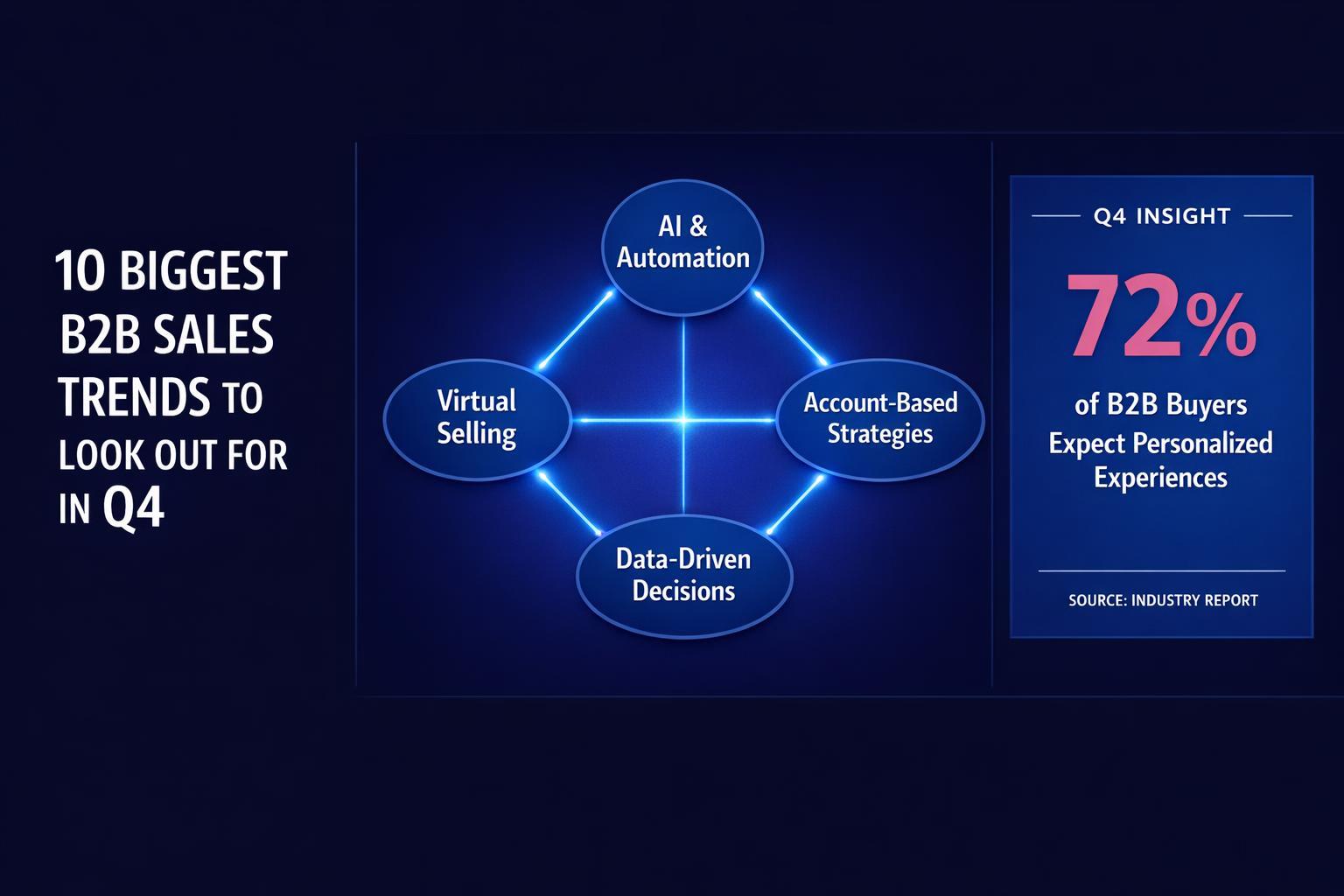
The biggest B2B sales trends for late 2026 and 2027 are: buyers researching in AI answer engines, rep-free buying that still needs a human to validate it, bigger buying groups that want proof, live deal rooms replacing attachments, AI agents working on both sides of the deal, data readiness, vendor consolidation, retention targets and seller readiness.
This page covers what changed in B2B selling between late 2025 and October 2026, and what to plan for through 2027. Every trend is backed by research published between August 2025 and October 2026, which we opened and link inline, followed by what to do about it. It replaces our earlier Q4 2026 and 2025 trend lists, and scores how the 2025 predictions held up.
Last updated: 16 October 2026
Disclosure: Revspire publishes this article and sells software for sales content, AI coaching and digital sales rooms, which several of these trends touch. Many of the surveys cited are run by software vendors; the vendor is named in each sentence that uses its figures. Revspire’s own benchmarks are reported as patterns observed in customer data, not as proof that a product caused a result.
What are the biggest B2B sales trends for 2026 and 2027?
The table summarises the ten trends and the strongest evidence behind each. The sections below give the detail and the practical response for each one.
#
Trend
What is changing
Key evidence (source, date)
1
Buyers start in AI answer engines
Shortlists form in chatbot answers before a seller is involved
51% of software buyers start research in an AI chatbot more often than in Google (G2, April 2026)
2
Rep-free by preference, rep-validated in practice
The seller’s job shifts from supplying information to validating it
67% prefer a rep-free experience (Gartner, March 2026); 69% validate AI insights with reps (Gartner, May 2026)
3
Bigger buying groups that want proof
More stakeholders, procurement from day one, trials as standard
13 internal stakeholders plus nine external influencers; over 60% of buyers use a trial (Forrester, January 2026)
4
Live deal rooms replace attachments
One shared buyer workspace per deal, if someone keeps it current
Around 48% of rooms never get engagement in one vendor’s data (Flowla, February 2026)
5
Seller AI moves from drafting to doing
Agents research accounts, update the CRM and run outreach
54% of sellers have used AI agents; nearly nine in ten plan to by 2027 (Salesforce, February 2026)
6
Buyer-side AI agents enter purchasing
Agents compare offers and negotiate quotes for the buyer
90% of B2B buying predicted to be AI-agent intermediated by 2028 (Gartner, October 2025)
7
Revenue data becomes the AI bottleneck
Disconnected systems and weak governance slow AI projects
48% of enterprise leaders say revenue data isn’t AI-ready (Clari Labs, January 2026)
8
Consolidation and a headless stack
Fewer, larger vendors; work moves into Slack, Teams and AI assistants
Seismic completed its merger with Highspot (Highspot, August 2026)
9
Retention moves into the sales number
Net revenue retention and value realisation become seller goals
Top-valued B2B SaaS firms: 113% NRR against 98% (McKinsey, November 2025)
10
Seller readiness under pressure
Lower attainment, longer ramp, more need for practice
48% of reps at quota; 6.2-month average ramp (The Bridge Group, June 2026)
How is B2B buying changing?
The first four trends are about buyers: where they research, when they want a person, who sits in the buying group and what they expect to see before they sign.
1. Buyers start in AI answer engines, and the shortlist forms there
In G2’s Answer Economy research (15 April 2026), a survey of 1,076 B2B software buyers fielded in March 2026, 51% said they start research in an AI chatbot more often than in Google, up from 29% in G2’s 2025 report, and 69% had chosen a different vendor than first planned because a chatbot recommended it. G2 runs a review site and has a stake in this finding, but other studies point the same way. 6sense’s 2025 Buyer Experience Report (12 November 2025), based on more than 4,000 buyers, found that 94% of buying groups had ranked their preferred vendors before first contact with a seller. The TrustRadius 2026 B2B Buying Disconnect report, as summarised by HG Insights (15 July 2026), found that 63% of buyers used AI in their buying process and 94% fact-check what it tells them.
Much of the evaluation now happens where a seller gets no form fill, no intent signal and no meeting request. What to do:
- Each quarter, ask the main AI assistants the questions your buyers ask (“best [category] for [use case]”, “[you] vs [competitor]”, “[you] pricing”) and record whether you appear and what is said about you.
- Publish the facts an answer engine needs on your own site: pricing model, integrations, security documentation, implementation time and honest comparisons.
- Keep review-site profiles current. G2 reports that citations from software review sites were the top factor raising buyer confidence in an AI answer.
2. Buyers prefer rep-free buying, but use reps to validate
A Gartner survey of 646 B2B buyers (published 9 March 2026, fielded August to September 2025) found that 67% prefer a rep-free experience and 45% used AI during a recent purchase. That is not the whole story. A second Gartner release (20 May 2026), based on 645 buyers, found that 69% prefer to validate AI-generated insights with sales reps, that buyers used seven information sources on average, and that buyers were split on which source was more likely to mislead them: 51% said GenAI and 49% a sales rep. Compared with GenAI, buyers were 39 percentage points more likely to say a rep understood their needs and 32 points more likely to say a rep made them confident in the decision, according to Gartner’s report on the same buyer survey (20 May 2026).
Peers carry weight too: in the TrustRadius data, 74% of buyers consulted customer reviews and 53% spoke to a peer (HG Insights, 15 July 2026). The “community-led growth” trend from our older list survives here, as peer validation. What to do:
- Mark the points where buyers need a person: framing the problem, building the business case, reviewing risk and the final commit. Put your most experienced people there and let digital self-service carry the rest.
- Give reps a short brief on what AI answers say about you and your main competitors, with the proof that corrects any errors.
- Offer customer references and peer conversations early in the evaluation, not only before signature.
3. Buying groups get bigger and want proof before they sign
Forrester’s State of Business Buying 2026 (21 January 2026) reports that a typical purchase involves 13 internal stakeholders and nine external influencers, that procurement professionals are decision-makers in 53% of buying cycles and engage from the start, and that more than 60% of buyers use a trial before they buy, rising to 78% for purchases of $10 million or more. The Bridge Group’s 2026 AE research (22 June 2026) attributes its record average ramp time partly to deal complexity and larger buying committees. How the group works together matters as much as its size: in Gartner’s buyer survey (20 May 2026), buying groups with low dysfunction were 13 times more likely to report high-quality deals. What to do:
- Run every trial or pilot as a written plan with success criteria, owners on both sides and dates, agreed before it starts.
- Give buyer-side steps buyer-side owners. In the Revspire mutual action plan benchmark (customer data, October 2025 to September 2026), buyers owned only 20% of plan milestones, even though security review, legal and procurement happen on their side.
- Send procurement what it evaluates, such as features, efficiency and terms, early in the cycle rather than a price sheet at the end.
4. Live deal rooms replace attachments, if someone keeps them live
Gartner argues that static sales collateral can no longer carry a seller’s influence, and recommends modular content that AI can assemble for each buyer (Gartner, 9 March 2026). In the TrustRadius data, vendor marketing collateral ranked last among the resources buyers consult (HG Insights, 15 July 2026). The response many teams have chosen is a digital sales room: one link holding the proposal, business case, security pack and plan. Adoption is uneven. Flowla’s State of Digital Sales Rooms 2026 (17 February 2026, updated 2 April 2026), published by a deal room vendor, reports that over 54% of the 100+ practitioners it surveyed use deal rooms on all deals while about 30% have never used one, that around 48% of rooms created never get any engagement, and that reps not keeping rooms updated was the top problem, cited by about 60%.
Revspire’s own data points the same way. In the Revspire digital sales room benchmark (about 40 B2B companies, October 2025 to September 2026), closed deals with an active room won 35% of the time against 28% without one, and after 20 days with no buyer view the win rate fell below half the overall rate. That is an observed pattern, not proof that the room caused the win. What to do:
- Use one room per deal and write its first screen for the person who was not on the call: the problem, the business case and the agreed next steps.
- Set an alert for 20 days without a buyer view, and re-engage with something new, such as a revised business case or a rollout plan.
How is AI changing B2B selling in 2026 and 2027?
5. Seller AI moves from drafting to doing
Salesforce’s State of Sales report (3 February 2026), a survey of 4,050 sales professionals in 22 countries fielded in August and September 2025, found that 54% of sellers have used AI agents and nearly nine in ten plan to by 2027. Sellers expect agents to cut prospect research time by 34% and email drafting time by 36%. Vendors have shipped accordingly: Outreach added a conversational agent, a builder for scheduled custom agents and a deal agent that sends suggested deal-field updates to Slack (Business Wire, 27 April 2026), and Salesforce showed Hunter, an outbound prospecting agent with general availability planned for November 2026 (Salesforce Ben, 23 September 2026). In a survey of 227 chief sales officers, Gartner (20 May 2026) found that sales organisations giving sellers AI-enabled next best actions were 2.6 times more likely to achieve commercial growth, and it predicts that by 2027, 95% of sellers’ research workflows will begin with AI, up from less than 20% in 2024.
Results are uneven. In The Bridge Group’s 2026 research (22 June 2026), a plurality of respondents rated 10 of 11 AI use cases “hit or miss”, and few organisations use AI across the whole AE workflow. In Allego’s 2026 AI in Revenue Enablement report (11 June 2026), a vendor survey of 318 enablement leaders, 56% were using or piloting AI that recommends or executes tasks, while 63% said they were in the initial phases of adoption. What to do:
- Pick two or three agent jobs with a baseline you can measure, such as research time per account, follow-up within 24 hours or CRM fields completed, and compare before and after.
- Ground every agent in approved content and messaging; our guide to governing GTM knowledge for AI agents covers how.
- Keep a human approval step for anything an agent sends to a buyer.
6. Buyer-side AI agents start to handle purchasing
Gartner’s top predictions for 2026 and beyond (Gartner, 21 October 2025) state that by 2028, 90% of B2B buying will be AI-agent intermediated, pushing more than $15 trillion of B2B spend through AI agent exchanges. Forrester’s 2026 predictions (Forrester, 28 October 2025) expect at least one in five B2B sellers to face agent-led quote negotiations in 2026, noting that in 2025, 61% of purchase influencers said their organisation has or will use a private generative AI engine for purchasing. Both are forecasts, not measurements, but they point the same way: by 2027, some buyers will send an agent to compare your pricing, terms and security answers before a person reads them. What to do:
- Write down pricing logic, discount bands and standard terms clearly enough that a machine, yours or the buyer’s, could apply them.
- Keep security and compliance answers in one approved, dated library.
- Decide which negotiation steps always need a person, and tell buyers which ones those are.
What is changing in revenue data and the sales tech stack?
7. Revenue data becomes the bottleneck for AI
In Salesforce’s State of Sales (3 February 2026), 51% of sales leaders using AI said disconnected systems were slowing their AI initiatives, 74% of sales professionals were focusing on data cleansing, and 79% of high performers prioritised data hygiene against 54% of underperformers. Clari Labs research (Business Wire, January 2026), a Censuswide survey of 400 North American enterprise revenue and IT leaders for Clari + Salesloft, found that 48% say their revenue data isn’t AI-ready, 55% see conflicting pipeline signals from disconnected sources, and 42% lack formal governance frameworks for data. Governance covers what AI tells buyers, too: Forrester (28 October 2025) predicts that B2B companies will lose more than $10 billion in enterprise value because of ungoverned generative AI use. What to do:
- List the 10 to 15 CRM fields your forecast and your agents depend on, name an owner for each and check completeness weekly.
- Limit what AI can say to buyers to approved content and claims, each with an owner and a review date.
8. Vendors consolidate, and the stack goes headless
Revenue software is consolidating. Clari and Salesloft agreed to merge (Business Wire, 5 August 2025). Vector Capital completed its acquisition of Showpad and combined it with Bigtincan under the Showpad brand (Bigtincan, 30 October 2025). Seismic completed its merger with Highspot, which continues as “Highspot by Seismic”, and reports about 2,500 customers for the combined company (Highspot, 18 August 2026). Salesforce acquired the conversation-capture company Momentum in February 2026 (Salesforce Ben, 23 September 2026).
At the same time, work is moving out of individual apps. At Dreamforce ’26, Salesforce introduced “Salesforce in Claude”, in open beta, which lets users work with Salesforce data and take Salesforce actions from Anthropic’s Claude, alongside MCP (Model Context Protocol) connections for other AI tools, and described “Headless Salesforce”, which makes its data, automation and AI available through tools such as Slack, Teams and Claude (Salesforce Ben, 23 September 2026). Outreach’s Omni agent runs in Slack and in its mobile app (Business Wire, 27 April 2026). Revspire, which publishes this article, also offers an MCP integration for assistants such as ChatGPT and Claude. What to do:
- If a vendor you use has merged, check renewal dates, get roadmap commitments in writing and confirm data-export terms before your 2027 renewal.
- Judge new tools by whether they work where sellers already are (the CRM, Slack or Teams, an AI assistant), and decide which system owns which data.
What do the trends mean for sales targets and seller skills?
9. Retention and expansion move into the sales number
McKinsey (19 November 2025) found that the most highly valued quarter of B2B SaaS companies (a median 24x enterprise value to revenue, against 5x for the lowest-valued quarter) achieved net revenue retention of 113%, against 98% for the lowest-valued quarter. In its survey of 98 B2B SaaS companies, those with the most advanced value-realisation and adoption programmes had NRR about seven points above companies with only basic practices, yet just 18% of respondents were in that group. Sales roles are following the money: in The Bridge Group’s 2026 research (22 June 2026), 38% of AEs had sole or blended ownership of renewals or expansion, nearly double the 2024 share. What to do:
- Agree measurable success goals with the customer at the outset and revisit them in onboarding, quarterly reviews and renewal conversations, as McKinsey recommends.
- Hand the deal room and the mutual action plan to the post-sale team, so the business case stays visible after signature.
- Where AEs own expansion, pay on retained and expanded revenue, not only on new contract value.
10. Seller readiness comes under pressure
The Bridge Group (22 June 2026), surveying 158 B2B companies, found 48% of reps at quota, down from 51% in 2024; an average ramp of 6.2 months, the highest in the study’s history; and 3.7 years of experience required at hire, up from 2.7 in 2022. In Salesforce’s State of Sales (3 February 2026), 46% of Gen Z reps said they rarely get feedback on their sales conversations and 47% said they don’t get enough role-play before customer calls. Highspot’s 2026 Go-to-Market Performance Gap report (450 GTM leaders; page updated 19 August 2026) found that 39% say managers lack the visibility to coach effectively and 36% say sellers struggle to apply messaging live. And Gartner (20 May 2026) found organisations that prioritise upskilling sellers on AI were 2.4 times more likely to achieve strong revenue growth.
Revspire’s sales skills gap benchmark, from more than 2,000 scored AI role-plays across 20 companies (October 2025 to September 2026), shows where practice is needed most: reps scored 4.4 out of 5 on product knowledge but 3.0 on closing and 2.9 against the status quo objection, and, in a later cut of the data, 78% of reps passed their certification on the first attempt. What to do:
- Practise the conversations reps lose most: the status quo, price, and the business case for a full buying group.
- Coach weekly from scored practice and recorded calls, not only from pipeline reviews.
- Plan new-hire productivity on a six-month ramp, not a single quarter.
Which 2025 B2B sales predictions came true?
This page absorbs our earlier list of eight B2B sales trends and predictions for 2025. Here is how each prediction looks in October 2026.
2025 prediction
Verdict
What the newer evidence shows
AI-powered lead scoring
Adopted, results uneven
55% of sales professionals use AI for prospecting (Salesforce, February 2026), but a plurality rated 10 of 11 AI use cases “hit or miss” (The Bridge Group, June 2026).
Hyper-personalisation
Held up, as role-specific value
Gartner puts “value clarity” for each buyer’s role at the centre of enablement (Gartner, March 2026); Forrester’s analyst calls for role-specific insights and trials (Forrester, January 2026).
Rise of digital deal rooms
Held up, adoption uneven
Over 54% of surveyed practitioners use rooms on all deals; about 30% never have (Flowla, February 2026).
Death of the static PDF
Held up
Static collateral can no longer carry seller influence (Gartner, March 2026); vendor collateral ranked last among buyer resources (TrustRadius via HG Insights, July 2026).
Data-centric decision making
Held up, limited by data quality
74% of sales professionals focus on data cleansing (Salesforce, February 2026); 48% say revenue data isn’t AI-ready (Clari Labs, January 2026).
Real-time buyer signals
Partly
Signals miss research done in AI chatbots, and 94% of buying groups rank vendors before first contact (6sense, November 2025).
Predictive forecasting
Not yet at scale
55% of enterprises see conflicting pipeline signals and 39% recalibrate forecast models only weekly or monthly (Clari Labs, January 2026).
The trust economy
Held up strongly
94% of buyers fact-check AI output (TrustRadius via HG Insights, July 2026); 69% validate AI insights with reps (Gartner, May 2026).
Two trends from the previous version of this page, the fractional sales workforce and hyper-verticalisation, are no longer listed: we could not find recent primary research measuring either, so they do not meet this page’s standard of a recent, named source. Agentic AI, asynchronous selling, digital deal rooms, net revenue retention, value realisation, trials and stack consolidation from that version are covered above with current data.
What should sales leaders measure in 2027?
A trend matters only if it changes the plan. These are leading indicators to add to a 2027 operating plan, one per trend, with the team that usually owns each.
Trend
Metric to add
Usual owner
1. AI answer engines
Share of tracked buyer questions where AI assistants name you, and whether the description is accurate
Product marketing
2. Rep validation
Buyer stakeholders met at the business-case and risk-review stages, per deal
Sales managers
3. Bigger groups, proof
Share of trials and pilots with written success criteria and named buyer-side owners
Sales and presales
4. Deal rooms
Share of deals with an active room; deals with 20 or more days of buyer silence
Sales managers, RevOps
5. Seller agents
Time saved or tasks completed per agent use case, against a pre-launch baseline
RevOps
6. Buyer agents
Pricing rules, standard terms and security answers documented and approved
Deal desk, legal
7. Data readiness
Completeness of the CRM fields your forecast and agents rely on
RevOps
8. Consolidation
Tools per seller, and renewal dates of vendors that have merged
RevOps, procurement
9. Retention
Share of new deals with success goals agreed at signature; NRR by segment
Customer success, sales leadership
10. Readiness
Time to first closed deal for new hires; practice scores on the team’s weakest skill
Enablement
For trends 3 and 4, a written plan that the whole buying group can see is the simplest place to start. Our free mutual action plan template has buyer and seller milestones ready to edit.
Frequently asked questions
What are the top B2B sales trends in 2026?
The best-evidenced B2B sales trends in 2026 are buyers researching in AI chatbots before they contact sellers, a preference for rep-free buying combined with reps as validators, larger buying groups that trial before they buy, AI agents taking on seller tasks, and pressure on data quality and seller readiness. Each is backed above by 2025 or 2026 research from Gartner, Forrester, G2, Salesforce or The Bridge Group.
What will B2B sales look like in 2027?
Forecasts point to more AI on both sides of the deal. Salesforce’s February 2026 survey found nearly nine in ten sellers plan to use AI agents by 2027, and Gartner (May 2026) predicts 95% of sellers’ research workflows will begin with AI by then. Gartner (October 2025) also expects 90% of B2B buying to be AI-agent intermediated by 2028, so pricing, terms and proof will need to be clear to machines as well as people.
How is AI changing B2B sales?
AI is moving from writing emails to doing tasks: researching accounts, updating the CRM, flagging deal risk and running outreach. Buyers use it too; Gartner (March 2026) found 45% of B2B buyers used AI during a recent purchase. Results so far are mixed, so the teams getting value pick a few measurable use cases and fix their data first.
Do B2B buyers still want to talk to sales reps?
Less often, but at the moments that matter. Gartner found in March 2026 that 67% of B2B buyers prefer a rep-free experience, yet its May 2026 release found 69% prefer to validate AI-generated insights with a sales rep. The rep’s job is shifting from supplying information to confirming it and helping the buyer decide.
What are the biggest sales enablement trends for 2026?
Enablement is shifting from distributing static content to AI support built into the tools sellers already use, as Gartner recommended in March 2026. Practice and coaching are the other focus: Salesforce (February 2026) found 47% of Gen Z reps don’t get enough role-play before customer calls.
Are digital sales rooms still a trend in 2026?
They have become a standard tool, but usage is uneven. In Flowla’s 2026 research, over half of surveyed practitioners use rooms on every deal while about 30% have never used one, and around 48% of rooms never get engagement. A room helps when it stays current and reaches the whole buying group, not when it is simply created.
Sources
- In the Answer Economy, Don’t Win the Click — Win the Answer, G2 (Tim Sanders), published 15 April 2026. Accessed 16 October 2026.
- The timeline for influencing B2B buyers is shrinking: insights from 6sense’s 2025 Buyer Experience Report, 6sense, published 12 November 2025. Accessed 16 October 2026.
- Trust More, Verify Everything: What the 2026 B2B Buying Disconnect Report Says About Where Buying Is Actually Heading, HG Insights (Grace Wells), summarising TrustRadius research, published 15 July 2026. Accessed 16 October 2026.
- Gartner Sales Survey Finds 67% of B2B Buyers Prefer a Rep-Free Experience, Gartner, published 9 March 2026. Accessed 16 October 2026.
- Gartner Survey Finds 69% of B2B Buyers Turn to Sales Reps to Validate AI-Generated Insights, Gartner, published 20 May 2026. Accessed 16 October 2026.
- Gartner Survey Finds Sales Organizations That Provide AI-Enabled Next Best Actions Are 2.6x More Likely to Achieve Commercial Growth, Gartner, published 20 May 2026. Accessed 16 October 2026.
- Gartner Unveils Top Predictions for IT Organizations and Users in 2026 and Beyond, Gartner, published 21 October 2025. Accessed 16 October 2026.
- Forrester’s 2026 Buyer Insights: GenAI Is Upending B2B Buying As Leaders Face Mounting Pressure To Justify Every Dollar Spent (press release on The State of Business Buying, 2026), Forrester, published 21 January 2026. Accessed 16 October 2026.
- Forrester’s 2026 B2B Marketing, Sales, and Product Predictions, Forrester, published 28 October 2025. Accessed 16 October 2026.
- State of Sales report announcement (2026), Salesforce, published 3 February 2026. Accessed 16 October 2026.
- AE Models, Motions & Metrics: 2026 Research Report, The Bridge Group, published 22 June 2026. Accessed 16 October 2026.
- New Clari Labs Research Reveals 87% of Enterprises Missed Revenue Targets in 2025 Despite Record AI Investment, Clari + Salesloft via Business Wire, published January 2026 (14 January per the release URL). Accessed 16 October 2026.
- Clari and Salesloft Announce Agreement to Merge, Clari and Salesloft via Business Wire, published 5 August 2025. Accessed 16 October 2026.
- Vector Capital Completes Acquisition of Showpad, Bigtincan, published 30 October 2025. Accessed 16 October 2026.
- Seismic completes Highspot merger, Highspot (part of Seismic), published 18 August 2026. Accessed 16 October 2026.
- Outreach Launches Omni, Reimagining How Revenue Teams Execute with AI Agents, Outreach via Business Wire, published 27 April 2026. Accessed 16 October 2026.
- Top Sales Cloud Announcements at Dreamforce ’26, Salesforce Ben (Christine Marshall), published 23 September 2026. Accessed 16 October 2026.
- 2026 AI in Revenue Enablement Report (press release), Allego, published 11 June 2026. Accessed 16 October 2026.
- 2026 Go-to-Market Performance Gap Report, Highspot (part of Seismic), page updated 19 August 2026. Accessed 16 October 2026.
- State of Digital Sales Rooms in 2026: Trends and Best Practices, Flowla (Elen Udovichenko), published 17 February 2026, updated 2 April 2026. Accessed 16 October 2026.
- The net revenue retention advantage: Driving success in B2B tech, McKinsey & Company, published 19 November 2025. Accessed 16 October 2026.
- Digital sales room benchmark, Revspire, customer data October 2025 to September 2026, last updated 16 October 2026. Figures checked 16 October 2026.
- Mutual action plan benchmark, Revspire, customer data October 2025 to September 2026, last updated 16 October 2026. Figures checked 16 October 2026.
- Sales skills gap benchmark, Revspire, customer data October 2025 to September 2026, last updated 16 October 2026. Figures checked 16 October 2026.