What a demo script is for
A demo script is the plan for one demo, written by the account executive or sales engineer from the discovery notes. It decides what to show, in what order and for how long, so the demo answers the buyer's problems rather than following the product menu.
The template has five parts: the timed agenda, a discovery recap, value moments (each one a problem, what you show and the point you want the buyer to repeat), objections and responses, and the close with an agreed next step. Most demos need only two or three value moments; showing more dilutes the ones that matter.
A script is not something to read aloud. It is preparation: once written, the seller should rehearse it, ideally out loud with someone playing the buyer, until it sounds like a conversation.
When to use the template
- Before every tailored demo that follows a discovery call.
- When a sales engineer and account executive share a demo and need roles.
- When building a standard demo for a new segment or product.
- When onboarding new sellers, as the model for a good demo.
- After a lost deal, to compare the demo given with what the buyer needed.
Discovery call, tailored demo or proof of concept
Three steps that are often merged.
| Step | Goal | Who talks most |
|---|---|---|
| Discovery call | Understand the problem, impact and decision process | The buyer |
| Tailored demo | Show the product solving the problems they described | The seller, with frequent check-ins |
| Proof of concept | Prove it works on their data or process | Both, against agreed success criteria |
The template
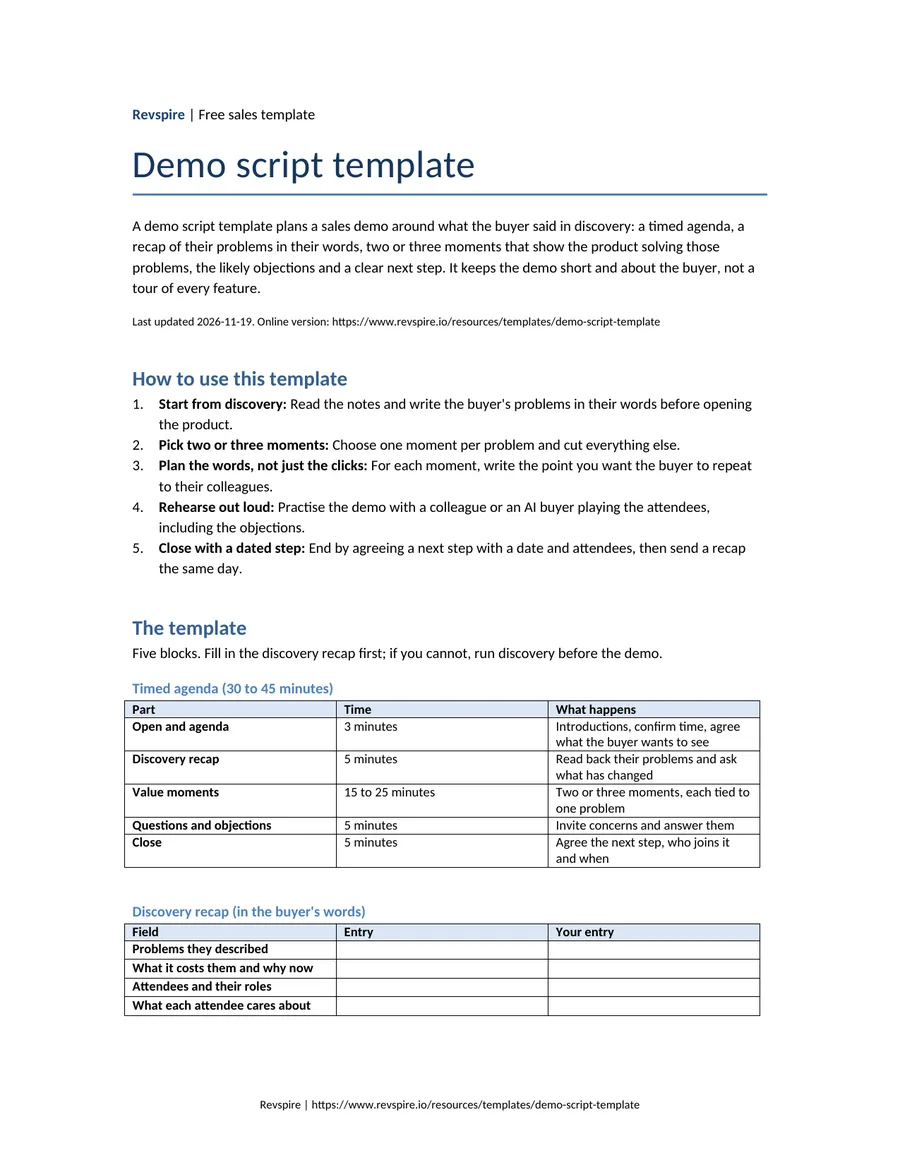
Five blocks. Fill in the discovery recap first; if you cannot, run discovery before the demo.
Timed agenda (30 to 45 minutes)
| Part | Time | What happens |
|---|---|---|
| Open and agenda | 3 minutes | Introductions, confirm time, agree what the buyer wants to see |
| Discovery recap | 5 minutes | Read back their problems and ask what has changed |
| Value moments | 15 to 25 minutes | Two or three moments, each tied to one problem |
| Questions and objections | 5 minutes | Invite concerns and answer them |
| Close | 5 minutes | Agree the next step, who joins it and when |
Discovery recap (in the buyer's words)
| Field | Entry |
|---|---|
| Problems they described | |
| What it costs them and why now | |
| Attendees and their roles | |
| What each attendee cares about |
Value moments
| Problem | What we show | Point we want them to repeat | Check-in question |
|---|---|---|---|
Likely objections
| Objection | Response | Proof to show |
|---|---|---|
Close
| Field | Entry |
|---|---|
| Next step we will propose | |
| Who must join it | |
| What we will send after the demo |
Prefer a file? We email the Word, Excel and PDF versions to your work address, free.
Email me the filesA worked example
Example: fictional company
Three value moments built from one discovery call.
After discovery with the head of sales operations at Marlow & Finch Logistics, a Ferncastle Analytics seller planned a thirty-minute demo for her and the CFO's chief of staff. Instead of the standard tour, the seller chose three moments, one for each problem the buyer had named.
Marlow & Finch Logistics: value moments
| Their problem | What we show | Point to repeat |
|---|---|---|
| "Regional forecasts never match" | One forecast built from all three regions' data | One number for the board, built automatically |
| "Finance spends a week reconciling" | The reconciliation view finance would use | Month-end reconciliation in hours, not days |
| "The CFO wants it by the next board meeting" | The rollout plan with dates | Live before the board meeting |
| Close | Propose a working session with finance next week | Chief of staff to invite the finance lead |
Example: fictional company. Ferncastle Analytics, Harborview Metrics, Marlow & Finch Logistics and every person named in this example are invented for illustration. Any resemblance to real companies or people is coincidental.
How to prepare a demo that wins
Start from discovery
Read the notes and write the buyer's problems in their words before opening the product.
Pick two or three moments
Choose one moment per problem and cut everything else.
Plan the words, not just the clicks
For each moment, write the point you want the buyer to repeat to their colleagues.
Rehearse out loud
Practise the demo with a colleague or an AI buyer playing the attendees, including the objections.
Close with a dated step
End by agreeing a next step with a date and attendees, then send a recap the same day.
Where demos go wrong
The feature tour
Showing everything the product does buries the parts that matter to this buyer.
No discovery
A demo without discovery is a guess about what the buyer needs.
No check-ins
Talking for twenty minutes without asking a question loses the room.
Ignoring the other attendees
The chief of staff and the end user care about different things; plan for both.
Ending without a next step
"We'll send some information" is not a next step.
Where Revspire fits
A demo script is only as good as the rehearsal. Revspire AI Sales Training & Coaching lets sellers practise a demo against an AI buyer persona by video or a live voice call, including the objections, and get scored feedback before the real call.
Revspire's AI Playbook Engine creates playbooks with AI grounded in your approved revenue knowledge, so demo talk tracks and objection responses for each segment stay current, and a Revspire digital sales room can hold the demo recording, recap and next steps for the buyer to share internally.
Demo script template FAQs
What should a sales demo script include?
A timed agenda, a recap of the buyer's problems in their words, two or three value moments each tied to one problem, likely objections with responses, and the next step you will propose.
How long should a sales demo be?
Thirty to forty-five minutes for most B2B demos, with most of the time on two or three value moments and at least five minutes for questions and the next step.
Should you read a demo script word for word?
No. Use it to prepare and rehearse, then run the demo as a conversation, checking in after each value moment.
What is the difference between a demo script and a talk track?
A demo script plans one demo for one buyer. A talk track is reusable wording for a type of conversation, such as handling a pricing objection, that a demo script can draw on.
Related templates and reading
- Free templateSales playbook templateA B2B sales playbook outline: ICP, personas, stages with exit criteria, discovery questions, plays for common situations and objection responses.
- Free templateMessaging framework templateA B2B message house: positioning statement, value proposition, three pillars with proof, persona messages and answers to the questions buyers ask.
- Free templateSales content audit templateOne row per asset, with the usage evidence and the verdict beside it: retire, fix or keep, each with an owner and a date.
- Free templateSales one-pager templateA one-page sales sheet in eight blocks, from headline to call to action, with a proof register and product, executive, competitive and industry variants.
- Template: the call before the demoDiscovery call template
- Template: reusable wording for each callTalk track template
- Template: the step after the demoProof of concept template
- Guide: tools for self-serve demosBest interactive demo software