What an executive business review is for
An executive business review, or EBR, is a meeting with the people on the customer side who approved the purchase and will approve the renewal. It happens once or twice a year, and its purpose is to confirm that the relationship is producing what was promised and to agree what comes next.
Executives do not want a product update or a tour of usage charts. They want to hear the goals in their own words, the results against them, an honest account of what has not worked and a short list of decisions. The template is built around those four things and leaves operational detail to the regular reviews.
It also has a block for decisions and asks, on both sides. An EBR that ends without a decision, such as a sponsor for the next phase or a date to review expansion, was a presentation rather than a review.
When to hold an EBR
- Six months before a renewal, while there is time to act.
- After a major rollout phase or milestone.
- When the executive sponsor changes.
- Before proposing an expansion.
- Once or twice a year for strategic accounts.
Executive business review or quarterly business review
The two are often confused. Many accounts need both.
| Aspect | Executive business review | Quarterly business review |
|---|---|---|
| Audience | Executive sponsors and budget holders | Day-to-day owners and their managers |
| Frequency | Once or twice a year | Every quarter |
| Focus | Outcomes, direction and decisions | Adoption, open issues and next quarter's plan |
| Length | 45 to 60 minutes | 60 to 90 minutes |
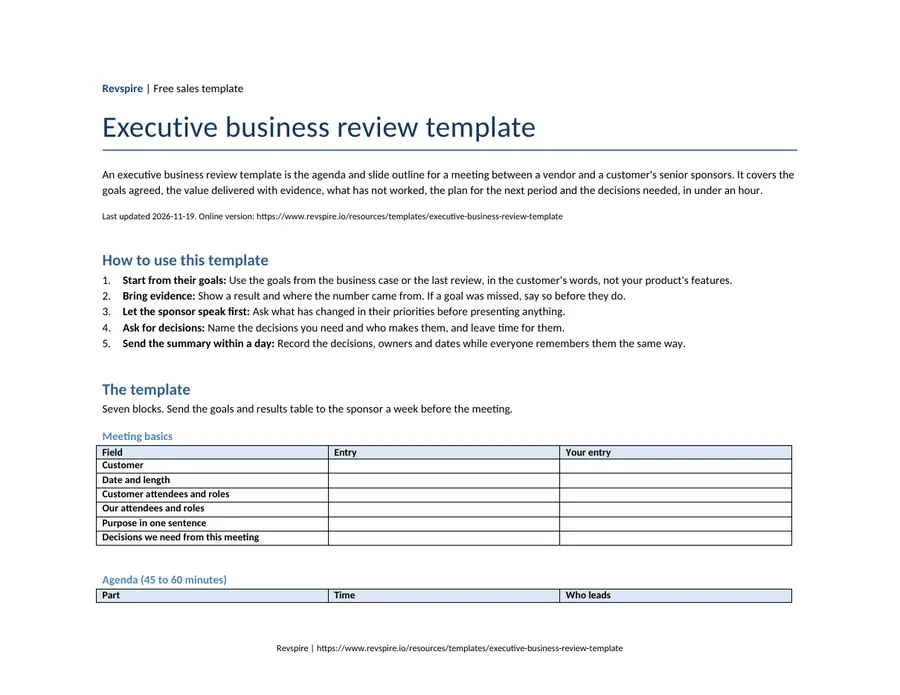
The template
Seven blocks. Send the goals and results table to the sponsor a week before the meeting.
Meeting basics
| Field | Entry |
|---|---|
| Customer | |
| Date and length | |
| Customer attendees and roles | |
| Our attendees and roles | |
| Purpose in one sentence | |
| Decisions we need from this meeting |
Agenda (45 to 60 minutes)
| Part | Time | Who leads |
|---|---|---|
| Their priorities: what has changed | 10 minutes | Customer sponsor |
| Goals and results | 15 minutes | Account owner |
| What worked and what did not | 10 minutes | Account owner |
| Plan for the next period | 10 minutes | Both |
| Decisions and next steps | 10 minutes | Both sponsors |
Goals and results
| Goal agreed | Measure | Target | Result | Evidence |
|---|---|---|---|---|
What worked and what did not
| Topic | What happened | What we are changing |
|---|---|---|
Plan for the next period
| Initiative | Outcome for the customer | Owner (customer) | Owner (us) | Date |
|---|---|---|---|---|
Decisions and asks
| Decision or ask | From whom | By when |
|---|---|---|
After the meeting
| Field | Entry |
|---|---|
| Summary sent by (name and date) | |
| Where actions are tracked | |
| Date of the next review |
Prefer a file? We email the Word, Excel and PDF versions to your work address, free.
Email me the filesA worked example
Example: fictional company
An EBR six months before renewal, with a new sponsor in the room.
Harborview Metrics held an executive review with Marlow & Finch Logistics six months before renewal. The original sponsor had moved on and the new operations director had never seen the business case. The account manager opened by asking what had changed, then walked through three goals from the original purchase with results and evidence for each.
Marlow & Finch Logistics: goals and results
| Goal agreed | Measure | Result | Evidence |
|---|---|---|---|
| One forecast across three regions | Regions on the shared forecast | All three regions live | Forecast report used at the last two board meetings |
| Faster month-end reconciliation | Working days to close | Shorter than before, target not yet met | Finance team's close calendar |
| Adoption by regional managers | Managers using it weekly | Two of three regions | Usage report by region |
| Decision asked for | Sponsor for the third region | Agreed in the meeting | Operations director to name a lead |
Example: fictional company. Ferncastle Analytics, Harborview Metrics, Marlow & Finch Logistics and every person named in this example are invented for illustration. Any resemblance to real companies or people is coincidental.
How to run an EBR executives will attend again
Start from their goals
Use the goals from the business case or the last review, in the customer's words, not your product's features.
Bring evidence
Show a result and where the number came from. If a goal was missed, say so before they do.
Let the sponsor speak first
Ask what has changed in their priorities before presenting anything.
Ask for decisions
Name the decisions you need and who makes them, and leave time for them.
Send the summary within a day
Record the decisions, owners and dates while everyone remembers them the same way.
Where EBRs go wrong
A product roadmap presentation
Executives came to talk about their outcomes, not your release plan.
Usage charts without meaning
Logins are not value. Tie every number to a goal the customer set.
Hiding what went wrong
Sponsors usually know already. Naming it first builds trust.
The wrong people in the room
Without the budget holder it is a quarterly review with a different title.
No follow-up
Decisions that are not written down the same day are remembered differently by each side.
Where Revspire fits
An EBR deck is usually rebuilt from email threads and memory, then sent as an attachment that nobody opens. A Revspire digital sales room gives each account one shared space where the agreed goals, the mutual action plan with owners and dates, and the supporting content live together for both sides.
Buyer engagement analytics show which stakeholders opened the review material before the meeting, and the stakeholder map shows who on the customer side is engaged, which helps when a sponsor changes between reviews.
Executive business review template FAQs
What is an executive business review?
A meeting, once or twice a year, between a vendor and a customer's executive sponsors to review results against agreed goals, discuss what has not worked and decide what happens next.
What is the difference between an EBR and a QBR?
An EBR is for executive sponsors and focuses on outcomes and decisions once or twice a year. A QBR is for day-to-day owners and covers adoption, issues and the next quarter's plan.
Who should attend an EBR?
The customer's executive sponsor and budget holder, the day-to-day owner, and on the vendor side the account owner and an executive of matching seniority.
How long should an EBR be?
Forty-five to sixty minutes, with at least ten minutes kept for decisions and next steps.
Related templates and reading
- Free templateMutual action plan templateA shared, dated plan from discovery to go-live, with a buyer owner and a seller owner on every milestone.
- Free templateSales enablement business case templateA one-page sales enablement business case: the problem, what ramp, rep time and turnover cost today, the options, the numbers and a dated decision ask.
- Free templateSales close plan templateEvery remaining step between verbal intent and signature, with owners on both sides, the approval chain and the risks the buyer never sees.
- Free templateDigital sales room templateThe sections of a buyer-facing deal room in order: summary, stakeholder map, mutual action plan, content by stage, business case, security, next steps and handoff.
- Template: the quarterly reviewQuarterly business review template
- Template: the goals the EBR reports onCustomer success plan template
- Template: the plan for the accountAccount plan template
- Template: who should be in the roomStakeholder map template