What a territory plan is for
A territory plan is written by a seller, usually an account executive, for the accounts they own. It answers where to spend limited time so the quota is reached, and it is reviewed with the sales manager at the start of the year and each quarter.
The template has five parts: a territory snapshot, an account tiering score, a coverage plan for each tier, a ninety-day plan, and the measures you will review. Tiering is the core: scoring accounts on fit, potential and relationship shows where to go deep and where a lighter touch is enough.
A territory plan is different from territory design. Design is how sales leadership and RevOps divide accounts between sellers; the plan is what each seller does with the accounts they are given.
When to write a territory plan
- At the start of each sales year, once territories and quotas are set.
- When a seller takes over a new or changed territory.
- When a new hire finishes onboarding and takes their first accounts.
- Mid-year, when the pipeline is behind and coverage needs rethinking.
- Before a quarterly business review with the sales manager.
Territory plan, account plan or sales plan
Three plans at different levels.
| Plan | Scope | Owner |
|---|---|---|
| Sales plan | The whole team: targets, segments, headcount | Sales leadership |
| Territory plan | All of one seller's accounts | Account executive, reviewed with their manager |
| Account plan | One strategic account in depth | Account owner and account team |
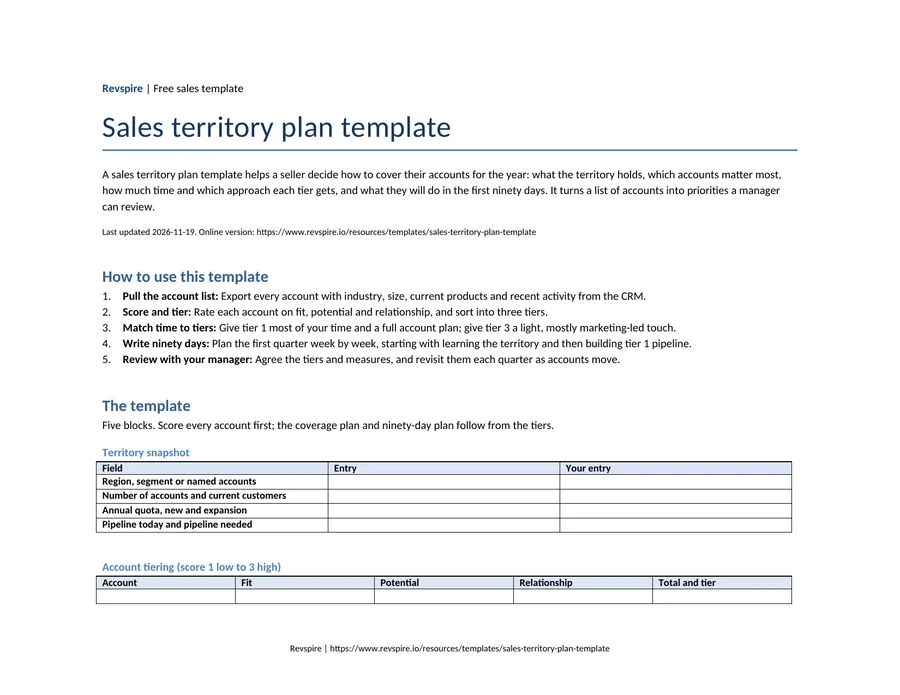
The template
Five blocks. Score every account first; the coverage plan and ninety-day plan follow from the tiers.
Territory snapshot
| Field | Entry |
|---|---|
| Region, segment or named accounts | |
| Number of accounts and current customers | |
| Annual quota, new and expansion | |
| Pipeline today and pipeline needed |
Account tiering (score 1 low to 3 high)
| Account | Fit | Potential | Relationship | Total and tier |
|---|---|---|---|---|
Coverage plan by tier
| Tier | Accounts | Share of time | Approach | Touch frequency |
|---|---|---|---|---|
| Tier 1 (score 8 to 9) | Account plan, multi-threading, executive sponsor | |||
| Tier 2 (score 6 to 7) | Targeted outreach and events | |||
| Tier 3 (score 3 to 5) | Marketing nurture and inbound |
90-day plan
| Weeks | Focus | Actions | Outcome |
|---|---|---|---|
| 1 to 4 | Learn the territory | ||
| 5 to 8 | Build pipeline in tier 1 | ||
| 9 to 13 | Advance and expand |
Measures reviewed each quarter
| Measure | Target | Actual |
|---|---|---|
| Pipeline created | ||
| Tier 1 accounts with an active opportunity | ||
| Meetings with new stakeholders | ||
| Closed won against quota |
Prefer a file? We email the Word, Excel and PDF versions to your work address, free.
Email me the filesA worked example
Example: fictional company
A tiering score that concentrated time on six accounts.
A new account executive at Ferncastle Analytics inherited forty accounts and had been splitting time evenly. Scoring them put six in tier 1, which became the focus of the first ninety days.
Ferncastle Analytics: sample of the tiering
| Account | Fit | Potential | Relationship | Tier and action |
|---|---|---|---|---|
| Marlow & Finch Logistics | 3 | 3 | 2 | Tier 1: account plan and introduction to the finance director |
| Harborview Metrics | 3 | 2 | 3 | Tier 1: expansion to a second team |
| A regional distributor | 2 | 2 | 1 | Tier 2: invite to the customer event |
| A small agency | 1 | 1 | 1 | Tier 3: marketing nurture only |
Example: fictional company. Ferncastle Analytics, Harborview Metrics, Marlow & Finch Logistics and every person named in this example are invented for illustration. Any resemblance to real companies or people is coincidental.
How to build a territory plan
Pull the account list
Export every account with industry, size, current products and recent activity from the CRM.
Score and tier
Rate each account on fit, potential and relationship, and sort into three tiers.
Match time to tiers
Give tier 1 most of your time and a full account plan; give tier 3 a light, mostly marketing-led touch.
Write ninety days
Plan the first quarter week by week, starting with learning the territory and then building tier 1 pipeline.
Review with your manager
Agree the tiers and measures, and revisit them each quarter as accounts move.
Where territory plans go wrong
Equal time for every account
Spreading effort evenly leaves the best accounts under-worked.
Tiering by size only
The largest account is not always the most winnable; score fit and relationship too.
No tier 3 approach
Low-tier accounts still need a light, automated touch so they are not forgotten.
A plan for the manager, not the seller
If it is not used weekly, it was written for a meeting.
Never re-scored
Accounts change tier when buyers move or budgets appear.
Where Revspire fits, and where it does not
Revspire does not have a territory management module: it does not design territories, balance account loads or assign accounts. Territory design usually lives in the CRM or a dedicated planning tool.
Where Revspire helps is working the tier 1 accounts. Revspire digital sales rooms give each opportunity a shared space with the buyer, with an AI-built stakeholder map that flags risks, a mutual action plan and buyer engagement analytics that show which stakeholders are engaged.
Sales territory plan template FAQs
What should a sales territory plan include?
A territory snapshot, an account tiering score, a coverage plan for each tier, a ninety-day plan and the measures you will review with your manager.
How do you tier accounts in a territory?
Score each account on fit with your ideal customer profile, revenue potential and the strength of your relationship, then group the highest scores as tier 1.
How often should a territory plan be updated?
Write it at the start of the year and review it each quarter, re-scoring accounts that have changed.
What is the difference between territory planning and territory design?
Territory design divides accounts between sellers. Territory planning is what each seller does with the accounts they own.
Related templates and reading
- Free templateMutual action plan templateA shared, dated plan from discovery to go-live, with a buyer owner and a seller owner on every milestone.
- Free templateStakeholder map templateEvery person in the buying group on one page, with buying role, influence, stance, priorities and a next action.
- Free templateSales enablement business case templateA one-page sales enablement business case: the problem, what ramp, rep time and turnover cost today, the options, the numbers and a dated decision ask.
- Free templateSales close plan templateEvery remaining step between verbal intent and signature, with owners on both sides, the approval chain and the risks the buyer never sees.
- Template: the plan for each tier 1 accountAccount plan template
- Template: the segments the territory servesSales strategy template
- Template: marketing plays for tier 1 and 2Account based marketing plan template
- Guide: how top teams plan accountsAccount planning strategies