What a customer success playbook is for
A customer success playbook is the team's agreed response to the situations that come up across the customer lifecycle: a new customer, low adoption, a lost sponsor, a renewal approaching, an expansion opportunity. Written down, it stops each customer success manager improvising and makes the best responses the default.
The template has three parts: a play library with one row per play (stage, trigger, owner, steps, assets, exit), a detailed sheet for writing one play in full, and a review section to keep plays current. Triggers matter most, because a play nobody starts is a document, not a play.
A playbook is different from a success plan. The success plan records one customer's goals and milestones; the playbook describes how the team responds to situations across all customers.
When to build a customer success playbook
- When the customer success team grows beyond a few people.
- When customers in the same situation get very different treatment.
- After losing renewals that showed warning signs nobody acted on.
- When onboarding new customer success managers.
- When moving plays into a customer success platform and needing them defined first.
Playbook, success plan or process
Three customer success documents and what each covers.
| Document | Covers | Scope |
|---|---|---|
| Customer success playbook | How the team responds to recurring situations | All customers |
| Customer success plan | One customer's goals, measures and milestones | One customer |
| Process document | Internal steps such as handoffs and escalations | The team's operations |
The template
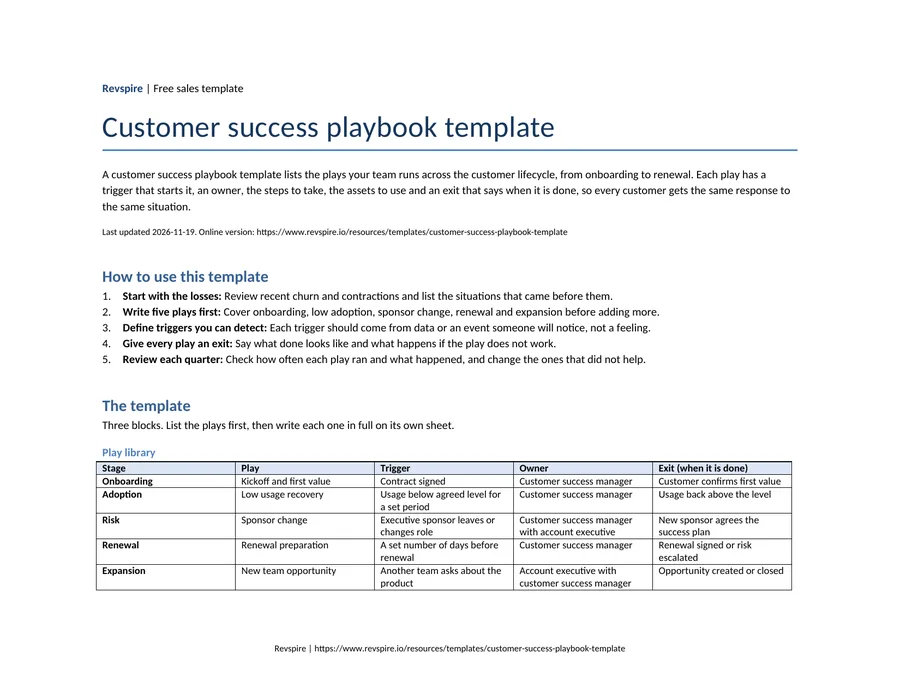
Three blocks. List the plays first, then write each one in full on its own sheet.
Play library
| Stage | Play | Trigger | Owner | Exit (when it is done) |
|---|---|---|---|---|
| Onboarding | Kickoff and first value | Contract signed | Customer success manager | Customer confirms first value |
| Adoption | Low usage recovery | Usage below agreed level for a set period | Customer success manager | Usage back above the level |
| Risk | Sponsor change | Executive sponsor leaves or changes role | Customer success manager with account executive | New sponsor agrees the success plan |
| Renewal | Renewal preparation | A set number of days before renewal | Customer success manager | Renewal signed or risk escalated |
| Expansion | New team opportunity | Another team asks about the product | Account executive with customer success manager | Opportunity created or closed |
One play in full
| Field | Entry |
|---|---|
| Play name and stage | |
| Trigger and how we detect it | |
| Owner and others involved | |
| Steps, in order, with timing | |
| Assets to use (emails, decks, guides) | |
| Exit and what happens if it fails |
Playbook review
| Play | Times run last quarter | Outcome | Change needed |
|---|---|---|---|
Prefer a file? We email the Word, Excel and PDF versions to your work address, free.
Email me the filesA worked example
Example: fictional company
A sponsor change play written in full.
Ferncastle Analytics lost a renewal after a customer's executive sponsor left and nobody noticed for two months. The customer success team wrote a sponsor change play and first ran it when Harborview Metrics' operations director moved to a new role.
Ferncastle Analytics: sponsor change play
| Step | Timing | Owner |
|---|---|---|
| Confirm the change and who replaces the sponsor | Within 2 days of the trigger | Customer success manager |
| Ask the departing sponsor for an introduction | Within 1 week | Customer success manager |
| Meet the new sponsor; review the success plan and results so far | Within 3 weeks | Customer success manager with account executive |
| New sponsor agrees updated goals | Within 6 weeks | Customer success manager |
| If no meeting by week 6, escalate to the sales director | Week 6 | Customer success lead |
Example: fictional company. Ferncastle Analytics, Harborview Metrics, Marlow & Finch Logistics and every person named in this example are invented for illustration. Any resemblance to real companies or people is coincidental.
How to build a playbook the team uses
Start with the losses
Review recent churn and contractions and list the situations that came before them.
Write five plays first
Cover onboarding, low adoption, sponsor change, renewal and expansion before adding more.
Define triggers you can detect
Each trigger should come from data or an event someone will notice, not a feeling.
Give every play an exit
Say what done looks like and what happens if the play does not work.
Review each quarter
Check how often each play ran and what happened, and change the ones that did not help.
Where customer success playbooks go wrong
Plays without triggers
If nothing starts the play, it will not be run.
Too many plays
Fifty plays nobody remembers help less than five the team knows well.
No exit
Plays that never end clutter the team's week.
Written by managers only
Customer success managers know which steps actually work; include them.
Never reviewed
Plays go stale as the product and customers change.
Where Revspire fits
Plays need assets and a place to work with the customer. Revspire's AI Playbook Engine creates playbooks with AI grounded in your approved revenue knowledge, with drafts routed for approval and usage analytics that show which plays get used.
A Revspire digital sales room gives each customer a shared space for the success plan, the mutual action plan with owners and dates and the content each play uses, and buyer engagement analytics show whether the customer's team is opening it, an early sign for adoption and risk plays.
Customer success playbook template FAQs
What is a customer success playbook?
A set of plays describing how the customer success team responds to recurring situations, such as onboarding, low adoption, a sponsor change, renewal and expansion, each with a trigger, owner, steps and exit.
What plays should a customer success playbook include first?
Start with onboarding, low adoption recovery, sponsor change, renewal preparation and expansion, then add plays based on the situations that come before churn in your own data.
What is the difference between a customer success playbook and a success plan?
The playbook describes how the team responds to situations across all customers. A success plan records one customer's goals, measures and milestones.
How often should a customer success playbook be updated?
Review it each quarter: how often each play ran, what happened, and which steps or triggers need changing.
Related templates and reading
- Free templateMutual action plan templateA shared, dated plan from discovery to go-live, with a buyer owner and a seller owner on every milestone.
- Free templateStakeholder map templateEvery person in the buying group on one page, with buying role, influence, stance, priorities and a next action.
- Free templateSales enablement business case templateA one-page sales enablement business case: the problem, what ramp, rep time and turnover cost today, the options, the numbers and a dated decision ask.
- Free templateSales close plan templateEvery remaining step between verbal intent and signature, with owners on both sides, the approval chain and the risks the buyer never sees.
- Template: one customer's goals and milestonesCustomer success plan template
- Template: the onboarding play in detailCustomer onboarding checklist
- Template: the quarterly review playQBR template
- Guide: platforms that run playsBest customer success software