Sales to Customer Success Handoff: Checklist, Process and Template
A practical perspective for connecting this idea to your revenue team’s next move.
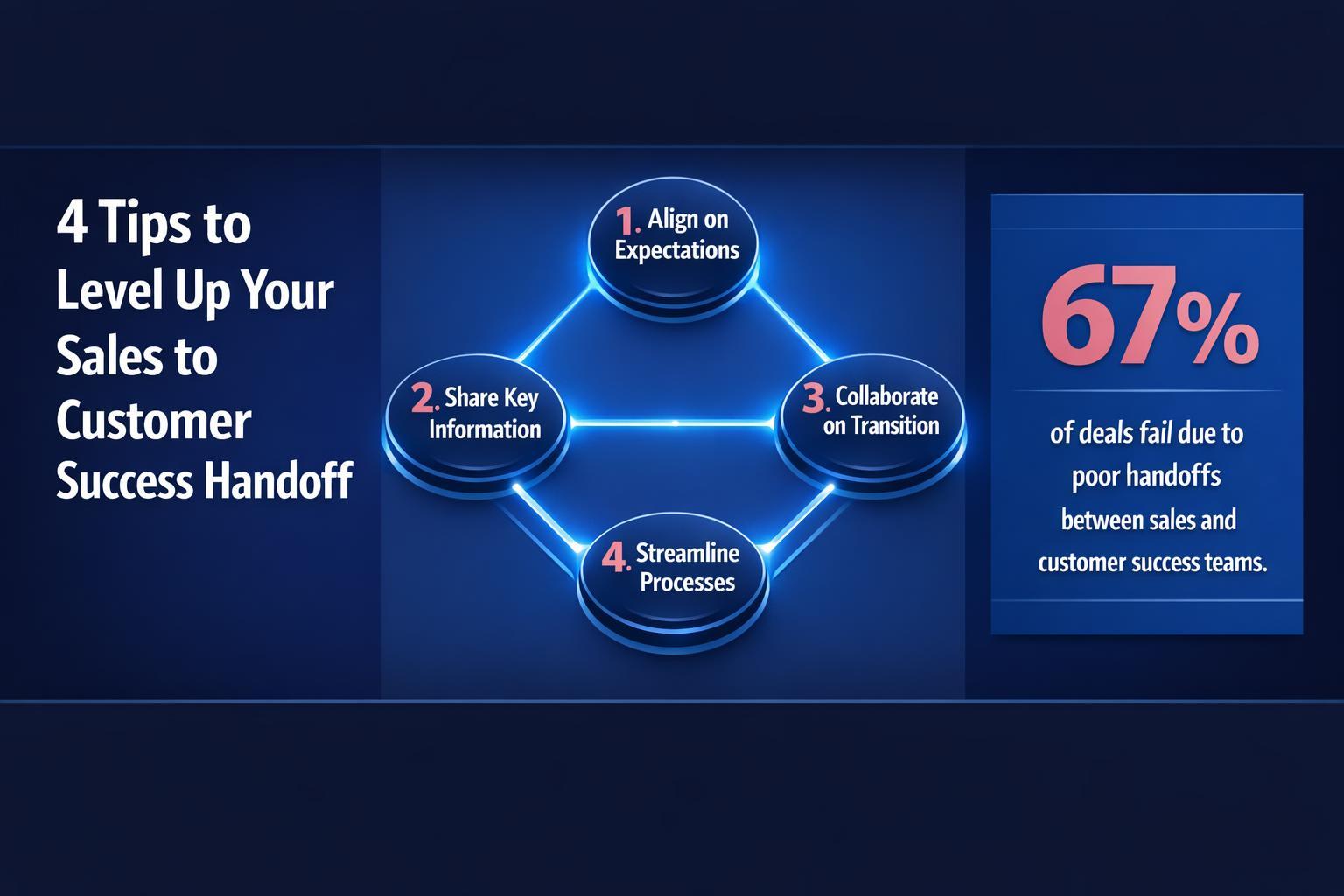
A sales to customer success handoff is the transfer of a newly won account from the account executive (AE) to the customer success manager (CSM), together with everything the customer told sales: why they bought, the outcomes they expect, who is involved and what was promised. Done well, the customer never has to explain their goals twice.
Below: when the handoff should start, a handoff document checklist, a six-step process with a kickoff agenda, owners, metrics, and how to keep sales and customer success aligned afterwards. The research cited was published between 2023 and 2026.
Last updated: 16 October 2026
What is a sales to customer success handoff?
The handoff, also called the sales-to-CS transition or account transition, is the point where responsibility for a customer moves from the team that sold the deal to the team that has to deliver its value. In most B2B software companies it runs from the AE, often with a sales engineer, to a CSM, an onboarding or implementation manager, or both. Smaller accounts may go to a pooled or digital customer success team; larger ones usually start with an implementation project.
It is less a meeting than a transfer of knowledge. Unless what sales learned about the customer’s problem, politics and expectations is written down and passed on, the CSM starts from the contract and a few CRM fields, and the customer gets the same discovery questions again. Forrester’s account transition checklist template (January 2025) describes a consistent handoff as what lets CSMs understand the customer’s needs and build a joint customer success plan with them.
Why handoffs break
- The context lives in the AE’s head. CRM fields record amount, close date and products. They rarely record why the champion fought for the deal or which objection nearly stopped it.
- The signer is not the user. The economic buyer signs; an admin, a project lead and the end users do the work. If sales only knew the signer and the champion, customer success starts with half a map.
- Promises are not written down. A roadmap feature, a custom integration, a go-live date tied to a discount: if it was said on a call and never recorded, the CSM learns about it from an unhappy customer.
- Success is undefined. “Better visibility” cannot be measured. Without a baseline and a target, nobody can show the customer at renewal that they got what they paid for.
- The handoff starts too late. If the CSM first hears of the account after signature, the customer meets a stranger at the moment they expect momentum.
Why does the sales-to-CS handoff matter?
Because many buyers end up unhappy with the providers they choose. Forrester’s State of Business Buying 2024 announcement (December 2024) reported that 81% of buyers express dissatisfaction with their chosen providers, that an average of 13 people are involved in a buying decision, and that 89% of purchases involve two or more departments. Those 13 people do not disappear at signature. They become the sponsors, admins and users customer success has to win over.
Regret also shows up at renewal. In a Gartner survey of 1,503 respondents, published in June 2023, 60% of technology buyers involved in renewal or expansion decisions for as-a-service agreements said they regret nearly every purchase they make. For expansion deals, Gartner recommends checklists that guide buyers through the process and shared workspaces for reviewing objectives and building business cases. A good handoff carries exactly that into onboarding.
Customers also expect to deal with one company, not two departments. Salesforce, citing its State of the Connected Customer report (August 2023), says 79% of customers expect consistent interactions across departments. A kickoff call that repeats discovery questions fails that test in the first hour.
Buyers are thinking about implementation before they sign. In Revspire’s digital sales room benchmark (aggregated customer data, October 2025 to September 2026), 80% of buyer views in the 14 days before a won deal closed went to the proposal and the implementation plan. That is an observed pattern, not proof of cause, but it suggests the handoff should begin while the deal is still open.
When should customer success get involved in a deal?
Before signature. A practical rule: assign the CSM once a deal reaches the late stage of your pipeline (proposal or commit), introduce them before the contract is signed, and finish the internal handoff within a few working days of signature. The table shows one way to stage it. Rename the stages to match your own sales process and set your own time targets.
Deal stage
Sales does
Customer success does
Output
Discovery and evaluation
Records the business problem, success criteria and stakeholders as they emerge
On large or unusual deals, reviews scope and technical requirements
Success criteria in the customer’s words
Proposal or commit
Shares a draft implementation plan; flags non-standard terms
CSM is assigned, reads the account and checks the plan is realistic
Named CSM and a draft onboarding plan
Verbal agreement
Introduces the CSM to the champion and admin
Meets the champion; agrees who attends kickoff
The customer knows who comes next
Signature
Completes the handoff document and runs the internal handoff meeting
Accepts the handoff or returns it with the gaps listed
Accepted handoff document
Kickoff
AE attends and restates why the customer bought
CSM or onboarding lead runs the agenda
Onboarding plan with owners and dates
First value milestone
Stays reachable for escalations and commercial questions
Reports progress against the success criteria to the sponsor
First outcome confirmed by the customer
A stage-by-stage handoff timeline. The CSM is named before signature, so the customer meets them while the deal still has momentum.
What should be included in a sales to CS handoff document?
Everything customer success needs to run kickoff without re-asking discovery questions, and nothing it can already read in the contract. Group it into six blocks. The table can be copied into a handoff template, a CRM object or a shared page in your deal room. The examples are hypothetical.
Block
Fields to fill
Example entry (hypothetical)
1. Why they bought
Trigger event, business problem, cost of the status quo, alternatives considered (including doing nothing), why you won
“Two acquisitions left three content libraries. Chose us over a larger vendor for the CRM integration.”
2. Success criteria
Two or three measurable outcomes in the customer’s words, with a baseline, a target, a date and who measures them
“Reps find an approved deck in under two minutes, down from about fifteen, by the end of Q1. Measured by the enablement lead.”
3. Stakeholders
Economic buyer, executive sponsor, champion, admin or project lead, end-user groups, IT and security, procurement; each person’s role, influence and stance
“CFO signed. VP Sales is sponsor. Enablement manager is champion and admin. RevOps was sceptical about the data sync.”
4. Commercial terms
Products, seats or usage, term, start and renewal dates, discounts and their conditions, non-standard clauses
“Two-year term. Discount conditional on a published case study.”
5. Commitments made
Every promise outside the standard contract: roadmap items, custom work, integrations, services, deadlines, named people
“CRM sync live before the sales kickoff in February.”
6. Technical and risk notes
Systems to integrate, SSO, data migration, security review outcome, open objections, a competitor still in the account, internal politics, deadline pressure
“Security review passed with one open item: user provisioning.”
A six-block sales to customer success handoff checklist. Attach the proposal, business case, mutual action plan, call summaries and security questionnaire as links.
The five-question test for a complete handoff
Instead of judging a handoff by how many fields are filled, ask whether the CSM can answer five questions without calling the AE:
- Why did this customer buy now, and what happens to them if the project fails?
- What does success look like in their words, and by when?
- Who do we need on our side, and who argued against the purchase?
- What did we promise that is not in the standard contract?
- What is most likely to go wrong in the first 90 days?
Forms are not the only format. Joanna Johnston, Gong’s SVP of customer success, argued in January 2025 for dropping intake forms and spreadsheets in favour of AI-generated account summaries of goals, pain points and promised outcomes. Whichever format you choose, the five questions are the test.
How do you run a sales to customer success handoff? Six steps
1. Assign the CSM before the contract is signed
Set routing rules by segment, deal size or product so assignment is automatic, not a favour. Once the deal reaches commit, the AE introduces the CSM in a short call or a message to the champion: who they are, what happens after signature and when kickoff will be. The customer should know the name of their CSM before they sign.
2. Map stakeholders beyond the signer
List everyone who touched the deal and everyone who will touch the product: sponsor, champion, admin, IT, security, end-user leads. Record each person’s role and stance. A stakeholder map template keeps this in one place. Many of these people were never on a call. In the same Revspire digital sales room benchmark, deal rooms engaged 15 unique buyer stakeholders, against 1 to 5 on deals run without one, and 80% of rooms gained a new viewer after the first share. If your deal room or email tracking shows who read the proposal, add those names to the map.
3. Carry the success criteria over in the customer’s words
The customer already explained why they bought, in the business case, the mutual action plan or discovery calls. Copy their goals into the handoff with a baseline and a target, for example “cut the time managers spend on weekly reporting by a fifth”. The CSM confirms them at kickoff rather than starting again, and uses them as the spine of the onboarding plan and every business review that follows.
4. Hold an internal handoff meeting, and let CS say no
Thirty minutes is enough: the AE walks through the handoff document, the sales engineer covers technical scope, the CSM and onboarding lead ask questions, and together they agree kickoff attendees and the first milestone. Give customer success the right to return a handoff that fails the five-question test, with the gaps listed. Track how often handoffs are accepted the first time; it is the clearest measure of handoff quality.
5. Run a joint kickoff with the customer
Treat kickoff as a working session, not a meet-and-greet. The AE attends to show continuity and confirm what was agreed; the CSM or onboarding lead runs it. A 60-minute agenda:
Time
Item
Led by
0-5 min
Introductions; how the transition works and how to reach the AE
AE
5-15 min
Recap of why you bought and the success criteria; customer confirms or corrects
AE, then sponsor
15-30 min
Onboarding plan: milestones, owners on both sides, dates
CSM or onboarding lead
30-40 min
Stakeholders and roles; who is missing from the room
CSM
40-50 min
Dependencies and risks: IT, security, data, competing projects
Onboarding lead, sales engineer
50-60 min
Next steps, first milestone date, meeting cadence, escalation path
CSM
A kickoff agenda that confirms the sale instead of repeating discovery.
6. Keep one shared plan and workspace
Do not send a new customer to a new portal, a new set of links and a new plan if you can avoid it. Extend what the buyer already used: the signed order and scope replace the proposal, the business case becomes the success plan, the mutual action plan gains onboarding milestones, and demo recordings and decks become a reference library for new users.
Give the customer real owners in that plan. In Revspire’s mutual action plan benchmark (October 2025 to September 2026), buyers owned only 20% of plan milestones. Onboarding depends on customer-side steps such as SSO setup, data access and nominating users, so each needs a named customer owner and a date.
Several tools can hold a shared plan, from onboarding platforms to deal rooms. Revspire Digital Sales Rooms include mutual action plans with owners and due dates, stakeholder mapping, secure content sharing and buyer-engagement analytics, so the plan, people and documents from the sale stay in one place the customer can find.
Who owns the sales to customer success handoff?
Sales owns the handoff until customer success accepts it; customer success owns the customer from then on. RevOps owns the fields, routing and reports that make it repeatable. The matrix below uses R (does the work), A (accountable), C (consulted) and I (informed).
Activity
AE
Sales engineer
CSM
Onboarding lead
RevOps
Sales and CS leaders
Record success criteria and stakeholders during the deal
A, R
C
I
–
–
–
Assign the CSM
I
–
I
–
R (routing rules)
A (CS leader)
Complete the handoff document
A, R
R (technical)
C
C
–
–
Accept or return the handoff
C
C
A, R
C
I
–
Run kickoff
R (attends)
C
A, R
R
–
–
Maintain handoff fields, routing and reports
–
–
–
–
A, R
I
Review handoff quality every month
C
–
C
C
R
A
Who owns each part of the handoff. Change the roles to match your team; keep one accountable owner per row.
How do you keep sales and customer success aligned after the handoff?
A clean handoff fixes one moment. Alignment is what stops the same problems coming back in the next cohort of customers. Five habits make it stick:
- Give alignment an owner and a standing slot. A monthly joint review, chaired by RevOps or by the sales and CS leaders together, beats a one-off project that fades when the quarter gets busy. Revspire’s RevOps alignment guide covers how to set up handoff SLAs between teams.
- Review the same numbers. Both teams look at the handoff metrics below, account by account, instead of separate dashboards.
- Treat single-threaded accounts as a shared risk. If only the champion is active, both teams work to add the sponsor, admin and user leads before the champion changes jobs.
- Trace early churn back to the deal. When a first-year account escalates or churns, ask whether it was the wrong fit, oversold scope, a missing stakeholder or an unrealistic timeline, and feed the answer into qualification criteria and the sales playbook.
- Be careful with incentives. TSIA’s State of Customer Success 2025 (updated February 2025) names organisational alignment among the three big challenges for customer success, and warns that pressure to align customer success with sales can inflate compensation, blur roles and erode its focus on adoption. A lighter-touch alternative is to include handoff quality, such as first-time acceptance, in the AE’s scorecard.
Which handoff metrics should you track?
We found no published benchmark with reliable targets for these, so take a baseline from your last two quarters and improve against it.
Metric
How to calculate it
What it tells you
Handoff completeness
Share of new accounts with every required handoff field filled before kickoff
Whether sales is doing the transfer at all
First-time acceptance rate
Handoffs accepted by CS without being returned, divided by all handoffs
Quality, not just completion
Signature to kickoff
Median working days from contract signature to the kickoff meeting
Whether momentum survives the transition
Time to first value
Days from signature to the first success milestone the customer confirms
Whether onboarding delivers what was sold
Repeated questions
Discovery questions the customer had to answer again at kickoff, logged by the CSM
The hidden cost of a thin handoff
Stakeholder coverage
Contacts active in onboarding compared with contacts recorded during the deal
Single-threaded risk
First-year retention by deal
Early churn or gross revenue retention for each cohort, split by segment, AE or deal source
Whether some deals are sold to customers who will not stay
Seven handoff metrics and what each one reveals.
Worked example: one handoff from commit to first value
A hypothetical mid-market software company buys a sales enablement platform for its 120-person sales team on a two-year contract:
- Two weeks before signature: the deal reaches commit and routing assigns a CSM, who is added to the deal room and the mutual action plan.
- One week before: the AE introduces the CSM to the champion. They agree that the sponsor, the admin and an IT contact will attend kickoff.
- Two working days after signature: the AE completes the handoff document. The CSM returns it once (no IT contact, no date for the promised CRM sync) and the AE fixes both the same day.
- Day 8: kickoff. The sponsor confirms the success criteria, and the onboarding plan gets owners on both sides, including customer-owned steps for SSO and user lists.
- Day 30: first milestone. A pilot team is live, and the CSM reports progress against the customer’s own goals, copying the AE.
None of this needs new software: just an early CSM, a complete handoff document and one plan the customer can see. After kickoff, a customer onboarding checklist takes over.
Next step: start from the free mutual action plan template, add an onboarding phase after signature, and give every customer-side milestone a named owner. It then works as both the closing plan and the handoff plan.
Frequently asked questions
What is a sales to CS handoff?
It is the transfer of a newly signed customer from sales to customer success, together with what sales learned during the deal: why the customer bought, their success criteria, the stakeholders and any commitments made. It lets customer success deliver value without making the customer repeat themselves.
What should be included in a sales to customer success handoff document?
Six blocks: why the customer bought, measurable success criteria in their words, the stakeholders and their roles, commercial terms, every commitment made outside the standard contract, and technical and risk notes. Attach links to the proposal, business case, mutual action plan and call summaries. A good test is whether the CSM can run kickoff without calling the AE.
When should a customer success manager be introduced to a new customer?
Before the contract is signed, ideally once the deal reaches the proposal or commit stage. An early introduction lets the CSM check that the implementation plan is realistic and means the customer meets someone they already know at kickoff, rather than a new name after signature.
Should the account executive join the kickoff call?
Yes. The AE should open the kickoff, restate why the customer bought and what was agreed, and then hand over to the CSM or onboarding lead. Their presence shows continuity, and the customer can correct anything that was lost in the handoff while the AE is still in the room.
Who is responsible for the sales to customer success handoff?
The AE is accountable for a complete handoff until customer success accepts it, and the CSM is accountable for the customer from then on. RevOps owns the handoff fields, routing rules and reporting, and the sales and customer success leaders review handoff quality together each month.
How do you improve customer success and sales alignment?
Give alignment an owner and a standing monthly review, look at the same handoff and retention metrics account by account, and trace early churn back to how the deal was sold so qualification improves. Change compensation with care: tying customer success too closely to sales can pull it away from adoption.
Sources
- Forrester: To Master B2B Buying Mayhem, Providers Must Prioritize Buyers’ Needs, Forrester (press release on The State Of Business Buying, 2024), 4 December 2024. Accessed 16 October 2026.
- The Sales-To-Customer Success Account Transition Checklist Template, Forrester (report summary), 2 January 2025. Accessed 16 October 2026.
- Gartner Survey Reveals 60% of Technology Buyers Involved in Renewal Decisions Regret Nearly Every Purchase They Make, Gartner (press release), 14 June 2023. Accessed 16 October 2026.
- How Are Customer Touch Points Changing?, Salesforce (article citing State of the Connected Customer, August 2023), undated. Accessed 16 October 2026.
- The State of Customer Success 2025, TSIA (Stephen Fulkerson), updated 13 February 2025. Accessed 16 October 2026.
- When handoffs fail, trust fails: Fixing the customer journey, Gong (Joanna Johnston), 30 January 2025 (modified 4 March 2026). Accessed 16 October 2026.